

Cooling tower thermal storage connects a cooling tower, chiller plant, and thermal storage system so a facility can produce cooling during low-cost or low-load periods and deploy stored cooling during peak demand. Common options include ice storage and a chilled water tank.
This strategy supports off-peak cooling, reduces daytime chiller load, and improves demand management when controls, storage capacity, tower performance, water treatment, and commissioning match the building's real cooling profile.
What Is Cooling Tower Thermal Storage?
Cooling tower thermal storage is the integration of a cooling tower system with a thermal energy storage system that stores cooling capacity for later use. The storage medium may be chilled water, ice, or another cooling substance depending on the application.
The cooling tower still rejects heat from the chiller condenser loop. The difference is that the chiller runs during selected hours—often overnight—to charge the storage system.
During peak demand periods, the storage system discharges, supplying cooling to the building or process without running the chiller at full capacity.
How the System Works
Each component plays a specific role, and the sequence matters. Poor sequencing is one of the most common reasons projects underperform.
Understanding the operating sequence before procurement prevents expensive redesigns later. The most critical points to define early are:
- Chiller produces cooling: The chiller generates chilled water or ice during the charge cycle, typically at night or during low-rate periods.
- Cooling tower rejects heat: The cooling tower handles condenser heat rejection throughout the charge cycle, just as it does during normal daytime operation.
- Storage system charges: Chilled water fills the insulated tank, or ice builds up on evaporator coils, storing cooling capacity for later use.
- Storage system discharges: During peak-load hours, stored cooling supplies part or all of the building load without requiring full chiller operation.
- Controls manage the sequence: Automated controls decide when to charge, when to discharge, how to stage chillers, and how to manage tower fans and pumps.
- Peak demand drops: With chillers partially or fully offline during peak utility hours, electrical demand charges fall.
Where Thermal Storage Is Used
Thermal storage fits a wide range of facility types where daytime cooling loads are heavy and off-peak charging windows exist:
- Commercial buildings
- Hospitals and healthcare campuses
- Airports
- Data centers
- District cooling systems
- Industrial and manufacturing plants
- Mission-critical facilities
Why Facilities Use Thermal Storage
The business case for cooling tower thermal storage is clearest when energy costs are high, peak demand charges are significant, and the cooling load follows a predictable daily pattern.
Main Benefits
Thermal storage does more than cut energy bills. It reshapes how a cooling plant operates under variable load conditions. The benefits below apply across most facility types, though the financial weight of each will depend on local utility tariffs:
- Lower peak electrical demand: Shifting chiller operation off-peak reduces the kW demand recorded during utility peak windows, cutting demand charges directly.
- Better use of off-peak electricity: Overnight electricity rates are typically lower. Charging storage during those hours replaces expensive peak-period chiller operation with lower-cost energy.
- Reduced chiller runtime during peak periods: Chillers run fewer hours at peak load, which can extend equipment life and reduce maintenance frequency.
- Improved plant flexibility: Storage adds a cooling resource that the controls team can deploy or hold in reserve depending on load conditions.
- Support for limited electrical infrastructure: A facility that cannot add electrical capacity can still increase effective cooling capacity through storage.
How Cooling Towers Work With Stored Cooling
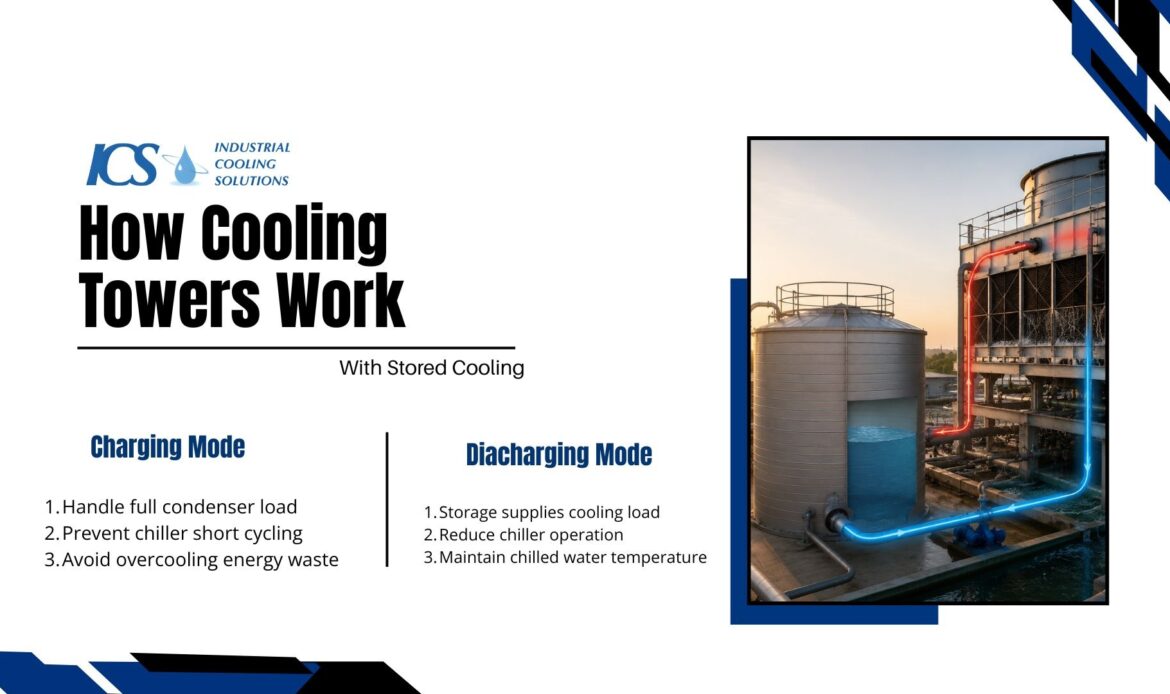
The cooling tower's role changes during charging and discharging cycles. Understanding both operating modes is key to sizing cooling tower thermal storage capacity correctly and avoiding surprises during commissioning.
Charging Mode
Charging usually runs at night or during low-demand periods when ambient conditions are cooler. Several factors affect how efficiently the tower supports the charging cycle:
- Nighttime wet-bulb temperatures are typically lower, which can improve condenser water supply temperature and chiller efficiency in some climates.
- Tower must handle full condenser load during charging, even if building load is low or zero at night.
- Controls must prevent short cycling of chillers or towers during partial-load charging.
- Overcooling wastes energy, so charge schedules should match storage targets rather than running chillers beyond what the storage system can hold.
Discharging Mode
During discharge, the storage system supplies cooling directly. Chiller load drops, and tower load may decrease as well:
- Storage meets part or all of the building load, reducing or eliminating the need for chiller operation during peak hours.
- Cooling tower load may decrease during full-storage discharge if chillers are offline.
- Chilled water supply temperature must stay within range to protect comfort or process requirements.
- Controls must prevent premature discharge that depletes storage before the peak period ends.
Main Thermal Storage Options
When selecting a cooling tower thermal storage system, it's crucial to compare space, efficiency, cost, and complexity. The best option depends on the project's specific needs, not vendor preference.
| Storage Option | How It Works | Best For | Main Advantage | Design Risk to Check |
| Chilled water tank | Stores cold water in a large insulated tank using thermal stratification | Campuses, large buildings, district cooling systems | Simple concept with direct cooling use and no phase-change equipment | Space requirements, stratification performance, tank volume calculations |
| Ice storage | Freezes water during charging and melts ice during discharge using phase change | Projects needing compact storage or high peak-reduction targets | Higher energy density than chilled water, smaller footprint | Lower charging temperatures may reduce chiller efficiency if not designed carefully |
| Partial storage | Stores enough cooling to reduce but not eliminate peak demand | Retrofit projects and demand management upgrades | Lower first cost than full storage; easier integration | Requires careful sequencing to avoid simultaneous charge and discharge |
| Full storage | Covers the peak cooling period mostly or entirely from stored cooling | Sites with high peak tariffs or electrical capacity limits | Maximum peak shifting and demand charge reduction | Larger storage volume and higher first cost; complex controls required |
| Hybrid strategy | Combines storage with active chillers and cooling towers for variable loads | Mission-critical or highly variable-load sites | Flexibility, resilience, and ability to handle unexpected load spikes | Complex controls, careful commissioning, and defined failure modes required |
Design Factors That Decide Performance

Storage performance depends on system integration, not tank size alone. A correctly sized tank connected to an underperforming cooling tower or a poorly configured control system will not deliver expected savings.
Cooling Load Profile
Every storage sizing calculation starts with real load data. Assumptions produce oversized or undersized systems that fail to meet their financial targets.
The load analysis should capture the full range of operating conditions the storage system will face:
- Hourly cooling load data across a full year, not just design-day peaks
- Peak cooling period duration, timing, and frequency throughout the year
- Nighttime and weekend load that affects available charging window
- Critical load requirements that storage must protect regardless of state of charge
- Future expansion that could shift load profile after the storage system is installed
Cooling Tower Capacity
Cooling tower performance directly affects charging efficiency and overall plant output. Thermal storage does not compensate for a tower that cannot reject heat at design conditions.
Key tower factors to assess before storage integration:
- Wet-bulb temperature at the site determines maximum tower performance; design must use actual site data, not handbook assumptions
- Fill condition affects heat transfer area; fouled or damaged fill can reduce capacity by 15–30%
- Fan and airflow performance must match nameplate ratings; worn blades or blocked screens reduce heat rejection
- Scale and biological control in the basin and fill directly affect thermal performance and longevity
- Tower upgrades may be required before storage can be added—connecting storage to an underperforming tower locks in a performance deficit
Water Treatment and Maintenance Requirements
Adding thermal storage changes operating patterns, water age, temperatures, and maintenance responsibilities across the cooling plant. A water treatment plan written for the cooling tower alone will need revision.
Cooling Tower Maintenance
The cooling tower serves as the heat rejection backbone for both charging and normal operation. Maintenance gaps show up as higher energy use and reduced charging efficiency:
- Fill inspection for scale, biological fouling, and physical damage every season
- Basin cleaning to remove sediment and biological growth that affects water quality
- Drift eliminator condition to control water loss and Legionella risk
- Fan and motor maintenance to confirm airflow matches design specifications
- Gearbox inspection per manufacturer schedule to prevent drive failures
- Scale and corrosion control with a current water treatment program tied to actual water chemistry
- Biological control logs maintained and reviewed regularly, especially during warm-weather charging
Storage System Maintenance
The storage system introduces additional equipment that requires scheduled inspection:
- Tank inspection for liner condition, insulation performance, and structural integrity
- Sensor calibration for temperature and level sensors that drive the control strategy
- Heat exchanger inspection where a plate heat exchanger separates the storage loop from the chilled water distribution
- Valve operation checks to confirm control valves respond correctly in charge and discharge modes
- Stratification performance monitoring to verify the thermocline is maintaining usable capacity
- Water quality testing within the storage tank to prevent biological growth and corrosion
Implementation Roadmap
A structured implementation process reduces risk and increases the likelihood that the installed system performs as modeled.
Step 1: Review the Cooling Load Profile
Use actual interval data where available. Identify peak hours, off-peak charging opportunity, nighttime load, and critical cooling requirements. Do not begin technology selection until this analysis is complete.
Step 2: Inspect Existing Cooling Tower Performance
Check fill condition, fans, motors, gearboxes, basin, airflow, water treatment records, and approach temperature before designing storage. A tower that cannot meet its rated capacity will constrain the entire project.
Step 3: Compare Storage Options
Evaluate ice storage, chilled water tanks, partial storage, and full storage against space, budget, tariff structure, and reliability targets. Use the site-specific data from Steps 1 and 2 to inform the comparison.
Step 4: Model Plant Operation
Simulate charge and discharge cycles with chillers, pumps, towers, and controls at multiple load and weather conditions. Confirm that the financial case holds across the range of real operating scenarios.
Step 5: Build the Financial Case
Compare first cost, peak demand savings, energy cost difference, maintenance cost, available incentives, and avoided equipment upgrades over the expected service life. Present results as a range based on modeling uncertainty.
Step 6: Write a Performance-Based Specification
Include storage capacity in ton-hours, charge and discharge rates, control sequence requirements, AHRI-rated performance data, warranty terms, commissioning scope, and acceptance testing criteria.
Step 7: Commission and Optimize
Test charge mode, discharge mode, emergency mode, controls, sensors, and tower response under real load conditions. Do not declare the project complete until acceptance testing confirms performance against specification.
How H2OCooling Supports Thermal Storage Integration
H2OCooling provides cooling tower expertise that directly supports cooling tower thermal storage projects at every phase.
H2OCooling's support capabilities for thermal storage projects include:
- Inspection and assessment to evaluate thermal performance before storage integration.
- Component review and replacement to restore heat transfer capacity and ensure airflow meets new charge cycle requirements.
- Structural repairs and upgrades to reinforce towers for integration.
- Commissioning and planning support to confirm tower response and plan for critical spare parts.
Contact H2OCooling to schedule a cooling tower performance assessment before your next thermal storage project begins.
Cooling Tower Thermal Storage: Summary
Cooling tower thermal storage systems, which use ice storage or chilled water tanks, can significantly reduce peak electrical demand and lower utility costs. By shifting cooling production to off-peak cooling periods, these systems support demand management goals in various facilities. However, successful project execution is critical. Proper sizing, integration, and performance are key.
The cooling tower must efficiently support the charging cycle, controls need to be precise, and water treatment must adapt to new conditions. This ensures that the thermal storage system delivers measurable peak demand reduction and functions as designed from the start.
Frequently Asked Questions
What is cooling tower thermal storage?
It's a system that produces and stores cooling during low-cost periods and deploys it during peak demand, using media like ice or chilled water to reduce costs.
How does thermal storage reduce peak demand?
It shifts energy use by storing cooling overnight and discharging it during the day. This reduces or eliminates chiller operation during peak hours, lowering utility demand charges.
Is ice storage better than a chilled water tank?
Neither is universally better. Ice storage is more compact, while chilled water is simpler. The best choice depends on your space, budget, and specific cooling load profile.
Can thermal storage help data center cooling?
Yes, it can provide backup cooling during chiller trips and help manage peak loads. However, data center applications require specialized engineering for reliability and emergency protocols.
What should be checked before adding thermal storage?
Assess your cooling load profile, tower and chiller capacity, utility rates, and available space. Verifying existing system performance is crucial to avoid inheriting performance issues.
How can H2OCooling help with thermal storage projects?
We ensure your cooling tower can support the new storage system through inspection, performance assessment, upgrades, and commissioning support, guaranteeing project success from the start.