

The era of traditional air cooling is over. For years, data center operators pushed the limits of what was possible, but 2026 marks a definitive turning point. The physical boundaries of air cooling, typically capped at 30–40 kW per rack, can no longer support the intense thermal demands of artificial intelligence and hyperscale computing. As compute density skyrockets, so does the energy required to manage it. In many modern facilities, data center cooling solutions now represent 30% to 40% of all energy consumption.
This is the AI thermal reset. We are moving beyond legacy metrics like Power Usage Effectiveness (PUE). Regulatory bodies and operational realities now push us toward Water Usage Effectiveness (WUE) and Heat Reuse. Success in this new high-density landscape is not just about adding more power; it begins with precision engineering. It starts with your cooling infrastructure.
Anatomy of Mission-Critical Heat Rejection
Achieving "Five Nines" (99.999%) uptime requires a system where every component is optimized for reliability and efficiency. Heat rejection is at the core of this mission. A failure here does not just cause a slowdown; it causes an outage.
The Open vs. Closed Loop Debate
The debate between open and closed-loop cooling towers is settling. In 2026, closed-loop systems are dominating the hyperscale market for one critical reason: isolation. By creating a separate loop for the IT equipment, these systems protect sensitive hardware from urban pollutants, dust, and other contaminants present in the outside air. This separation is vital for maintaining stability and extending the life of multi-million dollar server deployments.
Optimizing for Performance
Modern data center cooling systems are dynamic and intelligent. They adapt to fluctuating computational demands with advanced components.
- Variable Speed Drives (VFDs): These are essential for dynamic load matching. VFDs adjust fan speeds based on real-time thermal loads. During periods of low compute activity, they can reduce fan energy consumption by as much as 50%, delivering significant operational savings.
- Drift Eliminators: Water conservation is paramount. The 2026 standard for drift eliminators mandates aerosolized water loss of less than 0.0005%. This technology minimizes water waste and ensures environmental compliance by capturing water droplets before they can escape the tower.
The 2026 Data Center Cooling Solutions Matrix
Choosing the right cooling solution is a strategic decision for CTOs and Infrastructure Managers. This matrix serves as a diagnostic tool to align your technical requirements with the best available technology.
| Solution Type | Max Rack Density | Cooling Medium | Energy Efficiency | Best For / Typical Use Case |
|---|---|---|---|---|
| Traditional CRAH/Air | 15–20 kW | Air (Chilled Water) | Moderate | Legacy Enterprise |
| Direct-to-Chip (D2C) | 80 kW+ | Liquid (Cold Plate) | High | AI Training Clusters |
| Immersion Cooling | 150 kW+ | Dielectric Fluid | Extreme | HPC & Supercomputing |
| Rear-Door Heat Exchangers (RDHx) | 40–60 kW | Liquid/Air Hybrid | High | Retrofitted Colocation |
| Adiabatic / Free Cooling | Variable | Ambient Air + Water | Very High | Edge & High-Latitude Sites |
| Overhead / Raised-Floor Airflow | 10–30 kW | Air | Moderate | Standard Enterprise & Data Centers |
| In-Row Cooling Units | 30–80 kW | Air (Chilled Water) | High | High-Density Racks |
| Liquid Immersion Rack Cooling | 100–200 kW+ | Dielectric Fluid | Extreme | Supercomputing / GPU Clusters |
| Cold Aisle Containment | 20–100 kW | Air | High | High-Density Enterprise Data Centers |
| Hot Aisle Containment | 20–100 kW | Air | High | High-Density Enterprise Data Centers |
| Overhead Spray / Evaporative Cooling | Variable | Water / Air Hybrid | Very High | Data Centers in Hot Climates |
| Chilled Beam Cooling | 5–20 kW | Liquid (Chilled Water) | Moderate | Office / Small Data Rooms |
| Hybrid Air-Liquid Cooling | 50–150 kW | Liquid + Air | Very High | HPC / Edge Sites |
| Modular / Containerized Cooling | 50–200 kW | Air or Liquid | High | Rapid-Deployment Data Centers |
The Physics of Heat Removal: ESG Metrics for 2026
Evaluating data center efficiency now requires a more sophisticated approach that aligns with Environmental, Social, and Governance (ESG) goals. We must look beyond power and consider the full environmental impact. This involves tracking Total Usage Effectiveness (TUE) and a crucial new metric: Heat Reuse Effectiveness (HRE).
The formula for HRE is simple but powerful:
HRE = Reused Energy / Total Data Center Energy
This equation quantifies how effectively a facility repurposes its waste heat, turning a liability into a valuable asset for district heating or other industrial processes.
For facilities leveraging "Free Cooling," the Approach temperature is a critical indicator of viability. It calculates the temperature gap between the cold water from the cooling tower and the surrounding wet-bulb temperature.
The formula is:
A = T_ColdWater - T_WetBulb
A lower Approach value signifies a more efficient system, capable of leveraging natural environmental conditions to reduce mechanical cooling loads. As water scarcity becomes a global concern, technologies like "Ionic Cooling" are also emerging to bypass high-evaporation cycles, further optimizing water usage.
Strategic Heat Rejection: The Role of the Tower
The cooling tower is no longer a simple piece of HVAC equipment; it is a strategic asset. The design and operation of your tower directly influence your ability to scale, comply with regulations, and operate efficiently.
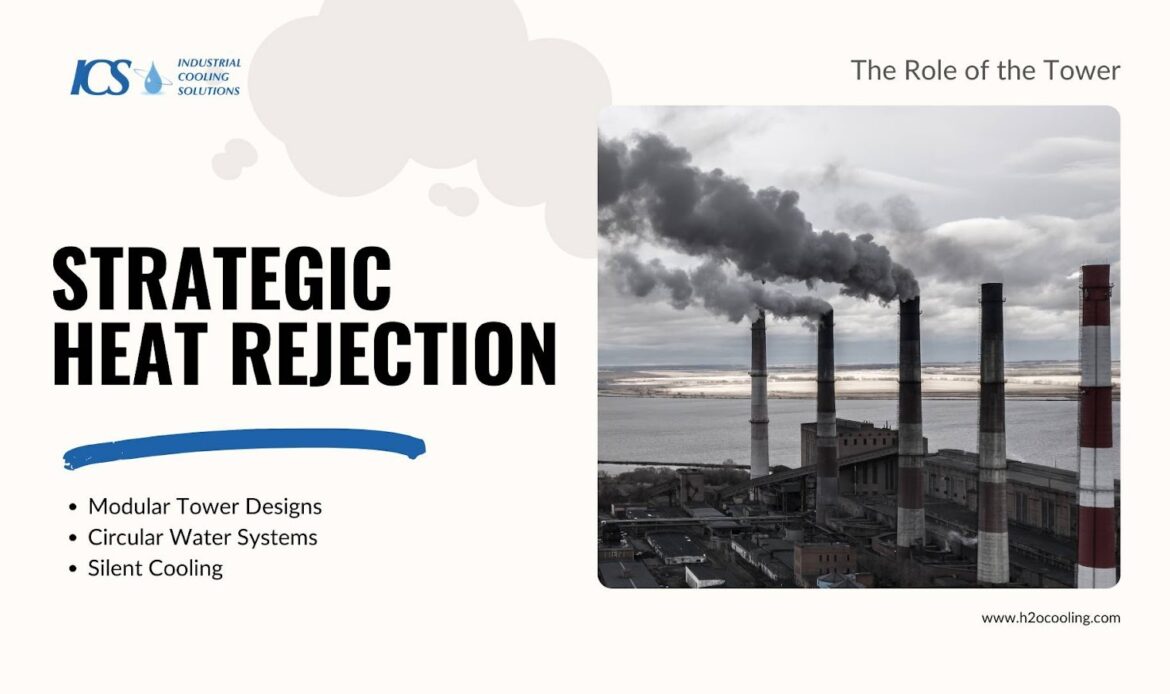
- Modular Tower Designs: The 2026 standard favors "Plug-and-Play" tower modules. This approach enables infrastructure to scale in lockstep with server deployments, preventing massive upfront capital expenditures and allowing for a more flexible, growth-oriented model.
- Circular Water Systems: Forward-thinking data centers now treat cooling tower blowdown, the water drained to remove mineral buildup, as a resource. This water can be treated and repurposed for greywater applications like irrigation or sanitation, reducing a facility's overall water footprint.
- Silent Cooling: As data centers move closer to urban and residential areas, noise pollution becomes a significant design constraint. Advanced low-decibel fan assemblies are engineered to minimize acoustic output, ensuring compliance with local noise ordinances and maintaining community goodwill.
Reliability & Compliance: ASHRAE 188 and Beyond
In mission-critical environments, compliance is not optional. It is the foundation of operational reliability. Modern health standards, particularly ASHRAE Standard 188 for Legionella risk management, demand a proactive approach.
Automated biocidal monitoring systems provide continuous analysis and treatment of the water loop, ensuring 100% compliance without manual intervention. This automation is complemented by predictive maintenance.
By using vibration analytics, operators can detect wear on components like fan motors long before a failure occurs. This predictive capability turns reactive problem-solving into proactive infrastructure management, preventing "Critical High Temp" alarms that could threaten uptime.
Troubleshooting: Solving the AI Hotspot
Even the most advanced systems can experience issues. Identifying the root cause of a problem quickly is essential to maintaining performance.
- Symptom: High Return Water Temperatures
- Diagnosis: This often points to bio-fouling in the tower fill media, which impedes heat transfer. Another potential cause is pump impeller degradation, reducing water flow rates.
- Symptom: Excessive Makeup Water Usage
- Diagnosis: The likely culprits are drift eliminator failure or improperly calibrated conductivity sensors. A failing drift eliminator allows too much water to escape, while faulty sensors can trigger unnecessary blowdown cycles.
Conclusion: Engineering the Future of Compute
In 2026, data center cooling solutions will not justbe a facility cost center. They are the fundamental enablers of AI and cloud performance. The ability to manage extreme heat density directly dictates the computational power you can deploy. Without a thermal resiliency strategy built on robust data center cooling solutions, your IT expansion will hit a wall.
Standard HVAC solutions are no longer sufficient for the demands of mission-critical infrastructure. A specialized approach is necessary to bridge the gap between traditional building services and the high-stakes world of hyperscale data centers.
Is your cooling infrastructure the bottleneck in your IT expansion? Contact Industrial Cooling Solutions for a 2026 Data Center Thermal Readiness Audit today.
Frequently Asked Questions (FAQs)
What are the best data center cooling solutions for 2026?
The best solutions include Direct-to-Chip (D2C) cooling, immersion cooling, and adiabatic/free cooling, tailored to AI and hyperscale data center needs.
How does immersion cooling benefit data centers?
Immersion cooling supports extreme heat loads (150 kW+ per rack), improves energy efficiency, and is ideal for high-performance computing and AI clusters.
Why is Water Usage Effectiveness (WUE) important in cooling?
WUE measures water efficiency in cooling systems, helping data centers reduce environmental impact and comply with 2026 sustainability regulations.
What is the role of closed-loop cooling towers in data centers?
Closed-loop towers isolate IT equipment from pollutants, ensuring reliability and extending hardware lifespan in high-density environments.
How can data centers reuse heat effectively?
By tracking Heat Reuse Effectiveness (HRE), facilities can repurpose waste heat for district heating or industrial processes, enhancing sustainability.