

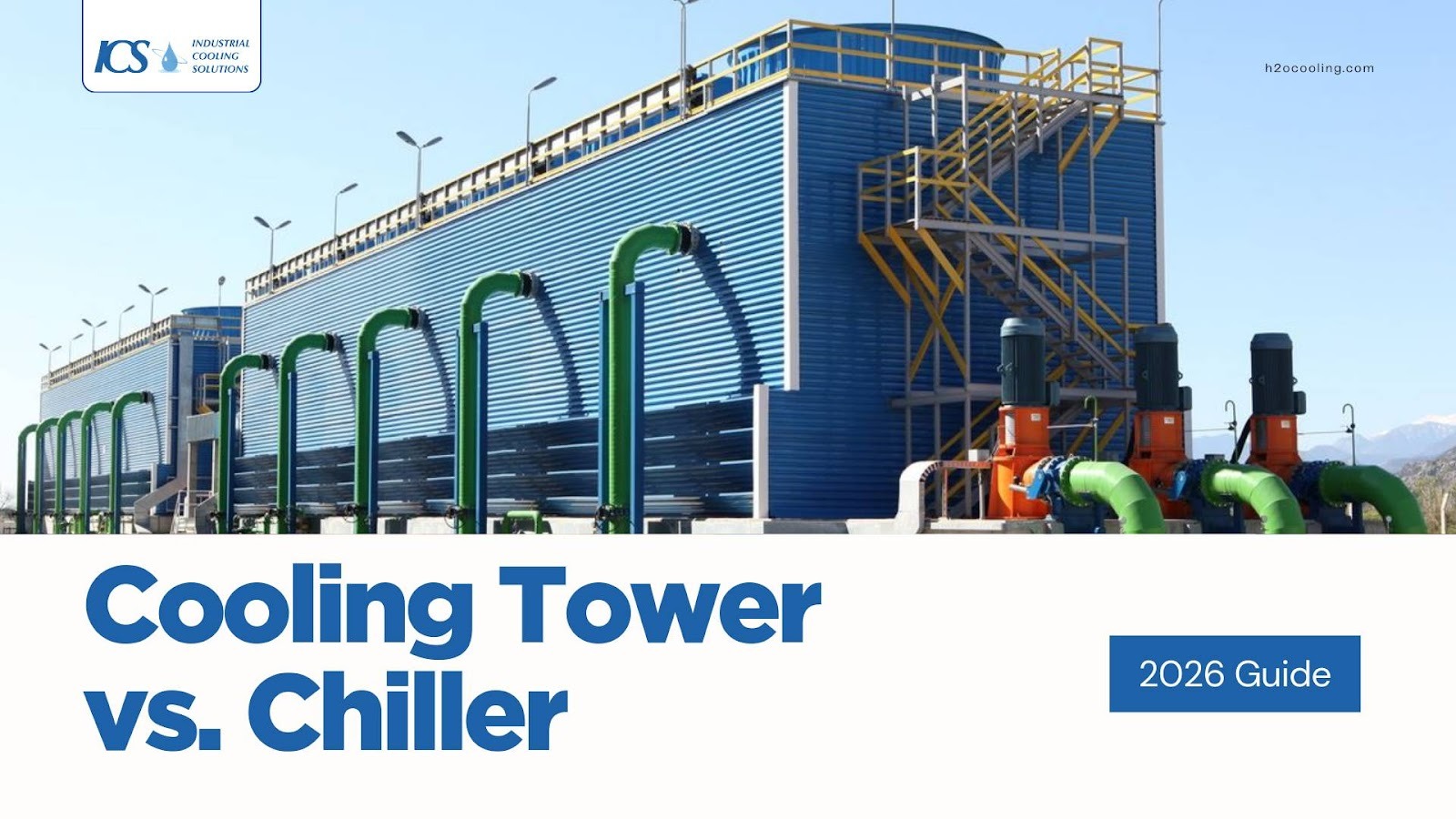
The debate of Cooling Tower vs. Chiller centers on their distinct cooling methods and applications. Cooling towers rely on evaporative cooling to reject heat into the atmosphere, making them ideal for bulk heat rejection in industrial processes.
In contrast, chillers use a vapor compression cycle to remove heat with precise temperature control, suitable for applications like data centers and pharmaceutical manufacturing. Choosing between these systems depends on factors like energy efficiency, water consumption, and the specific cooling needs of your industrial or commercial facility.
This guide will explain the exact differences between these large-scale applications. You will learn how to navigate 2026 regulations and evaluate your total cost of ownership. We will help you select the best cooling system to absorb heat and optimize your industrial processes.
Defining the Technologies: 2026 Industrial Standards
To make an informed choice, you must understand the fundamental mechanics of each system. Both systems dissipate heat, but they use entirely different physical processes to achieve efficient cooling.
The Cooling Tower: Bulk Heat Rejector
A cooling tower uses evaporative cooling to reject heat directly into the ambient air. Warm water flows through the tower while fans pull the surrounding air across the water stream. A small portion of the water evaporates, removing a large amount of excess heat.
However, ambient temperature limits the cooling capacity of natural-draft and induced-draft cooling towers. You cannot cool water below the local wet-bulb temperature. This makes water conservation a critical factor, as these systems rely heavily on water consumption to operate.
The Chiller: Precision Heat Remover
A chiller uses a mechanical vapor compression cycle to actively remove heat from a specific process. These units use a refrigerant fluid to transfer heat out of water or other system coolant materials. The expansion valve and evaporator heat exchangers allow chillers to cool fluids far below the ambient air temperature.
They offer immense precision, but they require significant electrical energy to run internal compressors. A chiller removes heat with exact control, making it ideal for food processing and large commercial buildings.
2026 Regulatory Alert
You must pay strict attention to the evolving legal landscape. Compliance with the Environmental Protection Agency American Innovation and Manufacturing Act is mandatory. New 2026 regulations state that new chillers must utilize low-Global Warming Potential refrigerants.
Systems must use refrigerants with a rating under 700. If your current systems use legacy refrigerants, you will face massive phase-out costs. You must upgrade your heat exchanger equipment to meet these strict new laws.
2. Technical Comparison: The 2026 ROI Matrix
When you evaluate a cooling tower vs chiller, you must analyze the ten-year Total Cost of Ownership. Use the following technical comparison to understand the operational differences and energy consumption profiles.
| Feature | Cooling Tower (Bulk Heat Rejector) | Air-Cooled Chiller | Water-Cooled Chiller |
| Primary Method | Evaporative (Open/Closed Loop) | Refrigeration (Air) | Refrigeration (Water) |
| Energy Intensity | Lowest (Fans and Pumps) | High (Compressor-heavy) | Most Efficient (When paired) |
| Water Consumption | High (Evaporative loss) | Zero (Closed-loop) | Moderate (Tower Makeup) |
| Maintenance Profile | Water Treatment & Cleaning | Mechanical Care/Refrigerant | High (Dual-system care) |
| Temperature Precision | Limited by Wet-Bulb | ± 0.5°C Precision | High Precision |
| Capital Cost | Lower Initial CAPEX | Moderate | High |
Cooling towers offer excellent electrical thermal efficiency, but they consume vast amounts of water. Air-cooled chillers rely on air flows to reject unwanted heat, which eliminates water usage but drives up your electrical costs. Water-cooled systems combine elements of both, offering lower energy consumption while requiring a dedicated portable cooling tower or large fixed tower to reject condenser heat.
Selecting for Your Site: Scenarios and Decision Drivers
Every industrial site has unique constraints. Your ideal industrial heat rejection strategy depends on your location, your process requirements, and local resource costs.
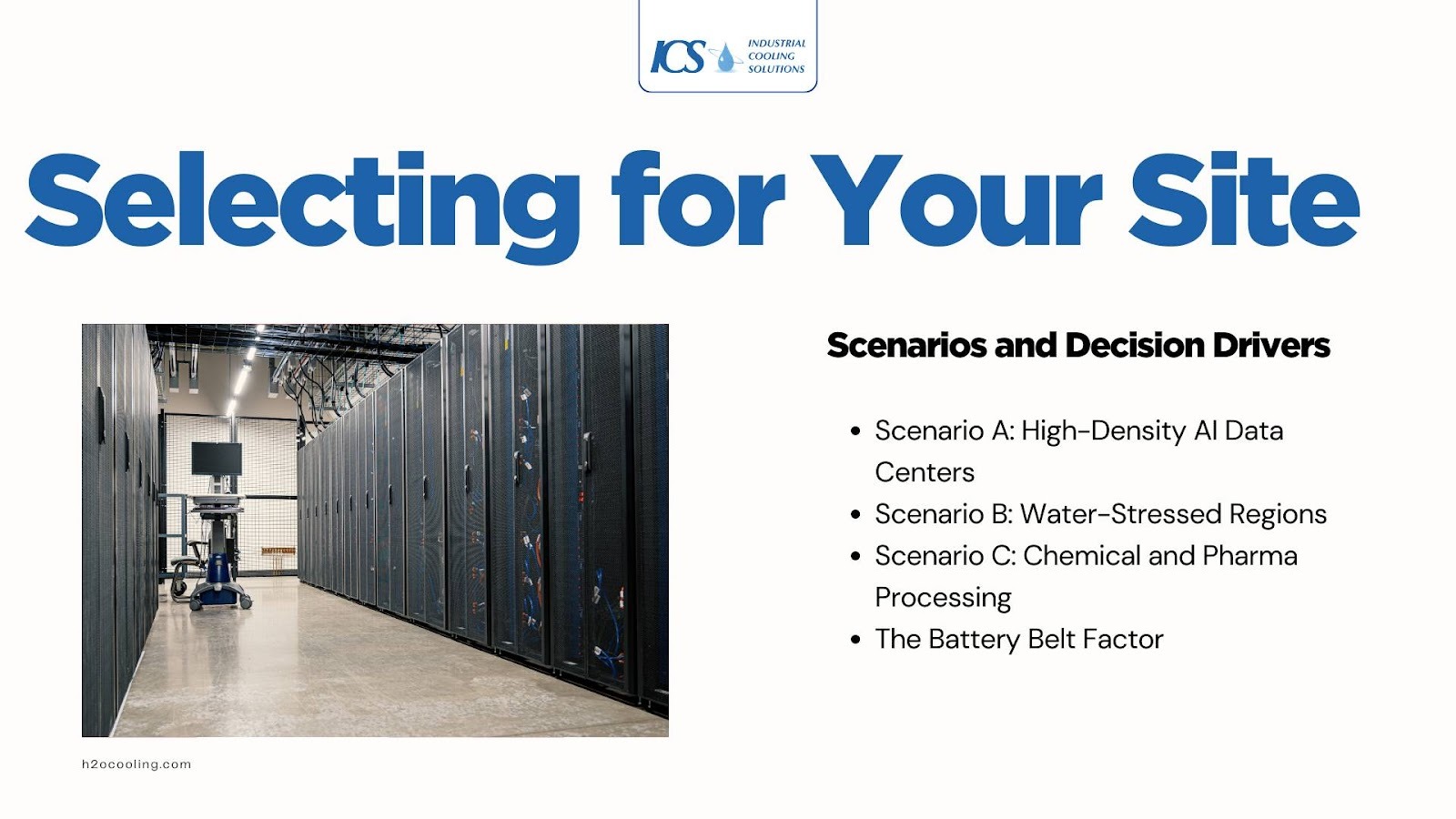
Scenario A: High-Density AI Data Centers
Artificial intelligence workloads generate unprecedented heat. Data centers must optimize their power usage to remain profitable. This requirement heavily favors water-cooled chillers paired with industrial counterflow cooling towers. This combination provides the reliability and massive heat exchange capacity that modern server racks demand.
Scenario B: Water-Stressed Regions
Facilities in the American Southwest face severe water scarcity. Municipalities are issuing strict water quotas. In these regions, the strategy shifts heavily toward air-cooled chillers or advanced adiabatic systems. Facilities must eliminate evaporative water loss to maintain their operating permits, even if this means accepting higher operating costs.
Scenario C: Chemical and Pharma Processing
Pharmaceutical and chemical manufacturing requires absolute thermal stability. A temperature drift of one degree can ruin an entire production batch. Precise temperature control makes a dedicated mechanical industrial chiller non-negotiable for these environments. The refrigeration cycle provides the exact cool air and cool water needed.
The Battery Belt Factor
Large-scale electric vehicle manufacturing is expanding rapidly across the American Midwest. These mega-factories use hybrid systems to handle fluctuating thermal loads. By combining towers and chillers, they maximize efficiency across dramatic seasonal weather changes. Power plants also utilize these hybrid large-scale HVAC systems to manage waste heat effectively.
The Hybrid Advantage: Where Efficiency Lives
You do not have to choose just one technology. The most efficient facilities use a hybrid approach to maximize thermal efficiency and minimize operational energy costs.
Free Cooling with Economizers
Engineers design systems that feature waterside economizers. During the colder seasons, the system bypasses the energy-intensive chiller completely. The cooling tower handles the entire thermal load using cool air. This free cooling method can slash your energy bills by up to seventy percent during the winter months.
Modular Scaling
You can easily expand a hybrid system. Facility managers use factory-assembled cooling towers to add thermal capacity. You can pipe a new tower into an existing chiller plant without enduring major site construction or facility downtime. It ensures a continuous flow of chilled water for cooling purposes.
Variable Frequency Drives
Modern automation relies heavily on Variable Frequency Drives. Smart controls synchronize your tower fan speeds and your chiller pump speeds. The system constantly adjusts these speeds to follow real-time thermal loads. This synchronization prevents energy waste during periods of low production.
Maintenance 4.0: IoT and Predictive Analytics
Maintaining your thermal assets is no longer a manual cooling process. The industry is rapidly adopting predictive analytics and sensors to prevent failures before they occur.
- Legionella Compliance: Facilities are moving away from manual water testing logs. They are installing automated dosing systems. Real-time monitoring is critical to meet strict 2026 safety standards and protect the remaining water in the basin.
- Tube Fouling Prevention: Scale accumulation is a silent threat to your efficiency. A tiny layer of scale can ruin condenser heat exchangers and increase energy consumption by ten percent. Smart sensors detect pressure drops, alerting you to clean the tubes before your energy bills spike.
- PFAS-Free Transition: The industry is making a massive pivot away from traditional synthetic plastics. Facilities must transition toward eco-friendly fill materials for their cooling towers by 2026.
Conclusion: Future-Proofing Your Thermal Assets
The choice between a Cooling Tower vs. Chiller is not just about selecting equipment; it is about designing a system that balances energy efficiency, water conservation, and compliance with 2026 regulations. Cooling towers excel in bulk heat rejection, while chillers provide precise temperature control for critical processes. By understanding your facility's unique needs, you can implement a cooling solution that optimizes performance and minimizes costs. Future-proof your operations by choosing the right system and ensuring compliance with evolving industry standards.
Is your current cooling system fully compliant with the new 2026 refrigerant laws? Do not wait for regulatory fines or mechanical failures. Schedule a professional thermal audit today to secure the future of your industrial facility with ICS.
Frequently Asked Questions
What is the difference between a cooling tower and a chiller?
A cooling tower uses evaporative cooling to reject heat into the atmosphere, ideal for bulk heat rejection in industrial processes. A chiller, on the other hand, uses a vapor compression cycle to remove heat with precise temperature control, making it suitable for applications like data centers and food processing. Both systems play vital roles in large-scale HVAC systems and industrial cooling solutions.
How do air-cooled chillers differ from water-cooled chillers?
Air-cooled chillers rely on ambient air to dissipate heat, making them ideal for water-scarce regions. Water-cooled chillers use cooling towers to reject heat, offering higher energy efficiency but requiring water consumption. The choice depends on factors like water availability, energy costs, and cooling needs for industrial processes or large commercial buildings.
What are the benefits of hybrid cooling systems?
Hybrid systems combine cooling towers and chillers to maximize efficiency. They use free cooling during cooler seasons, reducing energy costs by up to 70%. Modular scaling allows easy capacity expansion, while Variable Frequency Drives (VFDs) optimize fan and pump speeds. These systems are ideal for industries like EV manufacturing and power plants, balancing energy efficiency and water conservation.
Why is water conservation important in cooling towers?
Cooling towers rely on water evaporation to reject heat, leading to significant water consumption. In water-stressed regions, air-cooled systems or adiabatic cooling are preferred to meet municipal water quotas. Efficient cooling solutions focus on reducing water usage while maintaining performance, ensuring compliance with environmental regulations, and sustainable operations.
What are the 2026 regulations for chillers and cooling towers?
The 2026 EPA AIM Act mandates low-GWP refrigerants (e.g., R-454B) for new chillers, with a GWP under 700. Cooling towers must transition to PFAS-free materials and adopt IoT-enabled monitoring for Legionella compliance. These regulations aim to reduce environmental impact, improve energy efficiency, and ensure safe, sustainable cooling processes in industrial and commercial applications.