

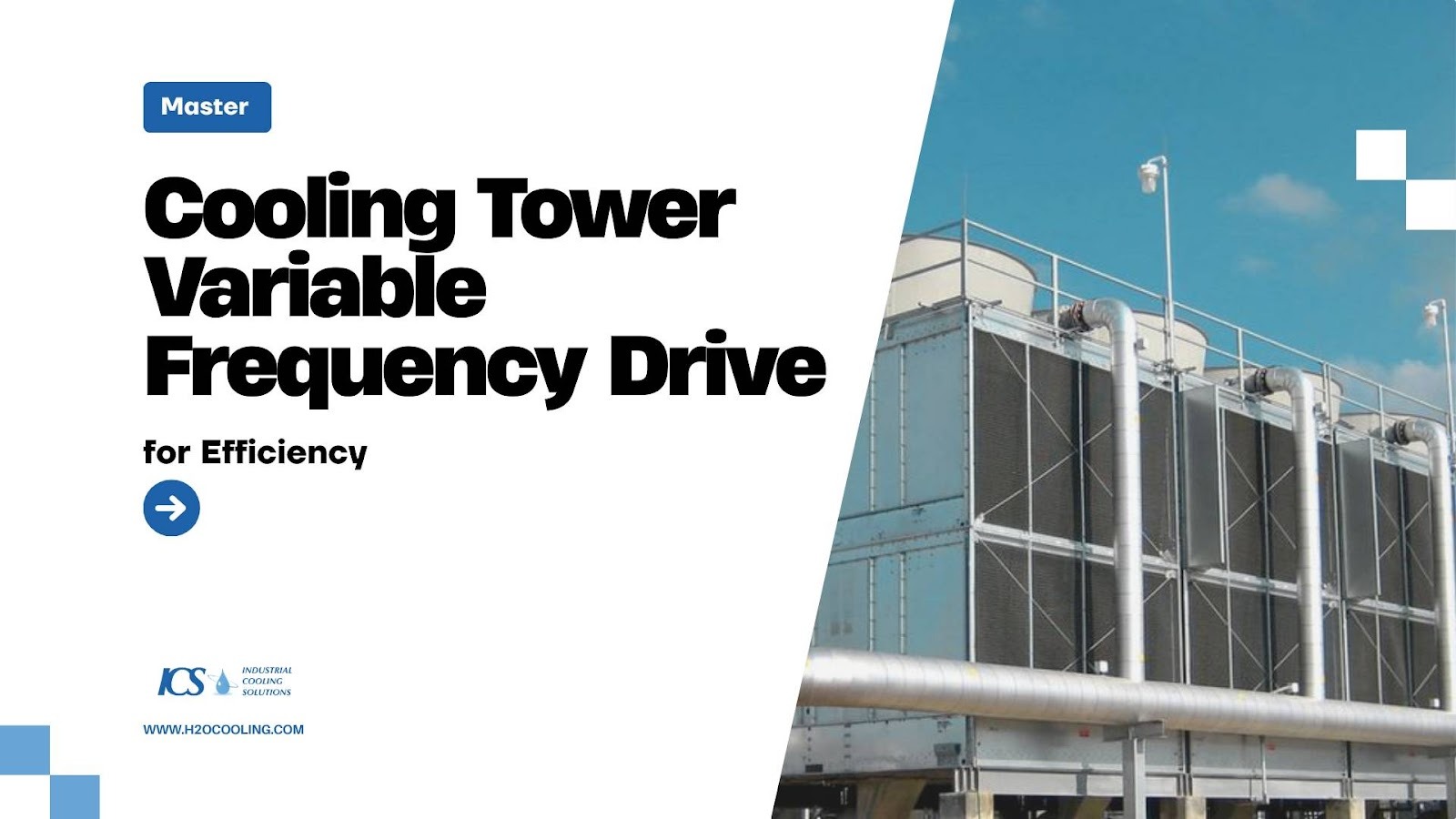
The era of "across-the-line" starting is over. In the modern industrial landscape, running a cooling tower fan at full speed regardless of the actual load is a legacy liability. It wastes capital and stresses mechanical components. Facility Directors and Mechanical Engineers demanding precision temperature control must view the cooling tower variable frequency drive (VFD) not merely as a starter, but as a Dynamic Load Regulator.
Unlike a two-speed motor starter or a soft-starter, a variable frequency drive VFD allows for precise modulation. It matches the fan speed to the exact rejection requirements of the system. This shift allows facilities to achieve process water temperature stabilization within \pm 1°F, a level of accuracy that old "bang-bang" controls simply cannot provide.
The Physics of VFD Energy Savings: Beyond the Cube Law
To understand the Return on Investment (ROI), engineers must look at the physics governing fan loads. The potential for reduced energy consumption is rooted in the Affinity Laws.
The Affinity Law Breakdown
The power required to drive a centrifugal fan varies with the cube of the speed. The formula is mathematically distinct:
P_2 = P_1 \times \left(\frac{N_2}{N_1}\right)^3
This means if you adjust the fan speed to 80%, the power consumption drops to approximately 51%. Operating at half speed consumes just 12.5% of the energy needed for full-speed operation. This exponential drop creates massive opportunities for lower utility costs.
The "Sweet Spot" Paradox
However, energy efficiency is not just about slowing down. A problem arises if you reduce the tower assembly speed too much. If the cooling tower water gets too warm, the chiller must work harder against a higher head pressure. This increases the chiller's "lift" and energy draw. You must identify the crossover point where tower savings do not negate chiller efficiency.
Water Stewardship
Variable frequency drives also contribute to water conservation. By maintaining lower air velocities during off-peak hours, you reduce "splash-out" and chemical loss. This lowers the cost-effective operational baseline for the entire plant.
Critical Guardrails: Mechanical & Electrical Constraints

Installing a frequency drive without considering the mechanical limitations of the power train leads to catastrophic failure. Competitors often overlook these risks, but a robust design must address them.
The Gearbox "Slinger Gap"
Many cooling tower fans use gearboxes that rely on an internal oil slinger for lubrication. These slingers require a specific rotational velocity to coat the upper bearings. If you operate below the manufacturer's minimum speed requirements, often around 20–25 Hz, you starve the bearings of oil. This leads to gearbox seizures. For belted cooling tower fans, low speeds can cause belt glazing and slippage.
Resonance & Skip Frequencies
Every fan and tower assembly has a natural resonant frequency. When the motor speed matches this frequency, the tower creates mechanical resonance or vibration. This can destroy the structure. You must perform vibration analysis during commissioning. Once you identify these certain speeds, you must program the drive or control system to "lock out" or skip these frequencies.
Motor Insulation & The Corona Effect
Standard NEMA MG1 Part 30 motors often fail under VFD operation due to voltage spikes known as the "Corona Effect." These spikes degrade the insulation. The 2026 standard dictates the use of NEMA MG1 Part 31 Inverter Duty motors. These motors can withstand the high voltage stresses a VFD creates.
2026 Strategic Control: AI & Floating Setpoints

Traditional control system logic relies on fixed setpoints. Modern strategies utilize dynamic Wet-Bulb Tracking.
Moving to "Approach" Logic
Instead of a static set point (e.g., 85°F), program the VFD to follow the ambient wet-bulb temperature plus a fixed approach (e.g., $7°F$). This floating logic maximizes the Chiller’s Coefficient of Performance (COP). It ensures the cooling tower provides the coldest water possible without wasting energy on hot days or during high humidity.
PID Tuning
Proper configuration of Proportional-Integral-Derivative (PID) parameters is essential. Without it, the system will "hunt," constantly ramping the fan up and down. This causes wear and unstable process water temperatures. Correct tuning accounts for the thermal inertia of the water volume.
Technical Specification & Implementation Matrix
Use this diagnostic tool to evaluate VFD health and compatibility.
| Variable | 2026 Design Target | Engineering Purpose | Risk of Non-Compliance |
| Carrier Frequency | 2 kHz – 4 kHz | Minimizes Audible Noise/EMI | Overheating / Insulation Stress |
| Minimum Speed | Site-Specific (Gearbox) | Ensures Oil Circulation | Gearbox Seizure |
| dV/dt Filtering | Mandated > 100ft leads | Voltage Spike Mitigation | Motor Insulation Breakdown |
| Ramp Time | 30–60 Seconds | Torque/Stress Reduction | Gearbox/Belt Slippage |
| Bypass Logic | Automatic Across-the-line | Emergency Redundancy | System Shutdown |
Installation & Retrofit: The ICS Protocol
When performing an installation or retrofit, the physical environment matters as much as the programming.
Outdoor Enclosure Standards
Cooling towers are harsh environments. Good practice dictates using NEMA 3R or 4X enclosures. These prevent moisture-induced VFD failure. Standard indoor enclosures cannot survive the corrosive, humid air near a tower.
Long-Lead Mitigation
If the VFD is in a remote motor control center (MCC), you may have long lead lengths between the drive and the existing motor. This causes a reflective wave phenomenon, leading to an overvoltage condition at the motor terminals. You must install dV/dt filters or line reactors to protect the motor insulation from breakdown.
Managing Windmilling and Reverse Rotation
A problem arises when the wind turns the fan while it is off. If the fan running in reverse (windmilling) is engaged by the VFD, it can trip on an overcurrent condition. Anti-ratcheting devices or software features like "catch a spinning load" are necessary. The drive must correctly identify motor rotation and slow it to zero speed before ramping up in the correct direction. This eliminates the need for mechanical and electrical brakes to stop the fan.
Maintenance & ROI Diagnostic Checklist
To ensure reduced maintenance requirements and longevity, implement a strict maintenance schedule.
- Annual Thermal Scans: Use infrared cameras to detect loose electrical terminations within the VFD enclosure. Heat indicates high resistance and potential failure.
- Cabinet Hygiene: Dust on heat sinks acts as an insulator. Vacuum does not blow dust out of the VFD cooling fins to prevent Insulated Gate Bipolar Transistor (IGBT) overheating.
- Vibration Switches: Test vibration switches regularly to ensure they trip the system during an imbalance event.
- Calculating Payback: When calculating ROI, factor in equipment replacement costs. A VFD reduces mechanical shock, extending the life of belts, gearboxes, and couplings. This is a value add beyond simple kWh savings.
Conclusion: Smart Cooling Starts at the Drive
A cooling tower variable frequency drive is the "brain" that allows the mechanical "heart" of the tower to beat in rhythm with the building's actual load. It moves beyond the limitations of starter-controlled fans and eliminates the mechanical stress of reversing starters.
The ICS advantage lies in understanding the Hydraulic-Electrical interface. We ensure your drive logic protects your mechanical assets while providing additional cooling capacity when needed. We navigate the complexities of HP requirements, varying scenarios, and multiple speeds to deliver optimal performance.
Is your cooling tower stuck in 'All or Nothing' mode? Contact the Industrial Cooling Solutions team for a VFD integration audit and start optimizing your plant’s COP today.
Frequently Asked Questions (FAQs)
What is a cooling tower variable frequency drive (VFD)?
A cooling tower VFD is a device that adjusts fan speed to match cooling demands, improving energy efficiency and stabilizing process water temperatures.
How does a VFD reduce energy consumption in cooling towers?
By modulating fan speed based on load conditions, a VFD minimizes power consumption, reducing utility costs and extending equipment lifespan.
What are the benefits of adjusting fan speed with a VFD?
Adjusting fan speed with a VFD ensures precise temperature control, reduces mechanical stress, and lowers energy consumption, enhancing overall system efficiency.
Why is the minimum speed important for cooling tower fans?
Minimum speed ensures proper lubrication in gearboxes and prevents mechanical issues like belt slippage or bearing failure in the fan and tower assembly.
How can VFDs help with process water temperature stabilization?
VFDs dynamically control fan speeds to maintain consistent process water temperatures, even under varying load conditions, ensuring better performance and energy efficiency.