Steam and heat drive the turbines that power our world, but managing the immense thermal energy left behind is just as critical as generating it. Without effective heat rejection, power generation grinds to a halt. This is where power plant cooling towers come into play, serving as the unsung heroes of energy production.
These massive structures remove excess heat, ensuring turbines run efficiently and safely. Their iconic hourglass shape is globally recognized, but their engineering is vital for balancing energy output, environmental impact, and efficiency.
This guide examines the mechanics of power plant cooling towers, the various system types available, and the trade-offs between water usage and efficiency. We will also examine future trends that are shaping the industry, as water scarcity becomes a pressing global concern.
Why Cooling Towers Are Critical in Power Plant Operations
In thermal power plants, whether nuclear, coal, or gas, generating electricity involves boiling water to create high-pressure steam. This steam spins a turbine connected to a generator.
However, once the steam passes through the turbine, it must be condensed back into water to be cycled through the boiler again. This condensation process releases massive amounts of latent heat.
Cooling towers are essential for two main reasons:
- They ensure efficiency: By cooling the condenser water, they maintain the pressure difference needed to drive the turbine. Without this, backpressure would increase, and power output would drop significantly.
- They prevent damage: If the heat rejection system fails, the uncontrolled heat buildup can cause critical components to overheat. This can lead to safety shutdowns or even catastrophic equipment failure. A reliable cooling system is crucial for reliable power generation.
How Power Plant Cooling Towers Work
The fundamental principle behind most cooling towers is evaporative cooling. Warm water from the plant’s condenser arrives at the tower and is distributed over a fill material. This fill increases the surface area of the water, allowing for maximum contact with air.
Here’s how a power plant cooling tower works, step by step:
- Step 1: Water Distribution: Warm water from the plant’s condenser is pumped to the cooling tower. It’s then distributed over a “fill material.”
- Step 2: Evaporation: The fill material maximizes the water’s surface area. As air flows past the water, a small amount evaporates. This evaporation process absorbs heat from the remaining water, cooling it down.
- Step 3: Collection: The now-cooled water gathers in a basin at the bottom of the tower.
- Step 4: Recirculation: This cooled water is then pumped back to the condenser to absorb more heat from the steam cycle.
- Step 5: Continuous Loop: This creates a closed-loop thermal cycle where the water continuously absorbs heat from the plant and releases it into the atmosphere via the cooling tower.
Primary Cooling Systems Used in Power Plants
Engineers must choose the right cooling method based on water availability, climate, and environmental regulations. There are four primary approaches used in the industry today.
Once-Through Cooling Systems
Do these systems recycle their water? They do not, which makes them distinct from modern tower-based designs. These systems withdraw water from a nearby source, pass it through the condenser once, and discharge it back warmer than it entered.
- Massive water withdrawal: These systems require a continuous, high-volume flow from a river, lake, or ocean.
- Simple design: They eliminate the need for large cooling towers, reducing initial construction costs.
- Environmental challenges: The discharge of warm water creates thermal pollution, which harms aquatic life and often faces strict regulatory limits.
Wet Recirculating Cooling Towers
Why is this the standard for modern power generation? It strikes a balance between water conservation and thermal efficiency. In this system, warm water goes to a cooling tower where evaporation removes the heat, and the cooled water recirculates back to the condenser.
- Reduced withdrawal: Because the water recirculates, the plant draws significantly less fresh water compared to once-through systems.
- High consumption: While withdrawal is low, water consumption is high because the system loses water to evaporation.
- Regulatory compliance: These systems are easier to permit because they do not discharge vast amounts of heated water back into the environment.
Dry Cooling Systems
In regions where water is scarce, dry cooling offers a viable alternative. These systems function much like a car radiator. Exhaust steam flows through finned tubes, and fans blow air across them to remove heat. No water evaporates in the process.
The advantage is clear: zero water consumption. This allows power plants to operate in arid environments. However, dry cooling comes with significant penalties.
- Zero water usage: These systems are ideal for arid regions as they require no water for cooling.
- Efficiency penalties: Air is a less efficient heat transfer medium than water, which lowers plant efficiency, especially on hot days.
- High costs: The equipment requires a large footprint and significant energy to run the fans, increasing both capital and operational expenses.
Hybrid Cooling Systems
Hybrid systems attempt to capture the best of both worlds by combining wet and dry cooling technologies. Typically, a hybrid tower features a wet section for optimal efficiency and a dry section to conserve water or minimize visible plumes.
During cooler months or periods of low water availability, the dry section handles the load. During hot summer days when maximum cooling is needed, the wet section engages.
- Plume abatement: Hybrid towers can reduce the visible vapor plume that standard wet towers produce.
- Water flexibility: Operators can adjust the ratio of wet to dry cooling based on current water availability and weather conditions.
- Balanced efficiency: They offer better performance than dry cooling while consuming less water than fully wet systems.
Key Design Types of Power Plant Cooling Towers
Beyond the cooling method, the physical design of the tower dictates how air moves through the system.
Natural Draft vs Mechanical Draft Cooling Towers
Natural draft towers are the colossal concrete hyperboloids often associated with nuclear power plants. They rely on the buoyancy of warm air to create an updraft. As hot, moist air rises inside the chimney, it draws fresh, cooler air in at the base. They require no fans, which keeps operating costs low, but their massive size makes them expensive to build.
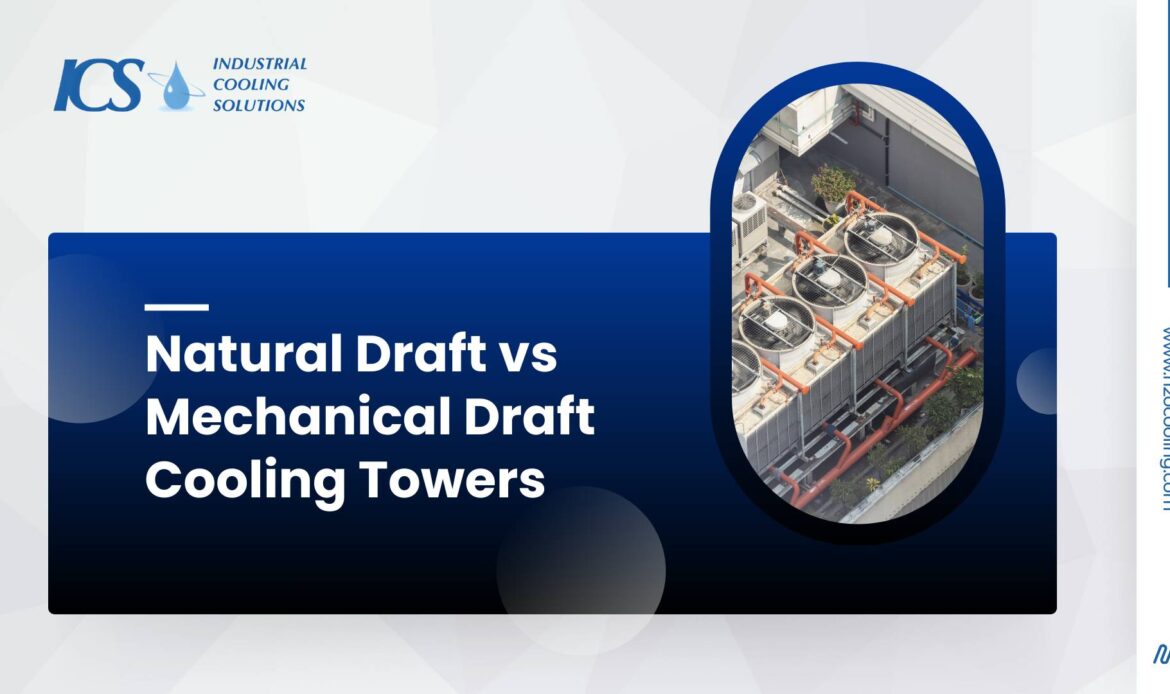
Mechanical draft towers use large fans to force or induce air through the structure. These are more compact and offer greater control over cooling performance. However, they consume electricity to operate the fans and require more maintenance.
Induced Draft vs Forced Draft
- In mechanical systems, the fan placement matters. Induced draft towers have fans at the top, pulling air up through the fill. This provides uniform airflow and prevents the recirculation of hot air.
- Forced draft towers have blowers at the base, pushing air up. While less common in large power plants due to recirculation issues, they are useful for specific high-static-pressure applications.
Water Use, Environmental Impact, and Regulatory Considerations
Water management is a defining challenge for modern power generation. It is crucial to distinguish between two key terms: withdrawal and consumption.
Once-through systems have high withdrawal but return most of it. Consumption refers to water that is removed from the immediate water environment, primarily through evaporation in cooling towers.
Power plant cooling towers experience three types of water loss:
- Evaporation: Pure water vapor leaving the tower (the primary cooling mechanism).
- Drift: Small water droplets carried out by the airflow, containing dissolved solids.
- Blowdown: Water is intentionally drained from the basin to reduce the concentration of minerals and impurities.
Environmental regulations promote cooling towers as they reduce thermal pollution by releasing heat into the air instead of water, protecting aquatic ecosystems. Operators, however, must ensure blowdown water meets chemical discharge standards.
Comparison Table: Cooling Systems Used in Power Plants
The following table provides a direct comparison of the primary cooling technologies to assist in understanding their trade-offs.
| Cooling System Type | Water Withdrawal | Water Consumption | Environmental Impact | Capital Cost | Typical Power Plant Applications |
| Once-Through Cooling | Very High | Low | High (Thermal Pollution) | Low | Older plants near large water bodies |
| Wet Recirculating (Cooling Towers) | Low | High (Evaporation) | Moderate (Plume/Blowdown) | Moderate | Most modern inland thermal/nuclear plants |
| Dry Cooling (Air Cooled) | None | None | Low | High | Arid regions; water-restricted sites |
| Hybrid Cooling | Low | Moderate | Low (Plume Abatement) | Very High | Sites with specific regulatory/water constraints |
Advancements and Future Trends in Power Plant Cooling
The demand for sustainable energy is pushing cooling technology forward. Smart monitoring and automation are transforming how operators manage power plant cooling towers. IoT sensors now track vibration, water chemistry, and thermal performance in real-time.
Algorithms adjust fan speeds and pump operations to optimize energy use minute by minute.
- Improved Fill Materials: Engineers are developing new fill materials with designs that increase the surface area for heat transfer and resist fouling. This helps towers cool more water with less airflow, which saves fan energy.
- Hybrid and Dry Cooling: In water-scarce regions, there’s a growing trend toward using hybrid and dry cooling systems. Although dry cooling has a higher initial cost, the long-term benefit of water security often justifies the investment.
- Sustainability and Emission Reduction: More efficient cooling towers help power plants burn less fuel to generate the same amount of electricity. This directly contributes to lowering carbon dioxide emissions and meeting sustainability goals.
Conclusion
In this blog, we explored the critical role of cooling towers in power plants and how they efficiently manage waste heat to ensure smooth operations. We discussed the shift from once-through systems to wet recirculating cooling towers, driven by environmental concerns.
IoT, AI, and improved materials are boosting heat transfer and energy efficiency. Meanwhile, hybrid and dry cooling systems are gaining ground in water-scarce regions, effectively balancing costs with conservation.
While wet recirculating towers are often seen as the most efficient option, the growing focus on sustainability and water conservation is leading to increased adoption of hybrid and dry systems for power plant cooling towers. Ultimately, proper design and maintenance are key to ensuring reliable and sustainable power generation, regardless of the system type.
For any of your cooling tower needs, including parts, maintenance, or new construction, visit h2ocooling.com.
Frequently Asked Question
What are power plant cooling towers used for?
Power plant cooling towers remove excess heat from condenser water after steam passes through turbines, allowing the steam cycle to continue efficiently and preventing equipment overheating.
How do power plant cooling towers work?
They use evaporative cooling by exposing warm condenser water to airflow, allowing a small portion to evaporate and carry away heat before the cooled water is recirculated.
What types of cooling towers are used in power plants?
Power plants commonly use wet recirculating cooling towers, dry cooling systems, hybrid cooling towers, and once-through cooling systems depending on water availability and regulations.
How much water do power plant cooling towers consume?
Water consumption depends on system type, but wet recirculating cooling towers primarily lose water through evaporation, drift, and blowdown during heat rejection.