

Most engineers and buyers focus solely on the initial purchase price, or Capital Expenditure (CapEx), when selecting cooling towers or large cooling tower systems. This is often the most expensive mistake you can make.
The real cost lies in the Operating Expenditure (OpEx) over the cooling tower system's 20-year lifespan. A seemingly small flaw in cooling tower design can lead to tens of millions of dollars in wasted energy, water, and maintenance costs due to poor heat transfer, higher dissolved solids, or inefficient air circulation.
This single factor dictates your downstream chilled water system’s efficiency, as well as your lifetime cooling capacity and energy bill. The temperature difference between a 7°F and a 5°F Approach can make your entire facility run 15-20% more efficiently, improving heat rejection and cold water temperature control.
The Fundamentals: How a Cooling Tower Works
A cooling tower is a specialized heat exchanger. It rejects waste heat from industrial operations or air conditioning systems by using advanced evaporative cooling principles. You will find cooling towers in facilities such as:
- Industrial facilities and plants (including power plants, food processing plants, and chemical processing plants)
- Data centers
- Large commercial HVAC systems
- Air conditioning systems and process equipment
- Industrial cooling towers and closed circuit cooling towers for process and circuit cooling towers
The working principle relies on the movement of ambient air and water flow. Hot water from a process enters the tower, is distributed over fill material or fill media, and encounters cooler air, often provided by a fan or natural convection. As incoming air meets a falling stream of water, a small portion of the water evaporates.
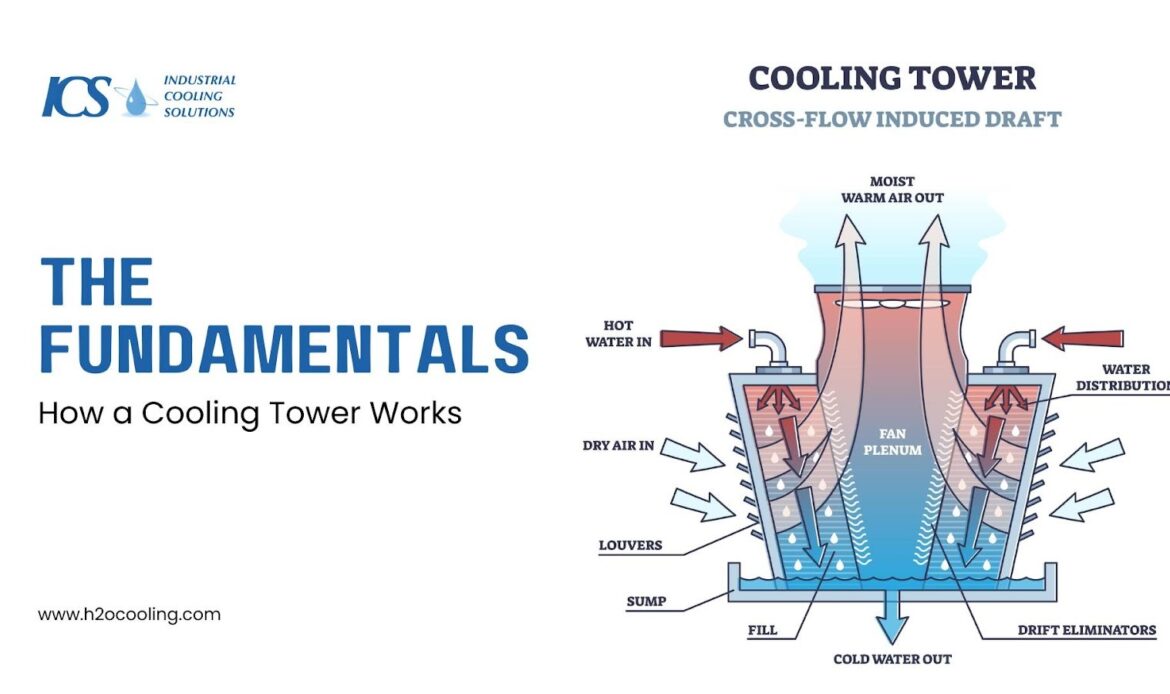
This process, where water evaporates, absorbs heat from the remaining water, effectively lowering its temperature. The cooled water is then pumped back to the heat exchanger coil, process equipment, or chiller to repeat the cooling cycle, maintaining controlled water temperature for the system.
Visually, cooling tower designs can vary. The common mechanical draft tower features a large box and fan, while the iconic hyperbolic chimney of natural draft cooling towers dominates the landscape at major power plants.
Hybrid cooling towers and dry cooling towers are gaining popularity for energy-efficient and water-saving solutions, addressing environmental protection agency guidelines and needs in hot climates.
Unlocking Peak Efficiency: Expert Design Tips
Applying strategic design principles not only maximizes cooling tower performance and tower sizing but also ensures energy savings and lifetime profit. These tips focus on optimizing energy, water, and air movement.
Obey the Cube Law
The power consumed by a cooling tower fan is proportional to the cube of its speed (P ∝ N³). This relationship is a primary lever for energy savings in all types, including induced draft cooling towers and forced draft cooling towers.
Always specify Variable Frequency Drives (VFDs) for the fan blades and motors. Reducing fan speed by just 20% can save roughly 50% of fan motor power and decrease OpEx significantly. Induced draft and forced draft towers benefit from this, increasing variable water flow flexibility in part-load operation for large cooling tower systems and hybrid towers.
Master Your Water Use
Cycles of Concentration (CoC) determine how many times recirculating water can be used before blowdown. Many towers run only at a CoC of 3.
Superior cooling tower system design incorporates water treatment and blowdown solutions that support a CoC of 6 to 10. This reduces makeup water usage (makeup water), chemical treatment, and water losses. Utilizing a side-stream filtration system minimizes biological growth, keeps tower water clean, and preserves heat exchanger performance.
A robust design uses corrosion-proof tower structure materials, like FRP, to prevent premature failure from dissolved solids and biological growth, and supports easier maintenance of process equipment.
Cooling Tower Classification and Components
Choosing the best cooling tower type and optimizing every component leads to optimal heat transfer and performance.
Classification by Airflow and Contact
- Crossflow vs. Counterflow: These wet cooling towers can be distinguished by water and air intake direction.
- Crossflow: Air intake is horizontal, water falls vertically. Allows for excellent maintenance access, lower pump head (gravity flow), and is suitable for high-fouling or splash-type fill applications where splash fill is preferred.
- Counterflow: Air intake is vertical and opposite to water flow, offering improved thermal efficiency and a closer Approach to wet bulb temperature, but requires more pump energy for higher pressure spray.
- Induced Draft vs. Forced Draft: Air movement through the tower is key. Induced draft cooling tower units have fans at the top pulling air, promoting efficient air circulation, while forced draft cooling towers use fans at the base to push air through the fill material. Natural draft towers use natural convection for airflow without forced or mechanical means.
Essential Cooling Tower Components
- Fill Media: The core of heat exchanger performance.
- Film Fill: Maximizes surface area, improving heat transfer in clean water conditions.
- Splash Fill: Best for industrial cooling towers with dirty or mineral-rich recirculating water.
- Drift Eliminators: Ultra-low drift ratings (as low as 0.0005%) are essential for environmental protection, minimizing water droplets leaving the tower, and reducing the risk of water loss and regulatory issues.
- Water Distribution System: Quality spray bars, basins, nozzles, and uniform distribution systems ensure balanced water coverage, preventing hotspots and maximizing tower performance.
- Fan, Motor, and Drive: Premium, energy-efficient assemblies and VFDs cut energy use and support variable water flow according to process demands.
Strategic Design: A Financial Risk Assessment
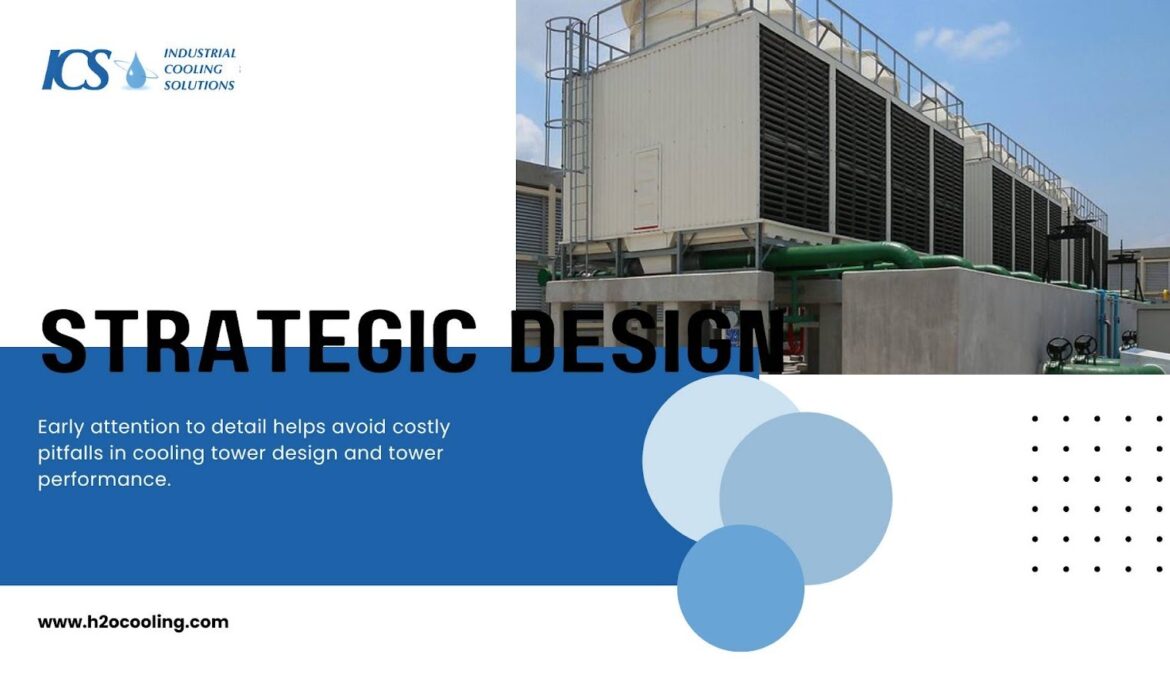
Early attention to detail helps avoid costly pitfalls in cooling tower design and tower performance.
Key Design Requirements
- Thermal Duty: Define Range (temperature difference between hot water and cooled water), flow rates, and ambient wet bulb temperature using precise historical data.
- Noise Constraints: Address urban or sensitive site needs.
- Structural Integrity: Account for wind, seismic load, and tower structure longevity for safety and compliance.
Common Mistakes to Avoid
- Ignoring LCC: Under-sizing a cooling tower system saves CapEx but penalizes you with decades of high energy bills and reduced cooling capacity.
- Improper Fill Match: Using film fill with dirty process water can cause rapid fouling, disrupt air intake, decrease performance, and raise maintenance costs.
- Poor Access: Inaccessible fans, motors, or fill increase downtime and risk early component failure due to missed maintenance.
The Future of Cooling Tower Design
The industry is advancing toward sustainable, intelligent, and energy-saving solutions.
- Adiabatic and Hybrid Cooling Towers: Adiabatic coolers and hybrid cooling towers combine dry air pre-cooling or dry cooling towers with traditional evaporative cooling, reducing water flows, minimizing Legionella risk, and enabling energy-efficient operation in changing weather.
- AI and Smart Controls: Modern cooling towers and HVAC systems now employ smart sensors to monitor temperature difference, heat load, water quality, and airflow in real time. Automated adjustments optimize system energy use, fan speeds, and cycles of concentration, upholding best practices for environmental compliance and savings across industrial operations and processing plants.
Key Design Comparison: Crossflow vs. Counterflow
| Feature / Design Choice | Crossflow | Counterflow | Strategic Rationale |
| Thermal Efficiency | Good (Horizontal Air, wet cooling towers) | Excellent (Opposite Air, improved heat rejection) | Best for facilities prioritizing cold water temperature. |
| Pump Head (Energy Cost) | Low (Gravity Flow) | High (Pressurized Spray) | Lowers energy use and tower OpEx. |
| Maintenance Access | Excellent (Easy Fill Access) | Good (Nozzle Access) | Favorable for large cooling tower systems with higher fouling risk. |
| Footprint (Space) | Wider Base, Shorter Height | Smaller Base, Taller Height | Ideal for constrained industrial facilities or urban settings. |
| Drift Eliminators | Requires a Larger Area | Smaller, More Efficient | Essential for water loss control. |
Your Next Step: From Concept to Profit
The $50 million secret is clear: strategic cooling tower design is your ultimate defense for long-term operating budgets. By prioritizing Life-Cycle Cost over initial pricing, you secure guaranteed thermal performance, extended equipment life, and significant, verifiable energy savings.
For your next project, visit H2O Cooling, initiate a full Life-Cycle Cost assessment with a professional engineer who understands cooling tower systems, wet bulb temperature analysis, tower water management, and current Environmental Protection Agency guidelines. This proactive approach ensures your facility’s profit and performance for its operational lifetime.
Frequently Asked Questions
Four Types of Cooling Towers:
- Natural Draft Cooling Towers: Use natural convection for air movement.
- Mechanical Draft Cooling Towers: Use fans for air circulation (induced or forced draft).
- Crossflow Cooling Towers: Air flows horizontally across falling water.
- Counterflow Cooling Towers: Air flows vertically opposite to the water flow.
Principle of Cooling Tower:
A cooling tower works on the principle of evaporative cooling, where hot water is exposed to cooler air. A portion of the water evaporates, absorbing heat and cooling the remaining water.
GPM in a Cooling Tower:
Cooling towers typically handle 3 GPM per ton of cooling. For example, a 100-ton system would require approximately 300 GPM.
pH and TDS for Cooling Tower:
- pH Range: 6.5 to 8.5 (ideal for minimizing corrosion and scaling).
- TDS (Total Dissolved Solids): Typically maintained between 1,500 to 2,500 ppm, depending on the system design and water quality.