

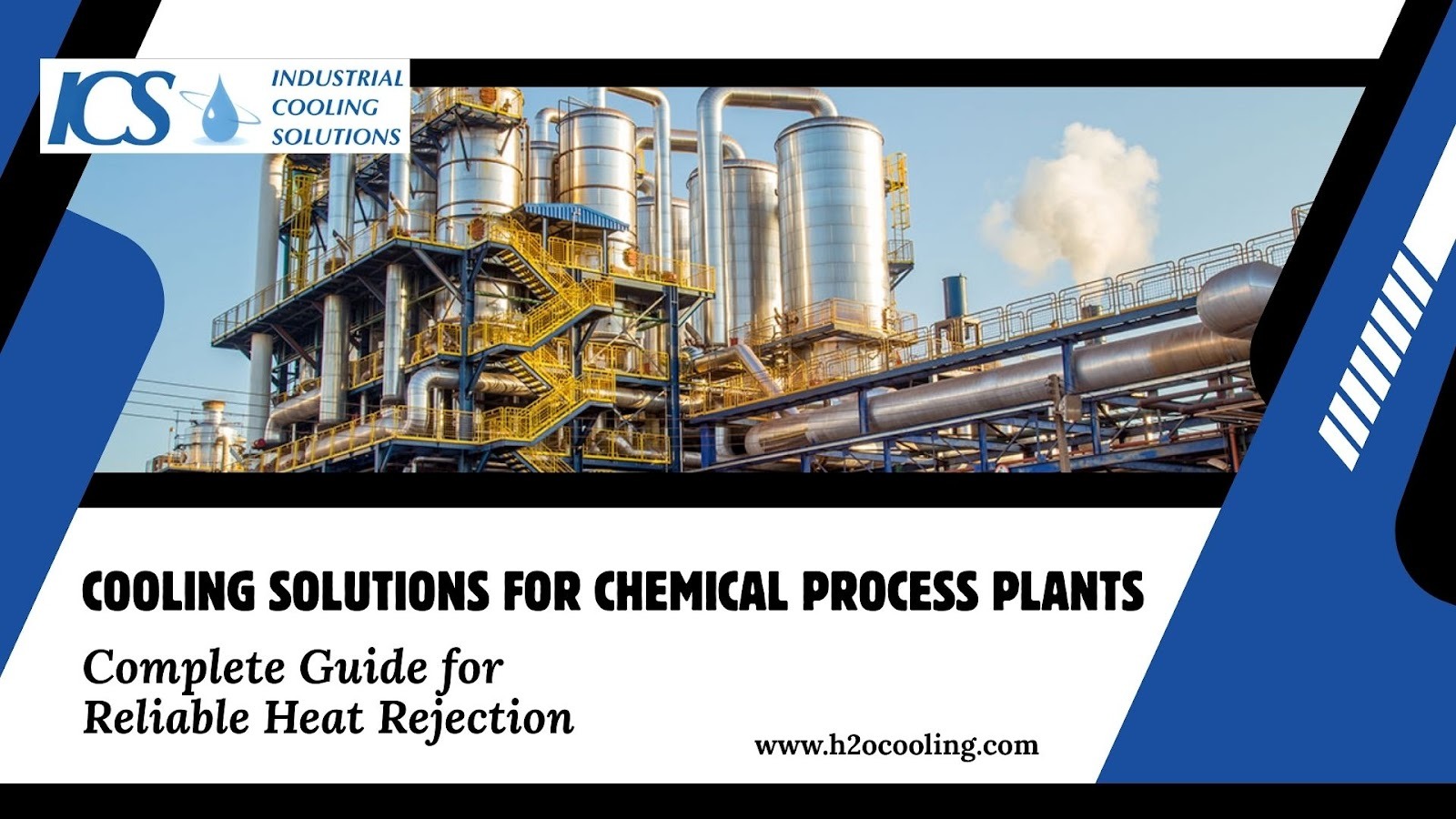
Chemical manufacturing operates on a razor-thin margin of error where thermal stability dictates success. Cooling Solutions for Chemical Process Plants serve as the backbone of these operations, ensuring that volatile reactions remain within safe limits. Without reliable heat rejection, a facility risks catastrophic safety incidents, compromised product quality, and costly unplanned downtime.
Engineers and plant managers must navigate a complex landscape of thermodynamics and fluid mechanics to select the right system. Whether utilizing evaporative cooling, air-cooled exchangers, or hybrid systems, the goal remains constant: precise temperature control.
This guide explores the critical role of cooling technology, the specific equipment available, and the best practices for maintaining efficiency in harsh chemical environments.
The Role of Cooling in Chemical & Petrochemical Processing
Temperature control is not merely a utility; it is a process variable that directly influences reaction kinetics. Chemical reactions often release significant heat, and managing this exothermic energy prevents runaway reactions.
Precise cooling ensures that catalysts function optimally and that reaction pathways produce the desired isomers rather than waste byproducts.
Why Precise Temperature Control Affects Reaction Kinetics
Reaction rates typically double for every 10-degree Celsius rise in temperature. This exponential relationship means that even minor fluctuations can drastically alter production outcomes. A robust cooling system absorbs this excess heat to maintain equilibrium. If the temperature drifts, the chemical process cooling efficiency drops, leading to off-spec products that require reprocessing or disposal.
Where Cooling is Required?
Heat rejection occurs at multiple stages within a processing facility. Engineers integrate cooling loops into the following critical areas to maintain operational stability:
- Reactors: The core of chemical synthesis often requires jacketed cooling or internal coils to remove heat generated during polymerization or oxidation.
- Heat Exchangers: Shell-and-tube or plate-and-frame exchangers transfer heat from process fluids to cooling water, protecting downstream equipment.
- Condensers: These units convert vapor back into liquid form, which is essential for solvent recovery and distillation processes.
- Scrubbers: Cooling the gas stream in a scrubber improves the absorption efficiency of pollutants.
- Distillation Units: Precise temperature gradients in distillation columns depend on effective overhead condensers to separate components based on boiling points.
Unique Challenges in Chemical Environments
Standard HVAC cooling towers are not built to withstand the aggressive conditions typical of chemical plants. The process water in these environments is often laden with impurities that can attack standard equipment components, leading to frequent and costly cooling tower repair.
Chemical process cooling equipment needs specialized designs and corrosion-resistant materials to withstand harsh elements and reduce disruptions.
Common problems include:
- High levels of dissolved solids: These can lead to scaling and blockages.
- Organic contaminants: These degrade standard fill media and reduce efficiency.
- Corrosive vapors: Leaks from heat exchangers can attack and destroy metal components.
Types of Cooling Solutions Used in Chemical Process Plants

Selecting the correct architecture for heat rejection depends on water availability, ambient conditions, and the specific chemical nature of the process fluid. Facilities often employ a mix of chemical process cooling systems to balance efficiency with operational resilience.
Here is how different technologies address the specific needs of the industry.
Wet Cooling Towers (Most Common in Chemical Plants)
How they work
- Evaporation principle: Wet cooling towers use evaporation to get rid of heat.
- Water flow: Warm process water is pumped to the top of the tower and trickles down over a material called fill media, which increases the surface area for air and water to mix.
- Cooling process: A fan pulls air through the falling water, causing a small amount of it to evaporate. This evaporation cools the rest of the water.
- Recirculation: The cooled water is then sent back into the process to absorb more heat.
When Should Chemical Plants Use Them?
These towers offer the most energy-efficient method for rejecting large heat loads. They are ideal for facilities with access to a steady water supply and where the process requires approaching the ambient wet-bulb temperature.
Wet towers excel in applications requiring maximum cooling density per square foot of footprint.
Advantages:
Wet cooling towers are highly thermally efficient. They can also be adapted to handle challenging water conditions; using splash fill instead of film fill can mitigate fouling risks, allowing the system to manage dirtier water effectively.
Disadvantages:
Because they are open systems, these towers expose water to airborne contaminants and biological growth. In a chemical plant, process leaks can introduce organics that serve as fuel for bacterial growth within the tower.
Air-Cooled Heat Exchangers (Dry Systems)
Zero water use
Dry coolers, or fin-fan coolers, use ambient air to cool process fluids inside finned tubes. The fluid never comes into direct contact with the air, eliminating water consumption entirely. This feature makes air-cooled exchangers an environmentally sustainable choice for regions facing water scarcity.
Ideal for Arid Climates
Dry cooling systems are a great option for facilities in deserts or places with strict rules about water use. Because these systems are sealed off, there's no chance for bacteria like Legionella to grow or for dirt from the air to contaminate the fluid inside..
When Dry Towers Work Better Than Wet Towers
Dry systems become the superior choice when the process fluid must remain absolutely isolated from the environment. They are also preferable when the required outlet temperature is significantly higher than the ambient dry-bulb temperature, as they do not rely on evaporation.
Hybrid & Closed-Circuit Systems
Blend of Dry + Evaporative
Hybrid systems combine the efficiency of wet cooling with the water conservation of dry cooling. These units can switch between modes based on ambient conditions, running dry during cooler months and utilizing water spray during peak summer heat.
Reduce Fouling, Scaling, and Contamination
Closed-circuit cooling towers isolate the process fluid in a coil while recirculating water over the exterior. This separation protects sensitive chemical process cooling equipment from fouling, as the internal process loop remains clean and treated.
Choosing the Right Cooling Tower for Chemical & Petrochemical Plants
Specifying a plant cooling tower involves more than just sizing for thermal load. You must consider the physical configuration and construction materials that will survive decades of continuous operation.
Do you prioritize ease of maintenance or initial capital cost?
Counterflow vs Crossflow Towers
Cooling efficiency
In counterflow towers, air moves vertically upward against the falling water. This design offers the most efficient thermal transfer for a given footprint. However, the compact nature of counterflow designs can make inspecting the spray system and fill difficult without shutting down the unit.
Maintenance access
Crossflow towers utilize a design where air flows horizontally across the falling water. This configuration creates a plenum area that allows maintenance personnel to walk inside the tower for inspection while it is running. For plants that cannot afford downtime, this accessibility is invaluable.
Suitability for dirty water
Crossflow towers equipped with splash fill perform better with water containing high levels of suspended solids. The vertical spacing allows debris to fall through into the basin rather than clogging the media, a frequent issue in chemical process cooling systems handling variable water quality.
Field-Erected vs Factory-Assembled Towers
Scale
Field-erected towers are custom-built on-site and are typically reserved for massive heat loads exceeding the capacity of modular units. Factory-assembled (packaged) towers arrive ready to install and suit small to medium-sized chemical processes.
Installation speed
Factory-assembled towers offer rapid deployment. Since manufacturers build them in a controlled environment, site work is limited to piping and electrical connections. Field-erected towers require significant construction time and labor on-site.
Cost considerations
While field-erected towers have a higher initial cost, they often provide a longer service life and lower fan energy consumption. Factory-assembled units have a lower upfront price but may require multiple cells to match the capacity of a single large field-erected unit.
Material Selection for Harsh Chemical Environments
FRP (best for corrosion resistance)
Fiberglass Reinforced Plastic (FRP) is the gold standard for modern chemical towers. It is impervious to most acids, chlorides, and biological attacks.
FRP structures do not rot like wood or rust like galvanized steel, ensuring structural integrity in aggressive atmospheres.
Concrete (durability + structural stability)
For the largest field-erected towers, concrete offers unmatched longevity. It resists vibration and fire, providing a permanent solution for major infrastructure projects. Concrete is immune to the corrosive vapors that often degrade metal cooling tower parts.
Stainless steel (certain applications)
Stainless steel, particularly grades 304 and 316, serves well for basins and structural supports in packaged towers. While more expensive than galvanized options, it provides necessary resistance to high concentrations of water treatment chemicals.
When each material is ideal
Choose FRP for the best balance of cost and corrosion resistance in most chemical applications. Select concrete for massive, 50-year lifespan projects. Specify stainless steel for smaller, hygienic, or high-temperature applications where plastic composites might deform.
Water Quality, Filtration & Treatment
Even the most robust equipment will fail without proper water chemistry management. Water acts as the heat transfer medium, and its quality directly impacts the thermal performance of chemical process cooling.
What contaminants are lurking in your recirculating loops?
Key Water Parameters for Chemical Process Cooling
pH, Conductivity, Hardness
Maintaining the correct pH balance prevents acidic corrosion or alkaline scaling. Conductivity measurements indicate the total dissolved solids (TDS), signaling when to bleed off water. Hardness levels, specifically calcium and magnesium, dictate the potential for scale formation on heat exchanger surfaces.
Microbial Load
Cooling towers act as massive air scrubbers, trapping dust and organic matter that feed bacteria. High microbial counts reduce heat transfer efficiency through biofilm formation and pose severe health risks to plant personnel.
Suspended Solids
In chemical plants, process leaks or airborne dust increase total suspended solids (TDS). These solids act as abrasives that wear down pump seals and clog spray nozzles, disrupting flow distribution.
Filtration Options
Side-stream Filtration
Side-stream filtration continuously treats a percentage of the recirculating water, gradually removing contaminants from the entire system. This method effectively reduces turbidity without restricting full system flow.
Sand/multimedia Filters
These filters trap fine particulates down to 10-15 microns. They are highly effective for removing organic matter and general environmental debris that accumulates in the tower basin.
Common Failures in Chemical Plant Cooling Systems & How to Prevent Them

Equipment failure in a chemical plant is rarely a sudden event; it is usually the result of gradual degradation. Understanding the failure modes of chemical process cooling equipment allows maintenance teams to intervene before a shutdown occurs.
Are your maintenance schedules addressing the root causes of system failure?
Scaling, Fouling & Sludge Accumulation
Causes
Scaling occurs when dissolved minerals precipitate out of the water onto hot surfaces. Fouling involves the accumulation of mud, biological growth, or process organics. In chemical plants, process leaks into the water are a primary driver of rapid fouling.
Prevention steps
- Implement rigorous water treatment protocols.
- Conduct regular blowdowns.
- Install side-stream filtration to remove solids and prevent sludge buildup in the basin.
Fan/Motor Failures
Bearings
Fan bearings operate in a hot, humid environment, making them susceptible to premature failure from moisture ingress. This is one of the most common mechanical issues in a plant cooling tower.
- Prevention: Use high-quality, sealed bearings. Implement a strict lubrication schedule with appropriate grease to prevent moisture from entering.
Alignment
Misalignment between the motor, driveshaft, and gearbox causes excessive wear on components.
- Prevention: Perform laser alignment checks while the equipment is at its normal operating temperature to account for thermal expansion.
Vibration
Excessive vibration often indicates an imbalance, which can be caused by scale buildup on fan blades or a failing gear.
- Prevention: Regularly clean fan blades to prevent scale accumulation. Install vibration switches as a safety measure to automatically shut down the tower and prevent catastrophic damage if high vibration levels are detected.
Fill Media Collapse
Causes
Fill media carries the weight of the water flowing over it. If the fill becomes clogged with scale or heavy biofilm, the combined weight can exceed the structural rating of the fill packs or their supports.
Prevention and replacement
- Regular preventive maintenance should include inspecting the bottom face of the fill for buildup.
- Lightly fouled fill can sometimes be restored with chemical cleaning.
- Severely blocked media must be replaced to restore proper airflow and cooling capacity.
Conclusion
Reliable heat rejection is the unsung hero of the chemical industry. From the selection of corrosion-resistant materials to the implementation of rigorous water treatment programs, every decision impacts process stability. Cooling Solutions for Chemical Process Plants must be robust, adaptable, and maintained with precision to handle the aggressive nature of chemical manufacturing.
Investing in high-quality systems, whether a field-erected counterflow unit or a specialized closed-circuit cooler, pays dividends through sustained production yields and safety.
By tackling the unique challenges of this sector and addressing failure modes head-on, plant operators can turn their cooling infrastructure into a powerful asset. Ready to optimize your operations? Discover how at h2ocooling.com!
Frequently Asked Questions
Why is cooling so important in chemical processing?
Cooling maintains reaction stability, prevents thermal runaway, and protects equipment. Without proper heat rejection, product quality drops and safety risks increase dramatically.
How do cooling towers work in chemical plants?
Cooling towers remove heat by evaporating a portion of warm process water. The cooled water is returned to heat exchangers, maintaining stable operating temperatures.
What makes chemical plant cooling more challenging?
High contamination potential, corrosive vapors, and variable load conditions increase fouling and scaling. These factors demand stronger materials and tighter water chemistry control.
What are the best cooling solutions for chemical process plants?
Cooling solutions for chemical process plants include cooling towers, heat exchangers, air-cooled condensers, and chillers, all designed to maintain optimal temperatures for safe and efficient operations.
How do I choose the right cooling solution for a chemical process plant?
Selecting the right solution depends on process heat load, chemical compatibility, water availability, energy efficiency, and environmental regulations.