

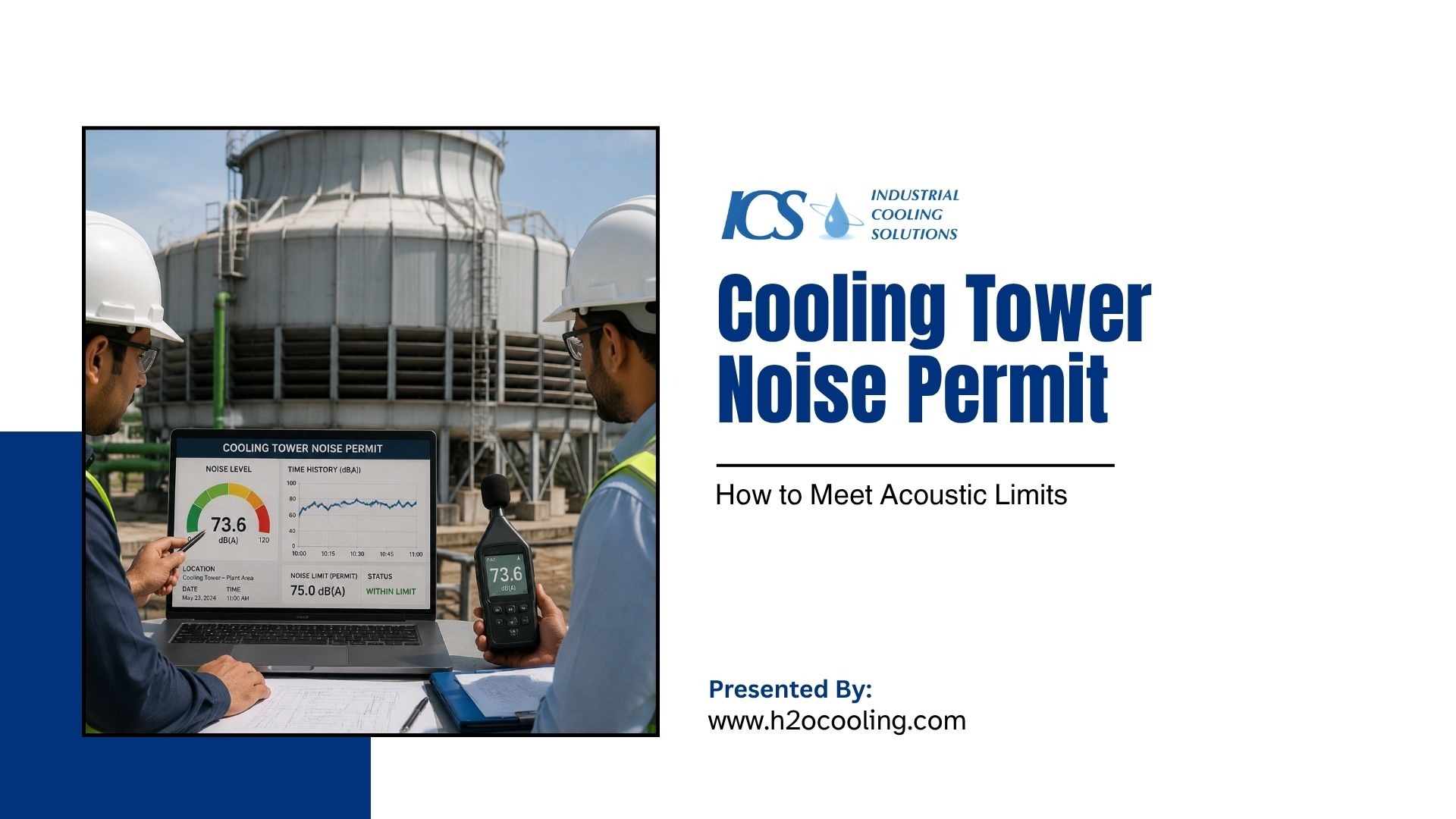
A cooling tower noise permit usually requires proof that the tower can meet the site's required dB limit at nearby homes, offices, property boundaries, or other sensitive receivers. Most projects need an acoustic assessment before approval, especially when a local council or authority reviews plant noise.
To reach sound compliance, facilities may add quieter fans, vibration control, silencers, operating controls, or a properly designed noise barrier that lowers sound without restricting airflow.
What Is a Cooling Tower Noise Permit?
A cooling tower noise permit is a local approval or compliance requirement that may apply when a cooling tower creates measurable sound near a property boundary, residential area, workplace, or sensitive receiver.
The exact requirement changes by location. It depends on local regulations, zoning, operating hours, and the type of project. Some areas require an acoustic report before installation. Others step in only after a complaint.
When a Cooling Tower May Need Noise Approval
Permit rules vary widely, so it helps to know the common triggers. Knowing them early lets you plan documents and mitigation before you buy equipment.
A permit or acoustic assessment may be needed when you:
- Install a new tower: New plant noise often triggers a fresh acoustic review.
- Replace an old unit with a larger one: More airflow usually means more sound.
- Add rooftop equipment: Rooftops reflect sound toward nearby buildings.
- Expand a data center or industrial plant: Added load brings added fan noise.
- Operate near homes: Residential receivers face the strictest limits.
- Run towers at night: Background noise drops, so towers stand out.
- Respond to a complaint: Authorities may require testing after a report.
- Apply for building or planning approval: Many permits ask for sound data upfront.
- Change fan speed or operating hours: New settings can raise measured sound.
Why Cooling Tower Noise Permits Matter
Cooling tower noise permits protect the facility and the surrounding community.
They matter because they:
- Reduce community complaints
- Protect workers and neighbors
- Help avoid enforcement action
- Prevent costly retrofits after installation
- Support project approval and commissioning
- Force buyers to compare acoustic performance before procurement
A permit review also helps engineers consider sound, airflow, maintenance access, and thermal performance together.
What Should an Acoustic Assessment Include?
An acoustic assessment measures or predicts how much sound the cooling tower will create at nearby receivers. It tells you whether the equipment meets the applicable limit before approval or operation.
Industrial Noise and Vibration Centre explains that effective cooling tower noise reduction starts with an accurate diagnosis of the noise problem and source, including whether the issue involves overall dB(A), tonal character, fan noise, falling water, pump noise, or gearbox noise.
What an Acoustic Assessment Reviews
A good assessment connects equipment sound to the real-world setting. The details below shape whether your project passes or fails the dB limit at the boundary.
A complete acoustic assessment should review:
- Cooling tower sound power level: The total sound energy the unit produces.
- Sound pressure at receivers: What people actually hear at homes or offices.
- Fan and motor noise: Often the loudest single source on the tower.
- Water splash noise: Broadband sound from falling water.
- Vibration transmission: Structure-borne noise through decks and frames.
- Background noise level: The baseline that sets the allowable margin.
- Distance to property boundary: Sound drops as distance grows.
- Sensitive receivers: Homes, hospitals, schools, and workplaces nearby.
- Day and night operation: Two schedules can mean two limits.
Acoustic Assessment Before vs After Installation
A pre-installation acoustic assessment predicts noise before equipment selection. It helps buyers compare fans, motors, tower location, barriers, silencers, and operating controls before they spend money.
A post-installation assessment measures actual sound after startup. It confirms compliance or identifies corrections.
The pre-installation assessment prevents costly retrofit. The post-installation test proves whether the final system meets the required dB limit.
How Do dB Limits Work for Cooling Towers?
Sound is measured in decibels, usually dB(A) for environmental noise. A local authority may set the dB limit at the property boundary, the nearest residential receiver, or another defined point.
The limit is not one fixed number. It shifts with location, time of day, and the noise character of your equipment.
What Affects the Applicable dB Limit?
The right target depends on rules and surroundings, not just the tower. Confirm the limit before you spend on equipment, since it drives every design choice.
Factors that set the dB limit include:
- Local council rules: The first source of your noise target.
- Zoning and land use: Residential zones carry tighter limits.
- Time of operation: Day and night limits often differ.
- Background noise: A quiet area lowers your allowable level.
- Area type: Industrial zones allow more than residential ones.
- Sensitive receivers: Hospitals and schools may need extra protection.
Why Are Nighttime Limits Often Stricter?
Nighttime noise limits are often stricter because background noise drops. Residents notice mechanical noise more easily when traffic, business activity, and general daytime noise are reduced.
Cooling towers may run continuously, especially for industrial plants, hospitals, hotels, commercial buildings, and data centers. Tonal fan noise, gearbox hum, or vibration can also become more obvious at night.
A permit condition may require lower nighttime operation, fan speed control, or additional acoustic treatment.
What Are the Main Cooling Tower Noise Sources?
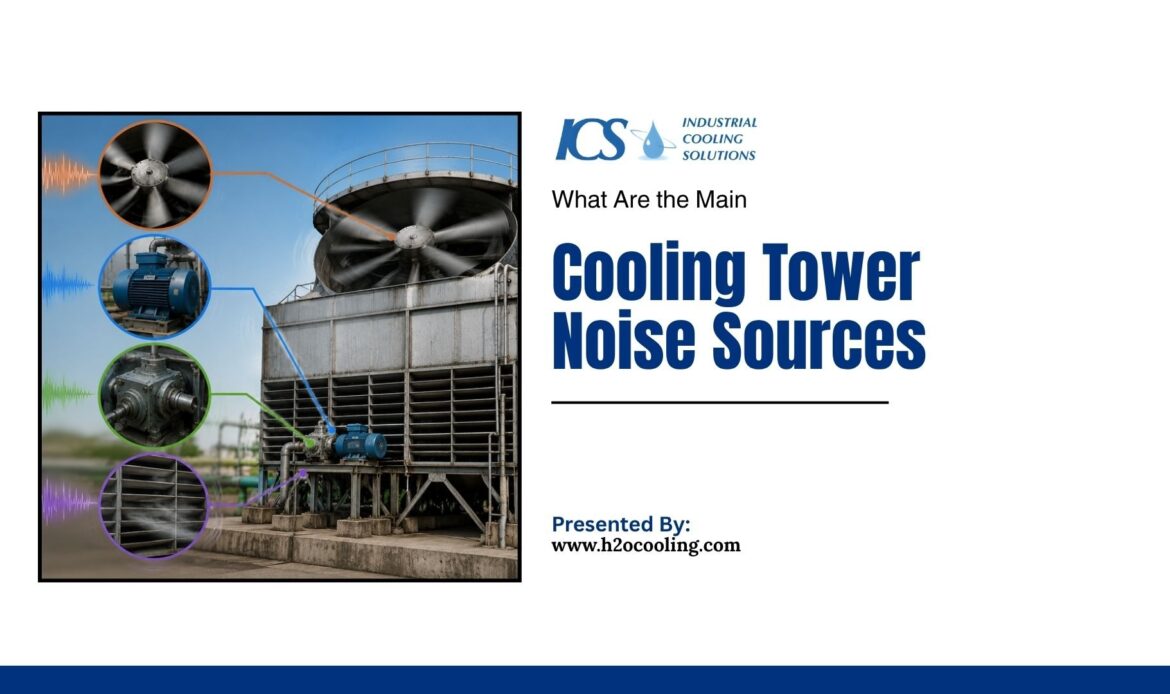
Cooling tower noise comes from several parts working together. A good fix targets the real source, not a guess.
Knowing each source helps you spend money where it counts. The list below shows where sound usually starts.
Common noise sources include:
- Fan blade noise: Often the dominant sound on the tower.
- Motor noise: Steady hum from the drive system.
- Gearbox noise: Mechanical whine from worn or loaded gears.
- Air inlet noise: Turbulence as air enters the tower.
- Fan discharge noise: Sound pushed out the top of the unit.
- Water splash noise: Broadband sound from falling water.
- Loose panels or doors: Rattles that grow louder over time.
- Structural vibration: Resonance through the deck and frame.
- Drift eliminator airflow: Turbulence near the air exit.
- Recirculation: Turbulent airflow that adds broadband noise.
How Do You Design a Noise Barrier for Cooling Towers?
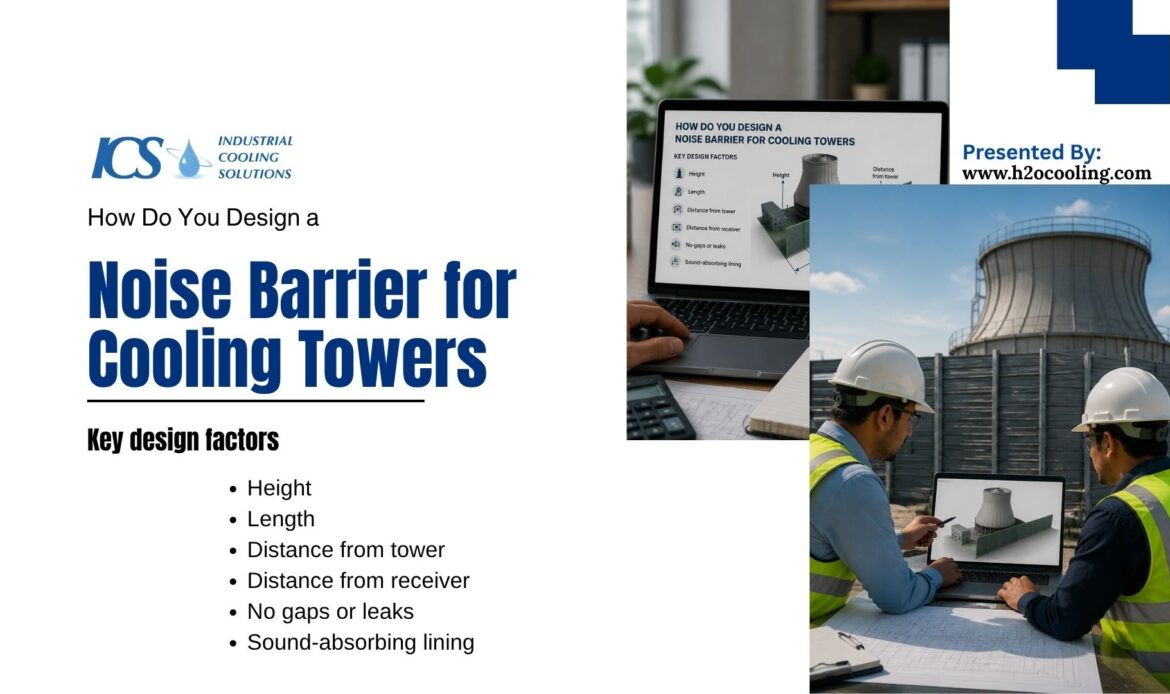
A noise barrier blocks the direct sound path between the cooling tower and the receiver. It helps most when sound travels in a clear line toward homes, offices, or property boundaries.
A barrier is not a simple wall. Poor design either fails to cut noise or chokes airflow.
What Makes a Noise Barrier Effective?
A strong barrier design should consider acoustic performance, airflow, maintenance, safety, and weather exposure.
Key design factors include:
- Height
- Length
- Distance from tower
- Distance from receiver
- No gaps or leaks
- Sound-absorbing lining
- Correct material density
- Wind and structural safety
A barrier should reduce noise without creating a new thermal or maintenance problem.
How Do You Reach Sound Compliance Without Hurting Cooling?
Sound compliance should never cause thermal failure. A cooling tower must meet both its acoustic limit and its process-cooling target at the same time.
The goal is balance. Quiet equipment that cannot cool is just as much a failure as a loud tower.
How to Balance Noise and Performance
Acoustic fixes and cooling performance share the same airflow. The steps below help you protect both at once.
To balance noise and cooling:
- Use verified fan data: Trust-tested numbers, not estimates.
- Compare sound and thermal data together: Judge both at the same time.
- Check pressure drop: Measure airflow loss through silencers or louvers.
- Keep air inlets clear: Never block the air the tower needs.
- Protect access: Leave room for inspection and cleaning.
- Model recirculation: Predict hot air paths before building.
- Use VFDs: Lower speed during part-load for quieter nights.
- Verify after install: Confirm performance once the tower runs.
- Inspect mechanicals: Fix worn bearings, imbalance, and loose parts.
Acoustic Fixes That Need Engineering Review
Some fixes carry real risk to airflow and capacity. Treat these as engineering decisions, not quick add-ons.
Fixes that need expert review include:
- Full acoustic enclosure: Can trap heat and starve airflow.
- Tall barriers near inlets: May block the air the tower needs.
- Discharge silencers: Add back pressure to the fan.
- Inlet attenuators: Restrict the incoming air path.
- Fan speed reduction: Lowers both noise and cooling capacity.
- New fan blade selection: Changes airflow and thermal output.
- Water splash control: Can disturb water distribution.
- Acoustic louvers: Reduce free area and raise pressure drop.
What Documents Does a Local Council Need?
A local council or authority sets the rules, and the documents vary by site. Some projects need a full acoustic report. Others need equipment data, a site layout, a mitigation plan, or post-installation testing.
Strong paperwork speeds approval and shows you took noise seriously.
Documents to Prepare
A clear, complete package answers questions before the reviewer asks them. The list below covers what most councils want to see.
Prepare these documents:
- Site plan: Shows the full layout and surroundings.
- Tower location: Marks the unit and its sound path.
- Equipment datasheets: Lists tower, fan, and motor specs.
- Sound power level data: Gives the source noise figures.
- Operating hours: States day and night running times.
- Acoustic assessment: Predicts or measures noise at receivers.
- Nearest receiver map: Identifies homes and sensitive sites.
- Predicted noise level: Shows expected sound at the boundary.
- Background noise data: Sets the baseline for the limit.
- Mitigation plan: Lists barriers, silencers, or fan controls.
- Barrier or silencer drawings: Details the proposed design.
- Commissioning test plan: Describes how you will verify results.
- Maintenance plan: Keeps noise low over the tower's life.
Cooling Tower Noise Permit Checklist
A checklist keeps your permit work organized and lowers the risk of a failed review. Use the table below to confirm each step, spot red flags, and act before problems grow.
| Checklist Area | What to Confirm | Why It Matters | Red Flag | Expert Recommendation |
| Applicable dB limit | Local council or permit noise limit | Defines compliance target | No clear limit identified | Confirm before equipment purchase |
| Acoustic assessment | Predicted or measured sound at receivers | Supports approval and design | Only equipment noise listed | Include site layout and receivers |
| Equipment sound data | Fan, motor, and tower sound levels | Allows fair vendor comparison | No octave-band or sound data | Request vendor acoustic data |
| Mitigation plan | Barrier, silencer, fan control, isolation | Reduces risk of complaints | Noise control added after install | Design mitigation early |
| Airflow impact | Pressure drop and recirculation risk | Protects cooling performance | Barrier blocks inlet air | Review acoustic and thermal design together |
| Verification testing | Post-installation noise check | Confirms sound compliance | No testing plan | Measure after commissioning |
| Maintenance plan | Fans, bearings, panels, vibration | Prevents noise increase over time | No routine noise inspection | Link noise control with maintenance |
How H2OCooling Can Help With Cooling Tower Noise Compliance
H2OCooling can help facilities identify noise sources, review cooling tower condition, compare noise-control options, and plan upgrades without damaging cooling performance.
This support can be useful before installation, after complaints, during replacement planning, or when an older tower becomes louder over time.
H2OCooling can support:
- Cooling tower inspection
- Noise source review
- Fan and motor assessment
- Low-noise fan upgrade planning
- Cooling tower maintenance
- Replacement planning
- Thermal performance review
The right approach helps the tower meet acoustic requirements while continuing to deliver reliable process cooling.
Summary
A cooling tower noise permit may require acoustic proof before installation or after complaints. An acoustic assessment helps predict or measure tower noise at sensitive receivers and property boundaries.
The applicable dB limit depends on local rules, land use, operating hours, background noise, and nearby receivers. Sound compliance requires both acoustic control and cooling performance protection.
A local council may request equipment data, site layout, mitigation plans, and verification testing. H2OCooling can help facilities evaluate noise sources, maintenance needs, upgrades, and replacement options.
Frequently Asked Questions
What is a cooling tower noise permit?
A cooling tower noise permit is a local approval or compliance requirement that confirms the tower will meet acoustic limits at nearby receivers or property boundaries. A local council may request a defined dB limit, an acoustic assessment, operating hours, equipment sound data, mitigation details, and post-installation verification before approval or after complaints.
What does an acoustic assessment include?
An acoustic assessment may include cooling tower sound levels, background noise, nearest receivers, property boundary distance, fan noise, water splash, vibration, operating hours, predicted dB levels, and mitigation recommendations. It should assess the whole site, not only manufacturer equipment data, because layout and receiver location strongly affect compliance.
What dB limit applies to a cooling tower?
The applicable dB limit depends on local council rules, zoning, background noise, operating hours, and nearby sensitive receivers. Residential areas often require stricter limits than industrial zones. Nighttime limits may also be lower because background noise drops and mechanical tower noise becomes more noticeable to nearby residents.
Can a noise barrier reduce cooling tower noise?
Yes, a noise barrier can reduce cooling tower noise by blocking the direct sound path to receivers. It should be tall enough, well-positioned, gap-free, dense enough, and structurally safe. The design must also protect inlet airflow, maintenance access, drainage, and cooling performance because a poorly placed barrier can restrict the tower.
How can cooling towers meet sound compliance?
Cooling towers can meet sound compliance through an acoustic assessment, low-noise fans, VFDs, silencers, vibration isolation, noise barriers, maintenance repairs, local council documentation, and post-installation testing. The best approach identifies the true noise source first and checks that every acoustic control still allows proper airflow and thermal performance.