


You invest heavily in upgrading mechanical components, yet the system fails to reach its thermal targets. Operators often replace fans, motors, and gearboxes, assuming these active components drive the entire cooling process. However, the true performance driver often lies hidden inside the unit.
Cooling tower fill materials function as the heart of the heat rejection process. They are not merely packing components or passive obstacles for water. They are the primary medium where air and water interact to facilitate evaporation. If this medium fails to perform, the most powerful fans and pumps cannot compensate for the thermal loss.
This article explains exactly what fill materials do, how they drive thermal efficiency, and why understanding their purpose is essential for maintaining industrial cooling performance.
What Is Cooling Tower Fill Material?
Cooling tower fill material acts as the primary medium for heat exchange within the tower. Its job is to maximize the contact between hot water and cool air. By increasing the surface area where air and water meet, fill allows evaporation to occur more rapidly. This evaporation is what removes heat from the process water.
The condition and design of your fill media directly impact the entire system's operation. When fill performs correctly, it optimizes:
- Thermal efficiency: The fill determines how much heat the water releases into the atmosphere per pass.
- Fan power consumption: Dense or fouled fill increases air resistance, forcing fan motors to draw more amperage.
- Water usage: Efficient heat transfer reduces the volume of water required to achieve the desired cooling effect.
- Maintenance frequency: The type and condition of fill dictate how often operators must shut down the system for cleaning.
Incorrect selection or neglected maintenance of cooling tower fill materials dramatically increases lifecycle costs, regardless of the quality of the mechanical equipment.
Key Factors That Determine the Right Fill Media Selection
Selecting the correct fill is a science that balances thermal requirements with water quality realities. Making the wrong choice here will lead to rapid fouling and performance loss.
Water Quality and Fouling Potential
Understanding what is in your water is the first step in selection. High levels of suspended solids or biological activity demand specific fill types.
- Suspended Solids: Particles in the water will clog tight fill packs rapidly.
- Biological Growth: Nutrients in the water promote biofilm, which adheres to fill surfaces.
- Oil and Debris: Process contamination can coat fill, rendering it ineffective.
- If your water quality is poor, high-efficiency film fill is often a disaster waiting to happen. Splash fill or fouling-resistant film fill are better choices despite having lower theoretical thermal density.
Heat Load and Operating Temperature
The temperature of the water entering the tower dictates the material integrity required. Standard PVC has thermal limits.
- High Inlet Temperatures: Process water exceeding 130°F (55°C) can melt or warp standard fill.
- Continuous vs Intermittent Loads: Thermal cycling puts mechanical stress on the glue joints of fill packs.
- Thermal Limits: High-temperature polypropylene (PP) may be necessary for severe service applications.
Airflow Resistance and Energy Consumption
Every fill type imposes a specific pressure drop penalty on the fan. This relationship must be calculated precisely.
- Pressure Drop: Tighter fill packs cool better but resist air more.
- Fan Horsepower: The fan must be sized to overcome the specific resistance of the chosen fill.
- Long-Term Costs: A high-pressure drop fill might save capital cost upfront but will cost thousands more in electricity over ten years.
Material Compatibility and Durability
The physical material must withstand the chemical and environmental conditions of the tower location.
- PVC vs Polypropylene: PVC is standard, but PP offers better heat and chemical resistance.
- Chemical Resistance: Aggressive biocides or acidic water conditions can attack certain plastics.
- UV Exposure: Fill exposed to sunlight (common in crossflow towers) needs UV inhibitors to prevent disintegration.
Why Cooling Tower Fill Materials Are Central to Heat Rejection
Heat rejection relies on physics, specifically the principles of evaporation and sensible heat transfer. For water to cool down, it must interact with air for a sufficient duration and over a large enough surface area. The fill facilitates this interaction.
- Extends Contact Time: Without fill, water falls directly to the basin with minimal cooling. Fill materials interrupt this fall, spreading the water out and slowing its descent to allow for maximum heat absorption.
- Optimizes Approach Temperature: The fill's efficiency directly influences the "approach", the critical difference between the cold water temperature and the ambient wet-bulb temperature.
- Determines Cooling Range: It dictates the temperature difference between the hot water entering the tower and the cold water leaving it.
- Acts as the Thermal Engine: Think of the fill as the engine of the cooling tower; while the fans provide the fuel (air), the fill is what converts that fuel into actual cooling work.
How Cooling Tower Fill Materials Increase Heat Transfer Efficiency
Efficiency in a cooling tower depends on the ratio of surface area to water volume. A solid stream of water has very little surface area relative to its mass. Fill materials solve this by breaking water into droplets (splash fill) or spreading it into thin sheets (film fill).

This expanded surface area allows for more rapid evaporation, and the fill's structure extends the contact time between air and water, maximizing heat transfer.
Understand the specific mechanisms through which fill enhances thermal performance per cubic foot:
- Surface area expansion: Fill multiplies the available surface area by thousands of times compared to an empty plenum.
- Contact time extension: The structure forces water to take a longer, slower path, allowing more heat to transfer to the air.
- Water film optimization: Modern film fills spread water so thin that heat travels instantly from the water core to the surface for evaporation.
An empty tower possesses almost zero cooling capacity. The efficiency of the heat transfer depends entirely on the design and integrity of the fill.
Airflow Interaction: How Fill Materials Affect Fan Performance
The relationship between airflow and fill materials centers on static pressure drop. As air moves through the tight channels of the fill, it encounters resistance. The fan must generate enough pressure to overcome this resistance while maintaining the required airflow volume.
If the fill gets clogged or is too dense for the fan, airflow will drop. This forces the fan motor to work harder against higher static pressure, changing the required brake horsepower.
Operators must recognize the tradeoff between thermal efficiency and airflow resistance when evaluating system performance:
- Fan horsepower requirements: Higher resistance in the fill requires more powerful fans to maintain the same airflow.
- Motor amp draw: As the restriction increases, the motor may over-amp, leading to trips or premature winding failure.
- Energy consumption: A system fighting against a high-pressure drop consumes significantly more electricity to reject the same amount of heat.
You can upgrade fans to increase airflow, but if the cooling tower fill materials create excessive resistance, operating costs will rise without a proportional gain in cooling.
Role of Fill Materials in Water Distribution Uniformity
Water distribution systems, such as nozzles, aim to spray water evenly over the fill. However, nozzles often clog or develop irregular spray patterns. Fill materials act as a secondary distribution system, correcting these inconsistencies as gravity pulls the water down.
As water hits the top layers of the fill, the structure spreads laterally. This ensures that the air rising through the tower encounters a uniform curtain of water rather than concentrated streams.
When fill fails to redistribute water effectively, the cooling capacity of the tower plummets due to specific operational defects:
- Dry spots: Areas where air passes through without encountering water perform zero cooling work.
- Channeling: Water concentrates in specific paths, overwhelming the air in that section and leaving the tower warm.
- Reduced capacity: The overall tonnage of the tower decreases because only a fraction of the fill volume actively participates in heat exchange.
Fouling, Scaling, and Biological Growth: How Fill Materials Are Affected
Because fill provides such a vast surface area, it acts as a massive filter for contaminants in the circulating water. It is invariably the first component to fail when water quality slips.
Suspended solids, calcium carbonate scale, and biological slime (biofilm) accumulate on the fill surfaces. This buildup creates two distinct problems:
- Surface Fouling: The layer of grime insulates the water from the air, inhibiting heat transfer.
- Internal Blockage: Physical clogs restrict airflow, starving the tower of the air it needs to cool.
This degradation is why water treatment is non-negotiable. Fouled fill fundamentally changes the physics of the tower. It reduces the system's reliability and forces fans to run at 100% speed while achieving only a fraction of the design cooling.
Common Fill Material Failure Modes in Industrial Cooling Towers
Industrial environments expose cooling towers to harsh conditions that accelerate fill degradation. Recognizing failure modes early allows operators to intervene before the tower loses its ability to hold the plant load.
Heat, chemicals, and physical stress attack the fill media in different ways. Plasticizers leach out over time, and the physical structure changes.
Inspect your system regularly for these specific signs of material failure:
- Thermal deformation: High inlet water temperatures warp the plastic sheets, closing off air passages.
- Brittleness: Temperature cycling and UV exposure make the fill prone to cracking and shattering.
- Chemical attack: Incompatible water treatment chemicals soften or dissolve the fill material.
- Mechanical collapse: The sheer weight of fouling pulls the fill pack apart or dislodges it from its supports.
How Proper Fill Materials Improve Energy Efficiency
Efficient fill allows the tower to meet its setpoint with less mechanical effort. If the fill maximizes the air-water contact effectively, the fans do not need to run at 100% speed continuously.
This relationship links directly to the Variable Frequency Drive (VFD) operations. With high-performing fill, the VFD can ramp down the fan motor sooner as the wet-bulb temperature drops.
Proper fill selection drives energy savings through these operational mechanisms:
- Reduced fan runtime: The tower achieves the desired temperature faster, allowing fans to cycle off or slow down.
- Lower motor loads: Clean, open fill reduces the brake horsepower required to move the air.
- Stable thermal output: Consistent heat rejection prevents the system from hunting, reducing wear on controls and motors.
Maintaining Fill Materials for Long-Term Performance
A performance-based maintenance approach extends the life of the fill and preserves the efficiency of the tower. Rather than waiting for a failure, operators should inspect fill based on performance data.
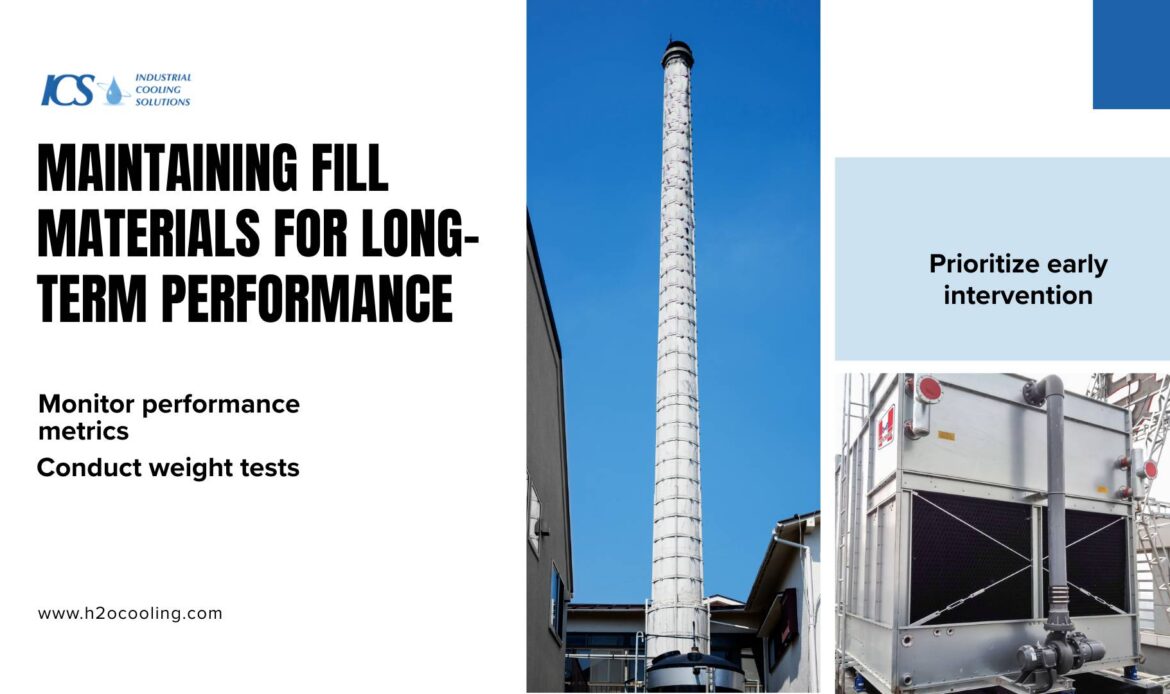
To maintain your cooling tower fill and ensure peak performance, follow these steps:
- Monitor performance metrics: Inspect the fill immediately if the approach temperature creeps up or fan amps rise without a change in load.
- Conduct weight tests: While visual inspections show surface fouling, weighing a fill pack reveals internal fouling that is invisible from the outside.
- Prioritize early intervention: Act quickly to prevent irreversible damage. Once fill becomes brittle or warped, cleaning is no longer an option, and replacement is required.
Conclusion
Cooling tower fill materials function as the primary drivers of thermal performance, energy efficiency, and system reliability. They are not static components but dynamic elements that dictate the success or failure of the heat rejection process. When fill performs correctly, energy costs drop, and mechanical stress decreases.
Understanding the purpose of the fill enables more accurate troubleshooting and smarter long-term planning. Before replacing a motor or blaming the water treatment program, evaluate the condition of the fill. It often holds the answer to your performance challenges.
If your cooling tower is struggling to meet load requirements despite being in good mechanical health, it's time for a professional inspection. For expert cooling tower maintenance, replacement services, or to purchase high-quality cooling tower parts, contact the specialists at Industrial Cooling Solutions today.
Frequently Asked Questions
What are the main types of cooling tower fill materials?
The two main types are film fill, which spreads water into thin sheets for maximum heat transfer, and splash fill, which breaks water into droplets and is better for dirty or high-fouling water.
Which fill material is best for industrial cooling towers?
There is no single best fill. Film fill is ideal for clean water and high efficiency, while splash fill performs better in industrial applications with high solids, oil contamination, or biological growth.
How long do cooling tower fill materials typically last?
Fill lifespan varies by water quality and operating conditions. In clean systems, fill may last 10–15 years, while harsh industrial environments can require replacement in 3–7 years.
Can degraded fill cause high fan amps?
Yes. If fill becomes clogged with scale or debris, it restricts airflow. The fan must work harder to pull air through the resistance, which increases the amperage draw on the motor.
Does fill condition affect water treatment efficiency?
Yes. Fouled fill harbors bacteria and biofilm (like Legionella) that consume biocides, making water treatment chemicals less effective and increasing the cost of chemical programs.