

Cooling towers are critical components in industrial facilities and HVAC systems. They reject heat from processes and equipment, keeping operations running safely and efficiently. But they also come with a significant energy cost.
Large fan motors that power cooling towers consume substantial electricity—and in many facilities, those fans run at full speed around the clock, regardless of actual cooling tower energy efficiency demands.
This constant full-speed operation is a costly problem. Variable speed cooling tower fan technology, powered by Variable Frequency Drives (VFDs), offers a proven solution. By adjusting fan speed to match real-time cooling demand, VFDs eliminate unnecessary energy consumption and deliver measurable financial returns. T
This article explains how VFD cooling tower savings work, the physics behind them, and how facilities can evaluate the return on investment from installing VFDs.
Why Cooling Towers Consume Large Amounts of Energy
Cooling towers transfer heat from industrial processes or HVAC systems into the atmosphere. Hot water from chillers, compressors, or process equipment circulates through the tower, where large fans force air across the water surface, evaporating a portion of the water and releasing heat. The result is cooled water that returns to the process.
The challenge? Those large fan motors are energy-intensive. In many industrial facilities, cooling tower fans rank among the top on-site electricity consumers. Several factors drive that consumption higher than necessary:
- Continuous full-speed operation: Traditional systems run fans at 100% speed regardless of load.
- Low-demand periods: Cooling requirements fluctuate based on production schedules, time of day, and ambient conditions, yet fixed-speed fans do not respond to these changes.
- Seasonal variation: Cooler outdoor temperatures naturally reduce cooling demand, but fixed-speed fans provide no mechanism to reduce output accordingly.
The result is a system that wastes energy every time actual cooling demand falls below maximum capacity—which, for most facilities, is the majority of operating hours.
What Is a Variable Frequency Drive (VFD)?
A Variable Frequency Drive is an electronic device that controls the speed of an AC electric motor by regulating the voltage and frequency of the electrical supply. Rather than allowing a motor to run at its fixed rated speed, a VFD adjusts motor output precisely to match the required load.
How VFD Technology Controls Motor Speed
VFDs provide precise, real-time control over motor performance by adjusting its speed to match the exact load requirements. This is a significant upgrade from standard AC motors, which typically run at a fixed speed determined by the electrical supply's frequency (usually 50 Hz or 60 Hz).
Here’s how VFD technology achieves this control:
- Intercepts Power: The VFD takes the incoming AC electrical supply.
- Converts to DC: It converts this AC signal into a DC signal.
- Inverts Back to AC: The device then inverts the DC signal back to AC, but at a new, precisely controlled frequency.
- Adjusts Motor Speed: By lowering the output frequency, the VFD reduces the motor's speed. By raising it, the motor's speed increases, giving operators fine-grained control.
Fixed-Speed vs. Variable-Speed Cooling Tower Fans
Fixed-speed cooling tower fans operate at one setting: full speed. When cooling demand drops, the fan continues running at 100% capacity, wasting energy on airflow that the system does not need. Variable-speed fans controlled by VFDs respond dynamically.
As cooling demand decreases, the VFD reduces fan speed to match. As demand rises, the VFD increases fan speed accordingly. The result is a system that only consumes as much energy as the process actually requires.
How VFDs Reduce Energy Consumption in Cooling Towers
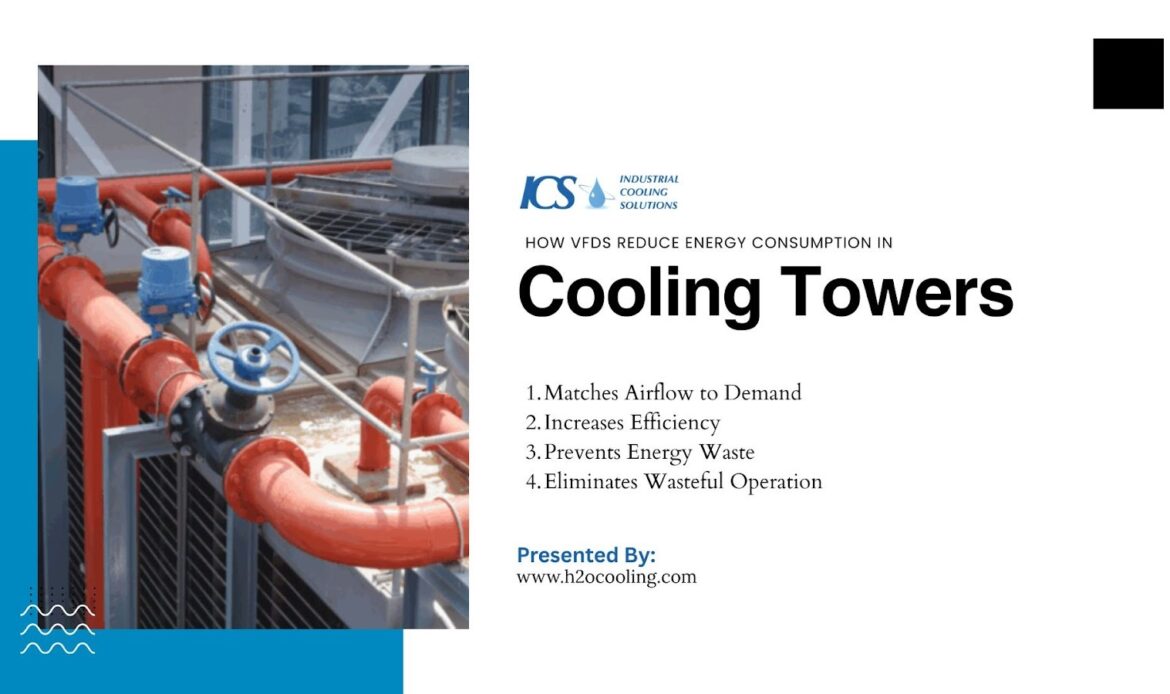
Variable frequency drives (VFDs) optimize cooling tower performance by ensuring the fan motor only uses the energy needed for the current load. This precise control prevents energy waste common in single-speed systems and leads to significant savings.
Here’s how a VFD reduces energy consumption in cooling towers:
- Matches Airflow to Demand: VFDs adjust fan speed based on real-time data from temperature sensors.
- Increases Efficiency: When the water temperature rises above the setpoint, the VFD increases fan speed to provide more cooling.
- Prevents Energy Waste: When the water temperature drops to or below the setpoint, the VFD slows the fan, avoiding over-cooling and reducing power consumption.
- Eliminates Wasteful Operation: This dynamic control gets rid of the constant full-speed operation found in traditional systems, with efficiency further amplified by the physics governing fan power usage.
The Science Behind VFD Cooling Tower Savings
The energy savings produced by VFDs are not linear—they are exponential. This is explained by the Fan Affinity Laws, a set of engineering principles that describe the relationship between fan speed, airflow, and power consumption.
Fan Speed and Airflow Relationship
The first Fan Affinity Law states that airflow changes in direct proportion to fan speed. If fan speed decreases by 20%, airflow decreases by 20%. This relationship is predictable and consistent, making it straightforward to calculate the airflow reduction at any given speed.
Why Power Consumption Drops Rapidly at Lower Speeds
The third Fan Affinity Law describes the relationship between fan speed and power consumption, and this is where VFD savings become compelling. Power consumption changes with the cube of the change in fan speed. This means that a modest reduction in speed produces a dramatic reduction in power draw.
The table below illustrates this relationship clearly:
| Fan Speed | Airflow | Power Consumption |
| 100% | 100% | 100% |
| 80% | 80% | ~51% |
| 60% | 60% | ~22% |
| 50% | 50% | ~12.5% |
Reducing fan speed from 100% to 80% cuts power consumption by nearly half. Reducing it to 60% cuts power consumption to just 22% of full-speed levels. This cubic relationship is the engine behind the substantial cooling tower energy savings that VFDs deliver in real-world installations.
Key Benefits of VFD Cooling Tower Savings
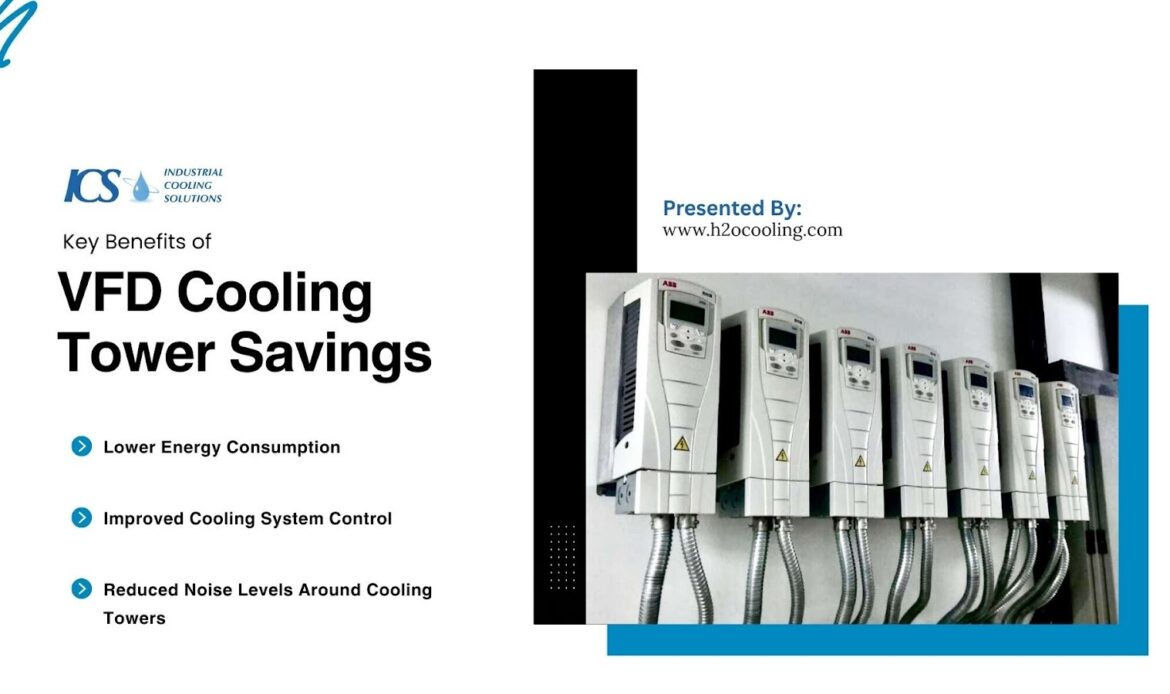
Installing VFDs on cooling tower fan motors produces advantages that extend well beyond reduced electricity bills. What specific outcomes do facilities typically gain?
Lower Energy Consumption
The most immediate benefit is reduced electricity usage. Because cooling towers rarely operate at peak load for extended periods, fans spend most of their operating hours at speeds below 100%. The cubic power law means that even modest speed reductions translate into significant kilowatt-hour savings across an annual operating period.
Improved Cooling System Control
VFDs allow for more precise control over cooling tower operations, directly impacting system stability and efficiency. Unlike fixed-speed fans that cycle on and off, VFDs continuously adjust fan speed. This modulation offers several key advantages for process control.
- Maintains Tighter Temperature Tolerances: VFDs help keep water temperatures consistent, preventing the fluctuations caused by the on/off cycling of fixed-speed fans.
- Eliminates On/Off Cycling: By modulating speed instead of stopping and starting, VFDs provide a smoother, more continuous operation.
- Improves System Stability: The result is more stable process temperatures and enhanced overall system performance.
Reduced Noise Levels Around Cooling Towers
Cooling towers installed near occupied buildings or noise-sensitive areas benefit significantly from VFD control. Fan noise reduces at lower speeds, making VFD-controlled towers considerably quieter during periods of partial load.
For facilities with noise ordinances or community relations considerations, this is a meaningful operational advantage.
How VFDs Reduce Mechanical Stress on Cooling Tower Equipment
Energy savings are one side of the VFD value equation. Equipment protection is the other.
Traditional across-the-line motor starters apply full voltage to the motor instantly at startup. This creates a powerful mechanical shock—high inrush current, sudden torque, and immediate full-speed rotation. Repeated over thousands of start cycles, this stress degrades motor windings, wears belts, strains gearboxes, and shortens equipment life.
VFDs reduce maintenance and equipment wear through a controlled, systematic process:
- Eliminating Hard Starts: Unlike standard motors that apply instant, maximum torque, a VFD replaces "across-the-line" starting with a controlled ramp-up.
- Gradual Torque Application: By increasing speed slowly, the VFD applies torque gently, preventing the sudden mechanical shocks that stretch belts and pit gear teeth.
- Vibration Reduction: This smooth acceleration lowers overall vibration levels across the cooling tower structure.
- Minimizing Structural Fatigue: Reduced vibration leads to significantly less fatigue on fasteners, supports, and fan blades.
- Extending Component Lifespan: With the gearbox and bearings shielded from high-stress loads, the entire system experiences less wear, resulting in a much longer service life.
ASHRAE guidelines for cooling system design emphasize the importance of matching system capacity to actual load conditions. VFDs align directly with this principle, supporting both energy efficiency and equipment reliability objectives outlined in ASHRAE 90.1 and related standards.
Real Example of VFD Cooling Tower Energy Savings
Abstract physics becomes compelling when translated into actual cost data. Consider a mid-sized industrial cooling tower operating in a facility with moderate process loads.
Energy Consumption With Fixed-Speed Cooling Tower Fans
A cooling tower equipped with a fixed-speed fan motor running at full capacity throughout its annual operating period consumes approximately 120,000 kWh per year. At an average electricity rate of $0.12 per kWh, that represents an annual energy cost of $14,400.
Energy Savings After Installing a VFD
After installing a VFD and configuring it for temperature-based control, the same tower—serving the same process load—reduces its annual energy consumption to approximately 70,000 kWh. The results speak clearly:
| System Type | Annual Energy Use | Estimated Energy Cost |
| Fixed-Speed Cooling Tower | 120,000 kWh | $14,400 |
| VFD-Controlled Cooling Tower | 70,000 kWh | $8,400 |
| Estimated Annual Savings | — | $6,000 |
Over five years, that $6,000 annual savings accumulates to $30,000—often exceeding the total cost of the VFD installation. As electricity rates rise, the financial case for cooling tower VFD installation becomes even stronger.
VFD Cooling Tower Savings Comparison Table
| Factor | Fixed-Speed Fan | VFD-Controlled Fan |
| Energy Use | High | Optimized |
| Startup Stress | Severe | Minimal |
| Maintenance Cost | Higher | Lower |
| Temperature Control | Limited | Precise |
| Long-Term ROI | Low | High |
Factors That Determine VFD Savings in Cooling Towers
Not every facility will achieve identical savings. The actual industrial cooling tower energy consumption reduction depends on several site-specific variables.
What factors most directly influence how much a facility saves?
- Motor size and operating hours: Larger motors and longer operating periods increase the total pool of savings available.
- Climate conditions: Facilities in regions with cooler ambient temperatures spend more time at partial load, increasing VFD savings potential.
- Cooling load variability: The wider the swing between peak and average cooling demand, the more opportunity the VFD has to reduce fan speed.
- Electricity cost: Higher electricity rates amplify the financial return of every kilowatt-hour saved.
Facilities with high load variability, long operating seasons, and elevated electricity costs stand to gain the most from cooling tower fan speed control via VFDs. A detailed energy audit of existing systems will provide the most accurate projection of site-specific ROI.
When Installing a VFD Makes the Most Sense
While most cooling tower systems can benefit from variable speed technology, certain operating coive.
The following conditions often indicate strong potential for VFDnditions make VFD cooling tower savings especially substantial. Facilities with high energy consumption and fluctuating cooling demands typically see the fastest return on investment after installing a Variable Frequency Dr implementation:
- Large fan motors: Cooling towers equipped with high-horsepower fan motors consume significant electricity. Reducing fan speed even slightly can produce major energy savings due to the cubic relationship between speed and power consumption.
- Facilities operating 24/7: Industrial plants that run continuously accumulate energy costs throughout the year. In these environments, even small efficiency improvements can translate into thousands of dollars in annual savings.
- Variable cooling loads: Many facilities experience fluctuating heat loads based on production schedules, ambient temperatures, or seasonal changes. VFDs allow fan speed to adjust dynamically, preventing unnecessary full-speed operation.
- High electricity costs: Locations with higher utility rates gain faster financial returns from energy efficiency upgrades. Lowering cooling tower power consumption through intelligent fan speed control can significantly reduce long-term operating expenses.
Common Misconceptions About VFD Cooling Tower Systems
Resistance to VFD adoption often stems from misconceptions rather than legitimate technical or financial barriers.
Myth: VFDs Are Too Expensive
The upfront cost of a VFD installation is real, but it must be evaluated against the full financial picture. Energy savings of 40–60% on fan motor electricity consumption are common in well-designed installations.
When combined with reduced maintenance costs and extended equipment life, the total cost of ownership strongly favors VFDs. Most installations achieve payback periods of one to three years, followed by years of net savings.
Myth: VFDs Are Difficult to Operate
Modern VFDs are sophisticated yet user-friendly. Most units include programmable controllers that automate speed adjustments based on temperature sensors, without requiring constant operator input.
Remote monitoring, fault diagnostics, and integration with building management systems are standard features on commercial-grade drives. For maintenance teams already familiar with motor control equipment, VFDs present a minimal learning curve.
The Bottom Line on VFD Cooling Tower Savings
VFD cooling tower savings represent one of the most financially compelling energy efficiency upgrades available to industrial and commercial facilities. The physics are unambiguous: reducing fan speed by even a modest amount produces dramatic reductions in power consumption.
The financial impact is clear, with potential annual savings in the thousands. Operationally, you'll see improved process control, lower noise, and longer equipment life.
If your facility is still using fixed-speed cooling tower energy efficiency systems, you're losing money every hour. Upgrading to a variable-speed cooling tower fan is a straightforward process, starting with a simple energy audit to model your potential savings.
The case for a cooling tower VFD installation is undeniable. The technology is proven, the savings are substantial, and the payback is fast. Act now to slash operating costs and gain a long-term competitive edge in energy management. Visit H2Ocooling.com to start quantifying your savings and transform your energy consumption today.
.
Frequently Asked Questions
What are VFD cooling tower savings?
VFD cooling tower savings are the energy cost reductions achieved by installing a Variable Frequency Drive (VFD) on a cooling tower fan motor. The VFD matches fan speed to the cooling load, significantly cutting electricity use.
How much energy can a VFD save in a cooling tower?
A VFD can save 30% to 60% of the fan motor's electricity consumption. This often translates to thousands of dollars in annual savings per motor, depending on climate and operating hours.
Are VFDs suitable for all cooling tower systems?
VFDs are suitable for most cooling tower systems using single or two-speed fan motors. A VFD specialist can assess your specific system's compatibility and recommend the right drive.
Do VFDs reduce cooling tower maintenance costs?
Yes, VFDs reduce mechanical stress on motors and components by enabling soft starts and slower operating speeds. This extends equipment life and lowers overall maintenance costs.
How does a VFD control cooling tower fan speed?
A VFD controls fan speed by adjusting the frequency and voltage of the electrical power supplied to the motor. By lowering or increasing the frequency, the VFD changes the motor speed so the fan only produces the airflow required for current cooling conditions.