

Cooling tower asset management helps industrial facilities track every tower from installation to replacement through a clear asset register, condition inspections, maintenance records, and long-term lifecycle planning. A strong program connects asset tracking with inspection findings, spare parts, water treatment history, an overhaul schedule, and future replacement planning.
This approach reduces emergency repairs, improves budget control, protects thermal performance, and helps plant teams make repair, rebuild, upgrade, or replacement decisions before failure disrupts operations.
What Is Cooling Tower Asset Management?
Cooling tower asset management is the structured process of recording, monitoring, maintaining, and planning every cooling tower asset from installation to retirement. It uses asset data, inspections, maintenance history, water treatment records, cost trends, and risk scores to guide overhaul, repair, upgrade, and replacement decisions.
The core idea is to treat each tower as a long-term investment with a known life, not a fixed object that runs until it breaks.
Asset Management vs Maintenance
Maintenance and asset management often get confused. They work together, but they are not the same thing. Knowing the difference helps teams build the right systems and set the right goals.
The key distinctions include:
- Maintenance fixes and services the tower: It cleans, repairs, lubricates, and replaces worn parts.
- Asset management decides how the tower should perform: It sets the strategy across the full life of the asset.
- Maintenance is task-based: Work happens by ticket, schedule, or breakdown.
- Asset management is strategy-based: Decisions follow cost, risk, and long-term value.
- The best program combines both: Strong maintenance feeds clean data into smart asset decisions.
Why Cooling Towers Need Lifecycle Planning
Cooling towers operate in wet, corrosive, and high-load environments. Parts do not age at the same rate. Fill may foul before the structure weakens. Gearboxes may need service before motors fail. Water quality may shorten the life of basins, nozzles, and heat transfer surfaces.
Lifecycle planning helps teams schedule work before problems turn into shutdowns. It also helps managers prepare capital budgets before the tower reaches end-of-life condition.
Why an Asset Register Is the Starting Point
An asset register is the master record of every cooling tower asset and major component. Without it, teams rely on memory, scattered invoices, or old inspection reports. That gap leads to missed work and surprise failures.
A well-built register serves four jobs at once: maintenance, procurement, compliance, and budgeting. When the data lives in one place, every team makes faster and better decisions.
Before you can track anything, you need to know what you own and what it is made of. A useful register captures both tower-level and component-level detail.
A complete cooling tower asset register should include:
- Asset ID and location: A unique tag plus the tower and cell number.
- Manufacturer and model: Brand, model, and serial number for parts matching.
- Installation date and capacity: Startup date and design thermal capacity.
- Tower and material details: Tower type, structural material, and basin material.
- Major components: Fill media type, fan type and size, motor horsepower, gearbox details, nozzle type, and drift eliminator type.
- Service history: Inspection records, major repairs, and replacement parts.
- Support data: Water treatment provider, warranty terms, and criticality rating.
- Forward data: Expected replacement year and known risk notes.
Why Component-Level Data Matters
A cooling tower is not one simple asset. It is a system of components that fail at different times.
Component-level records help teams plan spare parts, schedule overhauls, compare recurring failures, and avoid replacing the whole tower when only one system needs renewal. Fill, fans, motors, gearboxes, nozzles, drift eliminators, and basins all deserve their own history.
Asset Tracking for Cooling Tower Components
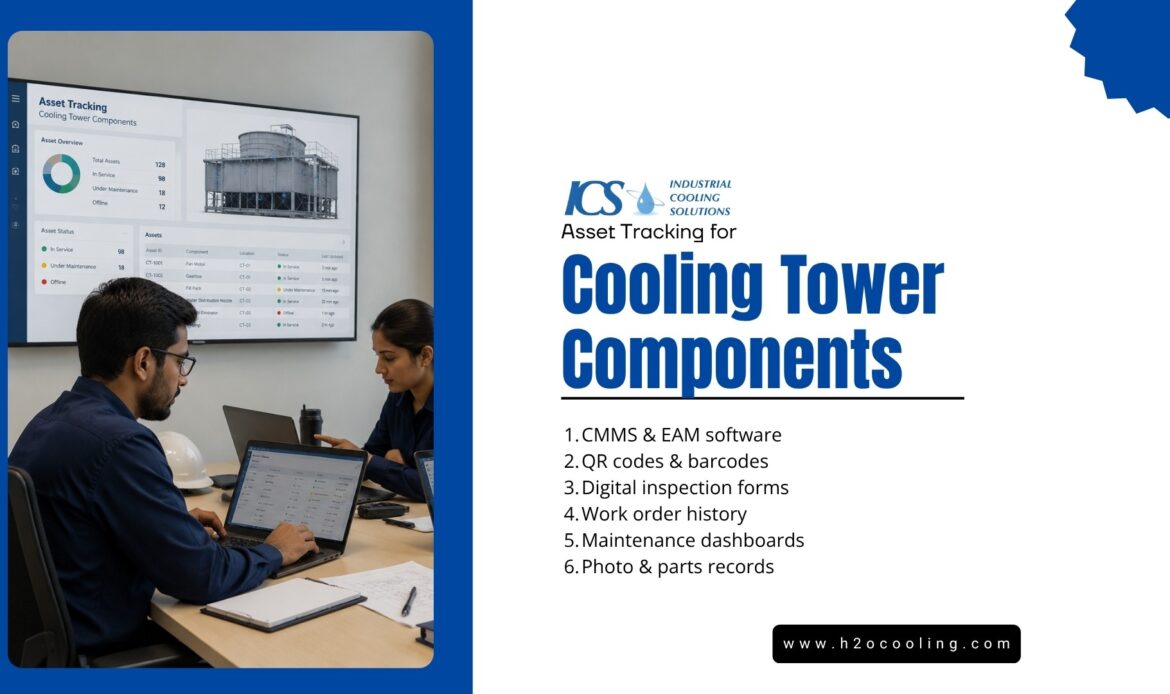
Asset tracking helps teams know what equipment they own, where it sits, what condition it is in, when it received service, and what work comes next. This matters more when a facility has multiple towers, several cells, or operations across Thailand and Asia.
Digital tracking reduces missed work and improves accountability. Modern CMMS systems help teams centralize maintenance information, work orders, inventory, and reporting. SAP describes a CMMS as software that helps companies centrally manage maintenance information and improve equipment uptime.
Useful asset tracking methods include:
- CMMS and EAM software: Central platforms that hold asset records and work orders.
- QR codes and barcodes: Quick scans that pull up a component's full history.
- Digital inspection forms: Standard checklists that capture findings in the field.
- Work order history: A running log of every repair and service event.
- Maintenance dashboards: Visual views of open work, trends, and overdue tasks.
- Photo and parts records: Image proof and live spare parts inventory.
- Mobile technician updates: Real-time entries from the deck, not days later.
A CMMS-based system can centralize the asset register, lifecycle stages, KPIs, and repair-versus-replace data. That single view helps maintenance teams make better asset decisions with less effort.
What Asset Tracking Should Show
Asset tracking should answer practical questions. It should not only store names and serial numbers.
Effective Cooling Tower Asset Management relies on strong records. A strong record should show the current condition, last and next inspection dates, open work orders, repeated failures, repair cost history, replaced parts, downtime events, safety notes, compliance issues, and replacement priority.
Cooling Tower Lifecycle Planning Stages
Lifecycle planning manages the tower from design and procurement through operation, overhaul, replacement, and retirement. Each stage carries its own asset management focus and its own data needs.
The asset lifecycle generally covers planning, acquisition, operation, maintenance, and eventual disposal or replacement. Mapping these stages helps you control cost and protect asset value over time.
The table below connects each stage to what happens and where your asset focus should sit. Use it to check that no stage gets ignored.
| Lifecycle Stage | What Happens | Asset Management Focus | Typical Owner | Expert Tip |
| Planning | Define capacity, materials, and access | Choose design for long-term value | Engineering | Plan for maintenance access early |
| Acquisition | Purchase tower, parts, and support gear | Record specifications and warranties | Procurement | Log serial numbers at delivery |
| Commissioning | Test performance and set baseline | Capture design and startup data | Project team | Save the baseline thermal report |
| Operation | Run the tower under normal load | Track performance and water treatment | Operations | Watch approach temperature trends |
| Maintenance | Inspect, clean, repair, replace | Build service history and condition trends | Reliability | Update records after every job |
| Overhaul | Rebuild systems or upgrade parts | Extend useful life and restore performance | Reliability | Bundle related work into one outage |
| Replacement | Replace tower or major cells | Use cost, condition, and risk data | Capital planning | Compare lifecycle cost, not just price |
| Retirement | Decommission or dispose of asset | Close records and plan next cycle | Asset manager | Capture lessons for the next tower |
How to Build a Cooling Tower Overhaul Schedule
An overhaul schedule helps teams plan major maintenance before tower condition reaches failure. It should pull from inspection findings, component age, water quality, performance data, and repair history.
A calendar-based approach alone will not work. Effective cooling tower asset management requires a schedule that reflects real-world conditions. A tower with harsh water, high load, or dirty air may need work far earlier than a lightly loaded tower next to it.
A strong overhaul schedule should include:
- Annual structural inspection: Check frame, supports, and access platforms.
- Basin work: Cleaning and a coating review for corrosion.
- Fill and eliminator checks: Fill media inspection and drift eliminator condition.
- Mechanical service: Fan blade inspection, gearbox oil analysis, and motor testing.
- Water path review: Nozzle cleaning and replacement plus water distribution checks.
- Performance testing: Vibration analysis and a thermal performance test.
- Program review: Water treatment program review and a major component replacement window.
Replacement Planning: When to Repair, Rebuild, or Replace
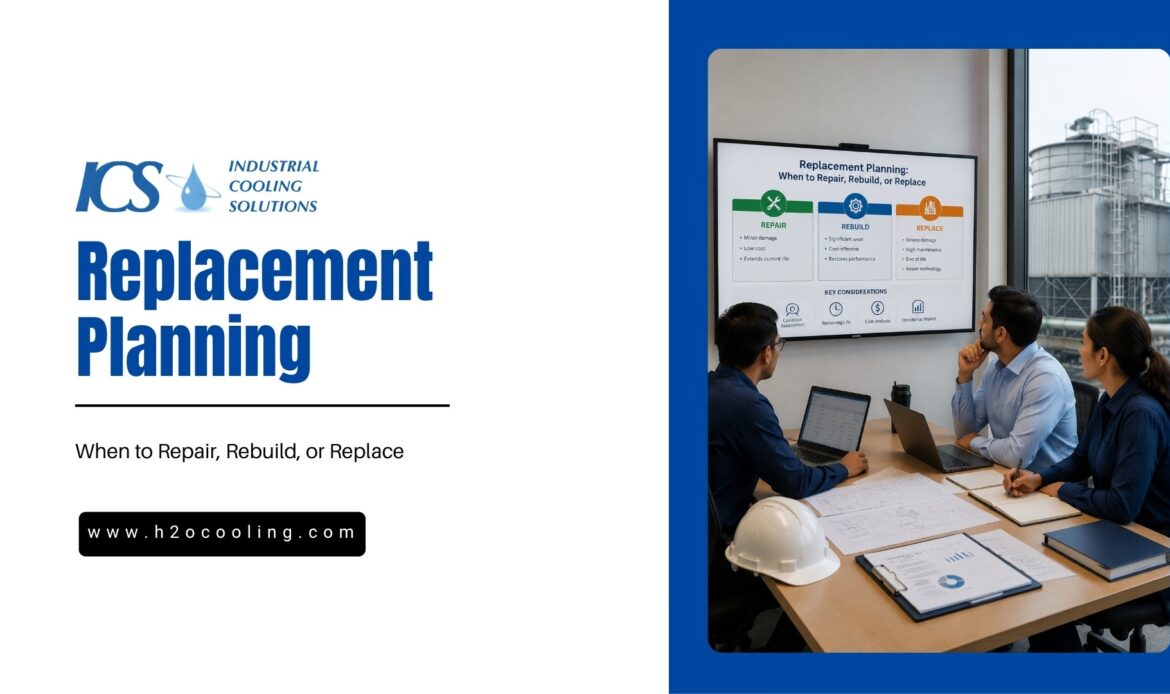
Replacement planning uses asset condition, lifecycle cost, downtime risk, repair history, and performance demand to find the right time to replace a tower. Good planning replaces a tower on your schedule, not on the tower's schedule.
Asset replacement planning aims to identify when assets should be replaced to optimize cost, reduce downtime, and keep operations efficient. The decision usually falls into one of three paths.
When Repair Makes Sense
Repair is the lowest-cost path when the core asset remains healthy. It works best when the damage is local and the structure is sound.
Repair often makes sense when:
- The structure is sound: No major frame or basin damage exists.
- Damage is limited: Only replaceable parts have failed.
- Performance still holds: The tower meets current thermal demand.
- Cost stays low: Repair cost is small next to replacement.
- Parts remain available: No obsolete component blocks the fix.
When Rebuild or Overhaul Makes Sense
A rebuild fits when several systems need renewal but the tower is worth saving. It extends service life without the full cost of a new tower.
Rebuild or overhaul often makes sense when:
- Multiple parts need renewal: Several components have reached end of life.
- Components limit performance: Fill, nozzles, fans, or eliminators drag down output.
- You need more service life: The asset must run several more years.
- The structure can support upgrades: The frame and basin remain strong.
- Replacement is not yet justified: The financial case for a new tower is not there.
When Replacement Makes Sense
Replacement becomes the smart choice when repair costs climb and risk grows. At a certain point, pouring money into an old tower stops paying off.
Replacement often makes sense when:
- Structural damage is severe: Frame or basin failure threatens safety.
- Repairs repeat every season: The tower never stays fixed for long.
- Performance falls short: Thermal output no longer meets process demand.
- Operating cost stays high: Energy or water waste keeps climbing.
- Parts are obsolete: Critical components are no longer available.
- Repair nears replacement value: The cost gap no longer justifies repair.
Cooling Tower Condition Assessment and Risk Scoring
A simple scoring model can help turn scattered observations into a clear priority list for effective Cooling Tower Asset Management.
This process is crucial for multi-cell towers and plants running several cooling systems at once, helping teams decide which components need attention first.
| Factor | What to Check | Risk Signal | Inspection Method | Priority Impact |
| Thermal performance | Approach, range, cold water temperature | Higher temperature than expected | Performance test | High |
| Mechanical condition | Fan, motor, gearbox, vibration | Repeated faults or abnormal readings | Vibration and oil analysis | High |
| Water distribution | Nozzles, spray pattern, flow balance | Dry spots or uneven cooling | Visual inspection | Medium |
| Structural condition | Basin, frame, supports, platforms | Corrosion, cracks, leaks | Structural inspection | High |
| Water treatment | Scaling, biofilm, corrosion, logs | Poor control or missing records | Water testing | Medium |
| Reliability | Downtime and emergency repairs | Frequent unplanned work | Work order review | High |
| Parts availability | Critical components and lead time | Long delays or obsolete parts | Supply chain review | Medium |
Asset Management KPIs for Cooling Towers
KPIs show whether your asset program actually works. They turn effort into numbers leaders can review. Track these metrics to measure progress and spot problems early.
Useful cooling tower KPIs include:
- Open work orders: Total active jobs across all towers.
- Preventive maintenance completion rate: Percentage of planned work done on time.
- Emergency repair count: Unplanned jobs over a set period.
- Downtime hours: Total tower downtime, planned and unplanned.
- Cost per tower cell: Spend tracked at the cell level.
- Repair cost by component: Where your repair budget actually goes.
- Inspection compliance rate: Inspections done against inspections due.
- Mean time between failures: Average run time before a fault.
- Fill, fan, and gearbox trends: Condition scores and fault patterns.
- Water treatment compliance: Treatment targets met over time.
- Energy use per cooling load: Efficiency of the cooling work delivered.
- Replacement risk score: A rolling view of which towers need capital soon.
How H2ocooling Can Support Your Asset Program
A solid asset plan needs field expertise behind it. The team at H2ocoling (Industrial Cooling Solutions) can help facilities inspect tower condition, document major components, plan maintenance, set repair priorities, schedule overhauls, source parts, and decide when an upgrade or replacement makes sense.
Support that fits naturally into an asset program includes:
- Cooling tower inspections: Condition assessments that feed your asset register.
- Cooling tower parts: Factory-authorized, OEM parts for any brand, sourced fast.
- Component support: Fill media replacement plus gearbox, fan, motor, and nozzle service.
- Thermal upgrades: Design improvements that boost efficiency and profitability.
- Cooling tower replacement: Custom counterflow and crossflow designs in wood, FRP, and concrete.
- Engineering and procurement support: American-based engineering paired with local field service.
Final Thoughts
Cooling tower asset management turns maintenance into a planned lifecycle system. An asset register gives teams one reliable source of tower and component data. Asset tracking connects inspections, repairs, spare parts, photos, and work orders.
Strong lifecycle planning helps teams manage cost from commissioning to replacement. A practical overhaul schedule reduces emergency repair risk. Clear replacement planning helps facilities avoid last-minute capital decisions. H2ocooling.com can support inspections, maintenance, upgrades, parts, and replacement planning across Thailand and Asia.
Frequently Asked Questions
What is cooling tower asset management?
Cooling tower asset management is the process of tracking, maintaining, evaluating, repairing, upgrading, and replacing cooling towers across their service life. It uses asset records, inspection data, maintenance history, water treatment logs, cost trends, and risk scores to guide decisions. The goal is to reduce downtime, control lifecycle cost, and plan repairs or replacement before failure happens.
What should a cooling tower asset register include?
A cooling tower asset register should include asset ID, location, manufacturer, model, serial number, installation date, design capacity, tower type, structural material, fill type, fan, motor, gearbox, nozzles, drift eliminators, inspection history, repair records, warranty details, water treatment provider, criticality rating, and expected replacement year. Component-level details make maintenance and replacement planning easier.
How does lifecycle planning help cooling towers last longer?
Lifecycle planning helps teams manage a cooling tower from installation to replacement. It connects inspections, maintenance, repairs, upgrades, and budget planning into one long-term strategy. This prevents teams from waiting until failure occurs.
What is a cooling tower overhaul schedule?
A cooling tower overhaul schedule is a planned timeline for major maintenance and component renewal. It may include fill media replacement, basin repair, fan inspection, gearbox service, nozzle replacement, drift eliminator replacement, structural repair, and thermal performance review. The schedule should use both calendar intervals and condition data from inspections, water treatment records, and performance trends.