

Proper cooling tower manufacturer selection requires evaluating technical capabilities, operational costs, and verified performance data. You must prioritize partners who offer independent CTI certification over those who rely on theoretical estimates. A strong supplier ensures you get durable materials and smart architecture for predictive maintenance.
By focusing on the total cost of ownership rather than the lowest bid, we help you avoid significant energy penalties. You secure reliable local service support and customized thermal profiles. Demand binding delivery schedules to guarantee your system runs smoothly during peak heat loads.
Our goal at Industrial Cooling Solutions (ICS) is to provide you with a rigorous, engineering-led framework. You will learn how to evaluate manufacturers based on verifiable data, rather than polished marketing brochures.
1. The Manufacturer Due Diligence Matrix
You must properly vet your supplier to meet strict 2026 industrial requirements. Use these three pillars to evaluate potential partners.
CTI Performance Validation
You must demand an independent CTI (Cooling Technology Institute) STD-201 certification. Never rely solely on a manufacturer offering theoretical performance data. Independent certification guarantees the equipment will perform exactly as promised under your specific design conditions.
Supply Chain Sovereignty
Investigate whether the manufacturer actually controls their core technology. Do they engineer their own fans, gearboxes, and drift eliminators? Avoid companies that simply operate as box-moving assemblers. Manufacturers who own their supply chain provide better quality control and faster replacement parts.
Local Service Ecosystem
A manufacturer providing only remote support acts as a severe liability. You must prioritize partners who maintain a certified service network within four to six hours of your site. Rapid deployment prevents minor mechanical issues from escalating into complete operational shutdowns.
2. Technical Capabilities: Designing for "Future-Proofing."
Prevent premature equipment replacement by demanding specific technical capabilities in your Request for Quotation (RFQ).
Sustainability-Ready Materials
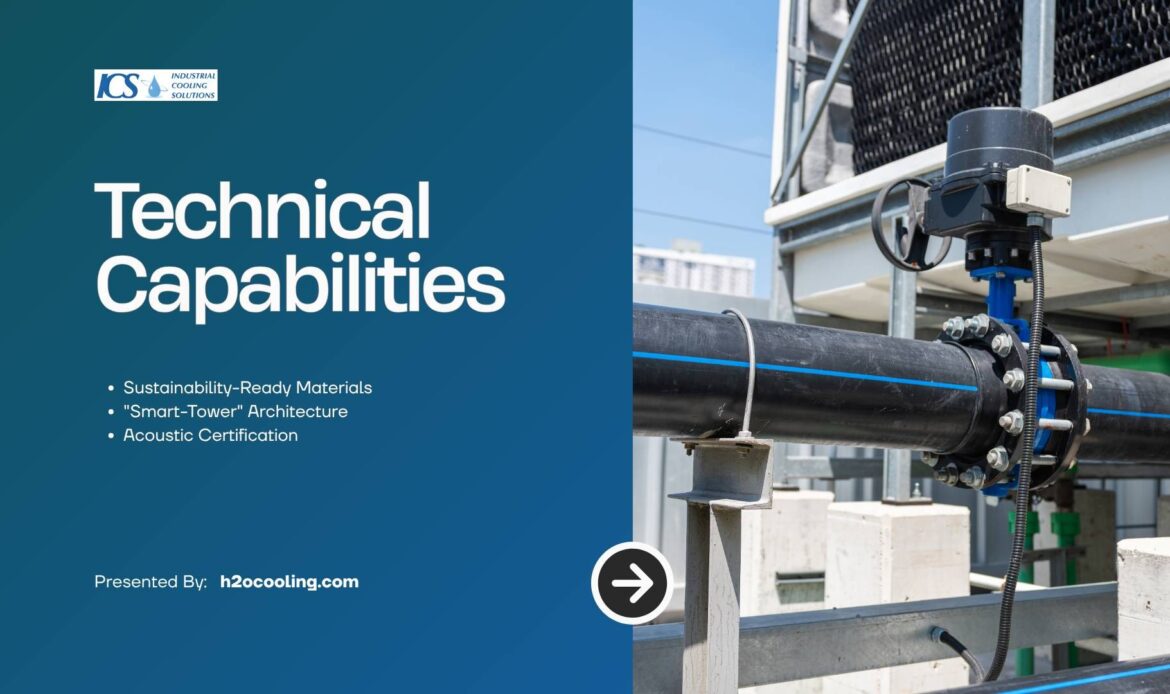
Environmental regulations grow stricter every year. Ask manufacturers if they offer PFAS-free PVC fill media and 316 Stainless Steel or Fiberglass Reinforced Plastic (FRP) construction. Securing these materials remains crucial for avoiding future environmental, social, and governance (ESG) liabilities.
"Smart-Tower" Architecture
Modern industrial facilities require intelligent infrastructure. Demand built-in vibration ports, IoT-ready sensor mounts, and Building Management System (BMS) compatible controllers as standard features. This architecture enables predictive maintenance and prevents catastrophic failures.
Acoustic Certification
Noise pollution represents a significant legal risk for industrial sites in 2026. You must require third-party certified sound-power levels embedded directly in your design specifications.
3. Cooling Tower Manufacturer Selection Table
Use this evaluation criteria matrix to differentiate between a low-bid vendor and a strategic partner.
| Evaluation Criteria | "Legacy" / Low-Bid Vendor | "Tier 1" Strategic Partner (ICS Standard) |
| Thermal Performance | Manufacturer-claimed only | Independent CTI Certified Data |
| Material Longevity | Galvanized Steel (High corrosion risk) | FRP / 316 Stainless Steel (Long-life) |
| Control Logic | Basic BMS / PID (Reactive) | IoT-Ready / AI-Predictive (Agentic) |
| Service & Support | Sub-contracted third-party | Direct Factory-Certified Engineers |
| Compliance Support | Minimal (Owner responsibility) | ASHRAE 188 / ESG Reporting Guidance |
4. Understanding the Total Cost of Ownership
The lowest upfront price frequently leads to the most expensive operational path. You must understand the hidden costs associated with cheap procurement.
The Energy Penalty
A cooling tower that underperforms thermally requires your chillers and compressors to work much harder. A mere 5 percent thermal performance gap over ten years creates an energy penalty that completely dwarfs the initial cheap purchase price.
The Maintenance Burden
Factor in the availability and cost of replacement parts. Low-bid manufacturers often trap buyers into purchasing expensive, factory-only proprietary spares. Strategic partners design systems that utilize accessible, standard components to keep maintenance costs low.
Regulatory Liability
Evaluate the support the manufacturer provides for ASHRAE 188 compliance. Determine if their equipment design allows your maintenance team to easily clean, inspect, and digitally document the system.
5. Procurement Red Flags to Avoid
Watch for these warning signs during your evaluation process. If you spot them, you should walk away.
- Lack of Industry-Specific References: The manufacturer must prove their equipment performs in your specific thermal and mineral profile. If they cannot provide five years of operational data for similar applications, you are taking a massive gamble.
- Opaque Lead Times: Supply chain volatility remains high in 2026. You must demand binding delivery schedules. Ensure your contract includes liquidated damages clauses for missed delivery dates.
- "One-Size-Fits-All" Engineering: The manufacturer must offer a customized thermal profile based on your site's peak wet-bulb temperature. If they refuse, they are selling you a standard unit that will likely underperform during peak heat loads.
Conclusion: Selecting for Certainty
The right cooling tower manufacturer treats your equipment as a critical, data-driven revenue generator. When you make your cooling tower manufacturer selection with a focus on engineering rigor and long-term reliability, you protect your operational budget for decades.
At Industrial Cooling Solutions, we leverage our independent engineering expertise to protect your investment. We ensure your selection process relies entirely on verifiable data and long-term Return on Investment (ROI).
Do you need an objective audit of your current vendor shortlist? Contact Industrial Cooling Solutions today to schedule your comprehensive 2026 Vendor Capability & Design Audit.
Frequently Asked Questions
How do I choose the best cooling tower manufacturer?
Selecting the right cooling tower manufacturer requires moving beyond initial price tags to evaluate long-term reliability. We recommend checking their supply chain control and local service capabilities. A strong partner engineers their own core components and provides factory-certified support near your facility. This approach minimizes downtime and prevents minor mechanical issues from causing expensive operational shutdowns.
What are the key 2026 industrial requirements for cooling systems?
Modern facilities face stricter regulations, making 2026 industrial requirements crucial for your procurement strategy. You must prioritize equipment with smart-tower architecture, including IoT-ready sensors and advanced building management system controls. Additionally, verified acoustic compliance helps you avoid new legal noise pollution risks. Meeting these standards ensures your infrastructure remains resilient, efficient, and legally compliant for decades.
Why is independent CTI certification important for new equipment?
Independent CTI certification guarantees that a cooling tower performs exactly as the manufacturer promises under your specific site conditions. You should never rely on theoretical thermal performance claims. When equipment carries the Cooling Technology Institute STD-201 validation, you secure verifiable data. This protects your investment by ensuring the system handles your peak heat loads without wasting energy.
How does sustainability impact cooling tower design choices?
Stricter environmental rules make sustainability a mandatory focus for any new installation. We advise requesting PFAS-free materials and durable metals like 316 stainless steel to prevent premature corrosion. Upgrading to these eco-friendly, long-lasting materials helps you avoid future environmental liabilities while meeting corporate governance goals. Sustainable designs ultimately reduce water waste and lower your carbon footprint significantly.
How can I reduce the total cost of ownership for cooling towers?
You lower the total cost of ownership by looking past the initial bid and analyzing long-term operational expenses. A unit that underperforms thermally forces your entire system to work harder, creating a massive energy penalty. You can save money by selecting equipment that uses standard replacement parts rather than expensive proprietary spares, keeping your maintenance budget predictable and controlled.