

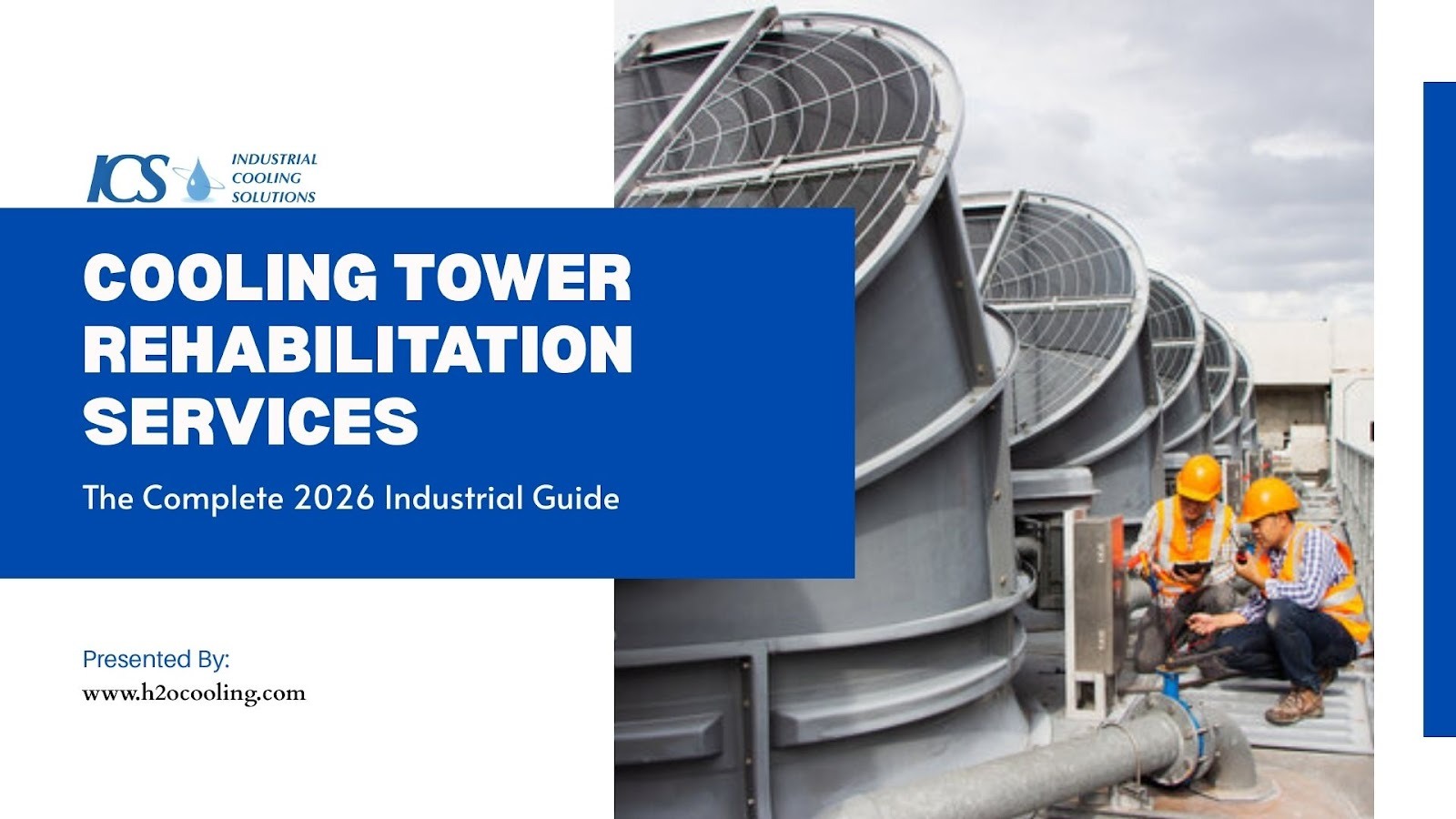
Cooling towers are the workhorses of industrial infrastructure, regulating heat across power plants, data centers, and manufacturing facilities. They often run for years without a break, but this constant use leads to aging. Components corrode, systems degrade, and efficiency drops.
When that happens, cooling tower rehabilitation services become essential. Not a patch job. Not a full teardown. A comprehensive, engineered restoration that brings aging systems back to peak performance while extending their operational lifespan by decades.
Industrial cooling tower restoration has become a top priority for facility managers in 2026. Rising energy costs, stricter environmental regulations, and aging infrastructure have made large-scale rehabilitation not just a smart decision—but a necessary one.
This guide covers everything you need to know about professional cooling tower rehabilitation services, from warning signs and cost factors to compliance requirements. Learn about the full cooling tower refurbishment process, including which components are replaced during a major overhaul, and see how industrial cooling tower restoration protects your operations and budget.
What Are Cooling Tower Rehabilitation Services?
Cooling tower rehabilitation services refer to the comprehensive structural and mechanical restoration of an existing cooling tower system. The objective is to return the system to full operational integrity—or better—without replacing the entire structure.
Rehabilitation is much more than a quick fix. The scope of work can include:
- Structural reinforcement
- Mechanical overhauls
- Corrosion protection
- Water distribution system restoration
- Technology modernization
Depending on the tower's condition, rehabilitation might involve partial disassembly, complete component replacement, and full recommissioning.
The main benefit of rehabilitation is extending the system's life. A well-executed project can add 20 to 30 years to a cooling tower's operational lifespan, making it a high-return investment.
Rehabilitation vs Routine Maintenance
While maintenance, repair, and rehabilitation are often used interchangeably, they represent fundamentally different scopes of work.
- Routine maintenance is preventive. It involves scheduled inspections, lubrication, minor adjustments, and cleaning to keep a functioning system operating correctly.
- Repair is reactive and component-level. A bearing fails, a nozzle clogs, or a motor trips—and the specific component is fixed or replaced. The broader system structure is not assessed or addressed.
- Rehabilitation is a large-scale restoration and upgrade. It addresses accumulated deterioration across structural, mechanical, and operational systems simultaneously. It is planned, engineered, and executed as a major project—not a routine task.
When Does a Cooling Tower Need Major Rehabilitation?
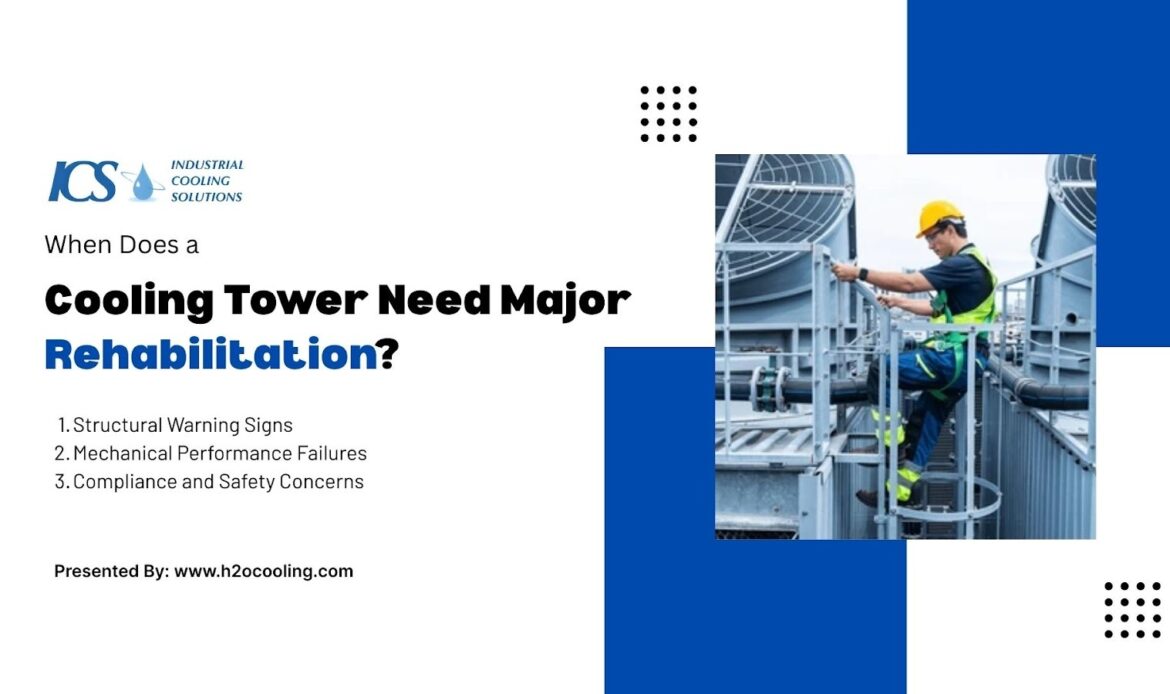
Most facility managers recognize maintenance and repair needs quickly. But major rehabilitation is often deferred until conditions become critical. Understanding the specific triggers helps decision-makers act before failure occurs.
Structural Warning Signs
Structural warning signs are often visible, but they are easy to underestimate. What appears to be surface rust or minor cracking can indicate deeply compromised integrity.
Key structural warning signs include:
- Severe corrosion on steel beams, fasteners, or basin walls that has progressed beyond the surface layer
- Cracked or spalled basins that compromise water containment and structural load distribution
- Frame instability, including visible deflection, shifting, or misalignment in the tower's primary support structure
- Advanced wood rot or composite degradation in older towers using non-metallic structural elements
Mechanical Performance Failures
Performance degradation does not always appear suddenly. It accumulates over time, masking itself as a minor inefficiency until it becomes a critical operational problem.
These mechanical failure indicators signal that rehabilitation is overdue:
- Persistent vibration that does not respond to standard balancing or alignment procedures
- Motor burnout patterns that recur repeatedly, indicating underlying misalignment or overloading
- Gearbox failures are characterized by elevated operating temperatures, oil contamination, or unusual noise
- Fan assembly imbalance resulting in uneven airflow distribution and accelerated bearing wear
Compliance and Safety Concerns
Regulatory pressure is intensifying. Facilities operating with outdated cooling tower configurations face increasing scrutiny from both industry bodies and federal agencies.
Critical compliance-related triggers for rehabilitation include:
- Systems that no longer meet current OSHA safety standards for industrial equipment operation
- Towers presenting elevated Legionella proliferation risks due to water stagnation, biofilm accumulation, or inadequate treatment infrastructure
- Configurations that violate environmental discharge regulations, particularly regarding blowdown water chemistry and thermal discharge limits
Common Structural and Mechanical Failures
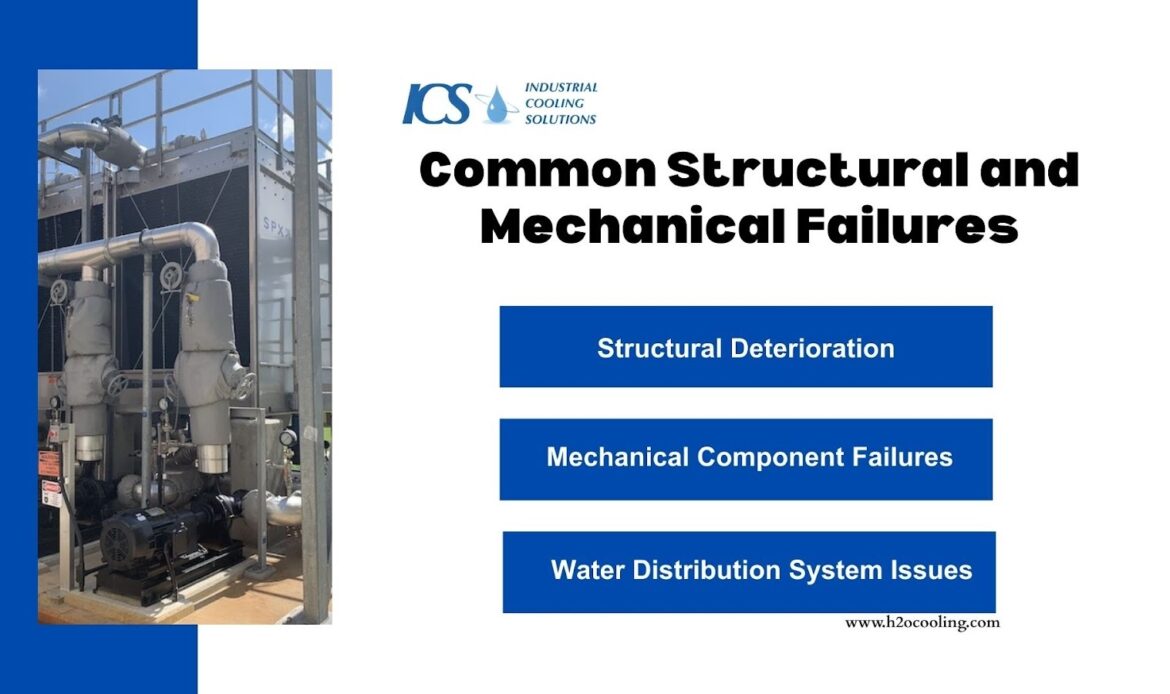
Understanding the specific points of failure in a cooling tower is crucial for effective maintenance. By identifying why and where a system is breaking down, maintenance teams and engineering specialists can apply targeted and cost-effective rehabilitation strategies.
Structural Deterioration
Steel and concrete do not last forever under continuous industrial conditions. What are the structural failure modes that most frequently force major rehabilitation?
The most common forms of structural deterioration include:
- Rusted and compromised steel beams that have lost cross-sectional area due to corrosion, reducing load-bearing capacity
- Foundation damage, including settling, cracking, or erosion of the concrete base supporting the tower's full operational weight
- Basin erosion and delamination, which create water loss, contaminant ingress, and progressive structural weakening
- Corrosion of connection hardware, including bolts, brackets, and welds that hold primary structural components together
Mechanical Component Failures
Mechanical systems operate under continuous thermal, vibrational, and chemical stress. Over time, even robust components reach the end of their service life.
Common mechanical failures requiring attention during rehabilitation include:
- Fan blade cracking or delamination, which creates imbalance, reduces airflow efficiency, and poses safety hazards
- Bearing wear across fan shaft assemblies and motor mounts, leading to misalignment and accelerated component degradation
- Drive shaft misalignment, causing vibration, increased mechanical load, and premature gearbox failure
Motor alignment services and drive shaft replacement are standard inclusions in a full mechanical overhaul, addressing both immediate failures and underlying causes.
Water Distribution System Issues
The water distribution system is often the least visible and most neglected aspect of cooling tower performance. When it fails, the entire thermal exchange process is compromised.
Common water distribution failures include:
- Clogged or worn spray nozzles that create uneven water distribution across the fill media
- Uneven water flow resulting from distribution header damage or basin level imbalance
- Scaling and biological buildup within pipes, nozzles, and distribution trays that reduce flow rate and promote Legionella growth
Repair vs Rehabilitation vs Replacement
Not every problem demands a full rehabilitation. Equally, not every problem can be addressed with a simple repair. Matching the solution to the severity of deterioration is critical for cost-effective decision-making.
Minor Repairs
Minor repairs address isolated, component-level failures in an otherwise sound system. They are cost-effective short-term fixes appropriate when the surrounding structure and mechanical systems remain in good operating condition.
Examples of minor repairs include:
- Replacing a single nozzle set
- Repairing a localized basin crack
- Servicing an individual motor bearing
These interventions are fast, low-cost, and minimally disruptive, but they do not address systemic deterioration.
Major Rehabilitation
Major rehabilitation is the appropriate response when deterioration is widespread, performance has declined significantly, or compliance requirements demand comprehensive upgrades.
It delivers a structural and mechanical overhaul that addresses root causes—not just symptoms. The cost savings compared to full replacement are substantial. A comprehensive rehabilitation typically costs 40 to 60 percent less than installing a new cooling tower of equivalent capacity, while delivering comparable performance and lifespan outcomes.
Full System Replacement
Full system replacement becomes necessary when the existing structure is beyond economic repair. This occurs when foundational damage is irreparable, when structural corrosion has compromised primary load-bearing elements beyond reinforcement, or when a facility's thermal load requirements have changed so significantly that the existing tower footprint cannot be adapted.
Replacement carries the highest capital expense but is sometimes the only viable path forward.
| Decision Factor | Minor Repair | Major Rehabilitation | Full Replacement |
| Structural Integrity | Sound | Compromised but repairable | Irreparable |
| Mechanical Condition | Isolated failure | Widespread degradation | Obsolete or failed |
| Cost Range | Low | Moderate | High |
| Expected Lifespan After Work | 2–5 years | 20–30 years | 30+ years |
| Downtime Required | Minimal | Planned shutdown | Extended |
Step-by-Step Cooling Tower Rehabilitation Process
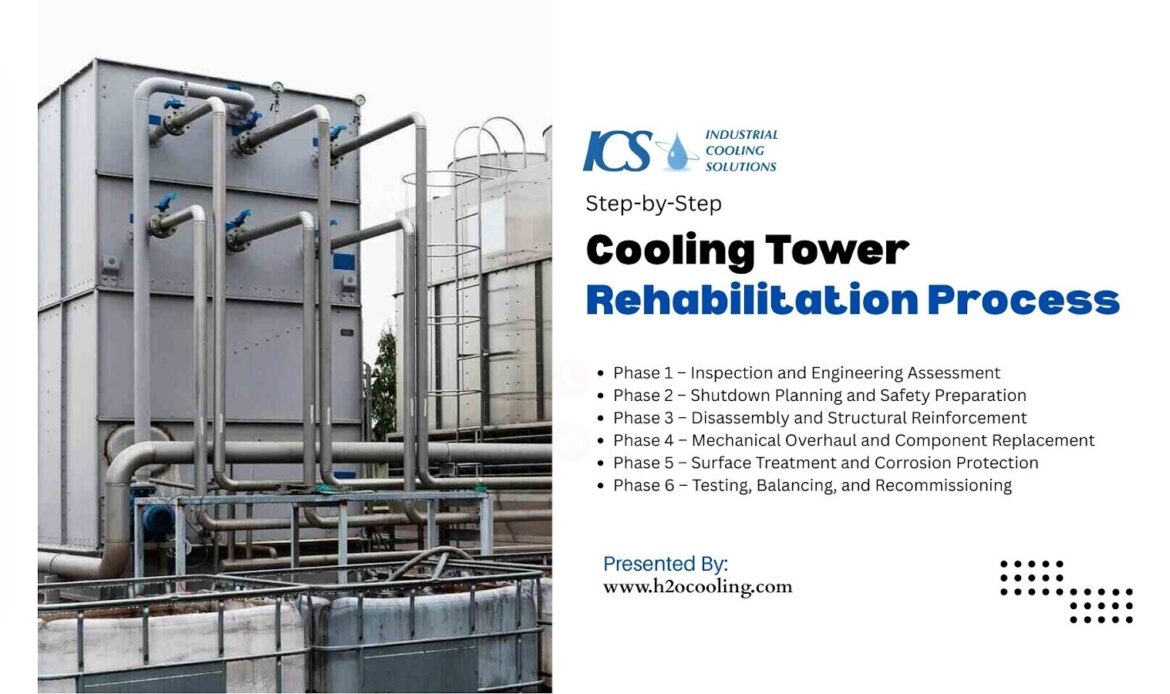
A successful rehabilitation follows a structured, phased process. Each phase builds on the last, ensuring that no step is rushed and that the recommissioned system meets or exceeds original specifications.
Phase 1 – Inspection and Engineering Assessment
Every effective rehabilitation begins with a rigorous engineering assessment. What is the actual condition of the system, and what exactly needs to be done?
This phase includes:
- Structural evaluation using visual inspection, non-destructive testing, and load analysis
- Performance testing to quantify thermal efficiency, airflow output, and water distribution uniformity
- Risk analysis identifying safety hazards, compliance gaps, and failure probability across all system components
The assessment produces a detailed engineering report that forms the foundation for all subsequent phases.
Phase 2 – Shutdown Planning and Safety Preparation
Rehabilitation requires a controlled shutdown. Poor planning at this stage leads to extended downtime and costly production disruption.
This phase involves:
- Downtime coordination with facility operations teams to schedule rehabilitation around production cycles
- Safety permits and work authorizations, including confined space entry permits, hot work permits, and lockout/tagout procedures
- Compliance checks confirming that all planned work aligns with current OSHA, EPA, and local regulatory requirements
Phase 3 – Disassembly and Structural Reinforcement
With the tower safely shut down and isolated, physical rehabilitation work begins. This is where the engineering assessment translates into action.
Key activities include:
- Removing damaged structural components, including corroded beams, degraded fill media, and failed mechanical assemblies
- Reinforcing steel supports using engineered replacement sections, welded gussets, or composite strengthening systems
- Basin repair and restoration, addressing cracks, delamination, and erosion through patching, resurfacing, or full liner installation
Cooling tower structural repair at this stage sets the foundation for every subsequent phase of work.
Phase 4 – Mechanical Overhaul and Component Replacement
Structural integrity restored, attention shifts to the mechanical systems that drive performance. This phase encompasses faH3: n assembly replacement, motor installation, and drive system restoration.
Key activities include:
- Motor, gearbox, and fan assembly replacement with components sized and specified for the tower's thermal and airflow requirements
- Drive shaft replacement and coupling alignment to eliminate vibration and mechanical stress
- Motor alignment services using precision laser alignment tools to ensure optimal drive train geometry
Phase 5 – Surface Treatment and Corrosion Protection
Structural and mechanical work without adequate surface protection will deteriorate rapidly under industrial conditions. This phase extends the lifespan of all rehabilitated components.
Key activities include:
- Sandblasting and abrasive preparation of all steel surfaces to remove corrosion products and prepare the substrate for coating adhesion
- Application of industrial-grade protective coatings formulated for continuous moisture, thermal cycling, and chemical exposure
- Installation of anti-corrosion systems, including cathodic protection in high-risk areas such as water basins and submerged structural elements
Phase 6 – Testing, Balancing, and Recommissioning
The final phase verifies that the rehabilitated system performs as designed before returning it to full operation.
Key activities include:
- Performance verification testing thermal output, airflow distribution, fan speed, and water treatment system function
- Safety inspection confirming all guards, access systems, and emergency shutdown mechanisms are correctly installed and functional
- Documentation, including commissioning reports, as-built drawings, and updated maintenance schedules delivered to the facility team
Key Components Replaced During Major Overhaul
Major rehabilitation typically involves the replacement of several core system components. Each has a defined service lifespan, and rehabilitation presents the ideal opportunity to upgrade to current-generation technology.
Fan Assemblies and Motors
Fan assemblies are among the highest-wear components in any cooling tower. Blade fatigue, corrosion, and impact damage accumulate over years of continuous operation.
Modern fan assembly replacement uses composite or aluminum blade materials that deliver higher efficiency, lower weight, and superior corrosion resistance compared to older fiberglass or steel designs.
Motors are upgraded to premium efficiency models during rehabilitation, reducing energy consumption and extending mechanical service life.
Gearboxes and Drive Systems
Gearboxes in forced-draft and induced-draft towers operate under continuous load in high-humidity, vibration-prone environments.
During rehabilitation, the entire drive shaft is replaced along with the gearbox overhaul. This process:
- Eliminates accumulated wear
- Restores mechanical precision
- Incorporates modern gearbox designs with improved sealing systems and synthetic lubricants to extend service intervals
Fill Media and Drift Eliminators
Fill media—the structured packing material through which water flows to maximize evaporative surface area—has a finite operational lifespan. Biological fouling, scaling, and physical deformation reduce thermal performance over time.
Rehabilitation includes full fill media replacement with current-generation high-efficiency packing, combined with upgraded drift eliminators that reduce water loss and comply with current environmental discharge standards.
Structural Supports and Basins
Structural support systems and cold water basins are replaced or comprehensively restored during major rehabilitation. Basins receive resurfacing or full liner systems that eliminate leakage and inhibit biological growth. Steel support columns and cross-bracing are replaced or reinforced to restore original load ratings.
Structural Reinforcement and Safety Considerations
Load-Bearing Analysis
Every cooling tower operates under a specific design load. Rehabilitation must restore—and in some cases enhance—the structural capacity to meet that load safely.
Load-bearing analysis uses engineering calculations and physical testing to determine whether rehabilitated structural elements can support the tower's full operational weight, including water load, mechanical equipment, ice loading in cold climates, and wind forces.
Wind and Vibration Resistance
Industrial cooling towers are exposed to sustained wind loads and continuous mechanical vibration throughout their operational life. Structural rehabilitation must address both.
- Wind resistance improvements include upgrading connection hardware, reinforcing frame sections, and verifying that the rehabilitated structure meets current wind load standards for the installation location.
- Vibration resistance is addressed through precision mechanical alignment, vibration-damping systems, and structural stiffening where required.
Worker Safety and OSHA Compliance
Safety compliance is non-negotiable during rehabilitation. The Occupational Safety and Health Administration (OSHA) establishes specific requirements for industrial maintenance and construction work that apply directly to cooling tower rehabilitation projects.
Key compliance areas include fall protection, confined space entry procedures, electrical lockout/tagout, and respiratory protection against Legionella and other biological hazards.
Energy Efficiency Upgrades in 2026
Rehabilitation is no longer just about restoring what was there before. The most effective projects in 2026 use rehabilitation as an opportunity to modernize—dramatically improving energy performance and operational intelligence.
High-Efficiency Motors and VFDs
High-efficiency motors reduce energy consumption by 5 to 15 percent compared to standard motors of equivalent output. When paired with variable frequency drives (VFDs), energy savings increase substantially.
- VFDs allow fan speed to be modulated in real time based on thermal demand, eliminating the energy waste of fixed-speed operation under partial load conditions.
- For facilities running cooling towers 24 hours a day, 365 days a year, the cumulative energy savings from VFD integration can offset a significant portion of total rehabilitation costs within the first few years of operation.
Smart Monitoring Systems
Smart monitoring technology has advanced rapidly. Sensors embedded in fan assemblies, motors, gearboxes, and water distribution systems now provide continuous data on vibration, temperature, flow rate, and electrical consumption.
- Predictive Maintenance: The data collected feeds into facility management platforms, which then generate alerts for predictive maintenance. This helps identify potential failures before they lead to unexpected downtime.
- Self-Reporting Asset: By installing smart monitoring systems during the rehabilitation process, a restored cooling tower is transformed into an asset that can report on its own status.
Automated Water Treatment Integration
Manual water treatment monitoring is being replaced by automated chemical dosing and water quality management systems. These platforms continuously measure conductivity, pH, biocide concentration, and scale inhibitor levels, adjusting treatment in real time to maintain optimal water chemistry.
Automated water treatment integration reduces chemical costs, improves Legionella risk management, and minimizes blowdown volume—directly reducing water consumption and discharge compliance obligations.
Cost Factors for Cooling Tower Rehabilitation Services
Rehabilitation costs vary significantly depending on multiple interrelated factors. Understanding these variables allows facility managers to develop accurate budget projections and evaluate proposals from service providers.
Structural Damage Severity
The extent of structural deterioration is the most significant cost driver. Towers with localized corrosion and intact foundational elements require far less structural work than systems with compromised primary frames or severely eroded basins.
Full structural replacement of beams, columns, and basin liners represents the upper end of the structural cost range.
Mechanical Component Replacement Scope
Mechanical replacement costs scale with the number and specification of components requiring replacement. A partial mechanical overhaul addressing only fan assemblies and motors carries a substantially different cost profile than a complete drivetrain replacement, including gearboxes, drive shafts, and motor control systems.
Downtime and Operational Impact
Extended shutdown periods create production and revenue impacts that must be factored into the total cost of rehabilitation. Facilities with redundant cooling capacity can manage longer rehabilitation timelines without operational disruption.
Those with single-tower configurations face direct production losses during shutdown—making efficient project execution a financial priority.
Technology Upgrades and Modernization
Incorporating VFDs, smart monitoring systems, and automated water treatment during rehabilitation adds upfront cost but creates a favorable long-term return through energy savings and reduced maintenance expenditure.
Many facilities structure rehabilitation projects using a variable cost model that separates essential restoration work from optional modernization upgrades, allowing phased investment aligned with capital budgets.
Benefits of Professional Cooling Tower Rehabilitation
The case for professional cooling tower rehabilitation services is built on four core value propositions that directly impact facility economics and operational reliability.
Extended System Lifespan
A professionally executed rehabilitation extends cooling tower service life by 20 to 30 years. This transforms what might have been an impending capital replacement into a multi-decade operational asset—delivering enormous long-term value relative to rehabilitation cost.
Reduced Long-Term Operating Costs
Rehabilitated systems with modern components operate more efficiently, require less frequent maintenance, and experience fewer unplanned failures. Reduced energy consumption, lower chemical usage, and decreased emergency repair expenditure all contribute to significantly lower long-term operating costs.
Improved Energy Efficiency
Modern motors, VFDs, high-efficiency fill media, and smart control systems dramatically improve the energy performance of rehabilitated towers. In many industrial facilities, cooling systems represent 20 to 40 percent of total energy consumption—making efficiency gains in this area highly impactful at the facility level.
Regulatory Compliance Assurance
Professional rehabilitation ensures that systems meet current OSHA, EPA, and industry standards upon recommissioning. This provides facility operators with documented compliance assurance, reducing liability exposure and supporting ongoing regulatory reporting requirements.
Why Choose Expert Cooling Tower Rehabilitation Specialists
Major rehabilitation is a complex, multi-phase engineering project. It requires not just technical capability, but operational experience, certified expertise, and the project management infrastructure to execute safely and on schedule.
The right cooling tower rehabilitation services partner brings measurable advantages to every project. Here is what differentiates top-tier specialists from general contractors:
- Deep industry experience across diverse tower configurations—counterflow, crossflow, mechanical draft, and natural draft—ensures that engineering solutions are appropriate for the specific system being rehabilitated
- Certified technicians trained in OSHA compliance, confined space entry, precision mechanical alignment, and industrial coating application deliver consistently high-quality workmanship
- Nationwide service capability ensures rapid deployment of crews and equipment regardless of facility location, minimizing shutdown duration
- A safety-first approach embedded in every phase of project planning and execution protects both personnel and facility assets throughout rehabilitation
- A proven track record of completed projects across power generation, manufacturing, chemical processing, and commercial HVAC sectors provides the reference base that confirms capability
For ongoing system health between major rehabilitation projects, explore our Cooling Tower Maintenance Services to understand how proactive maintenance programs extend the benefits of rehabilitation.
Conclusion
Cooling towers are not optional infrastructure. They are essential systems whose failure stops production, triggers regulatory action, and creates safety hazards. Deferred maintenance accelerates deterioration. But cooling tower rehabilitation services—executed with engineering rigor and professional expertise—reverse that trajectory entirely.
The benefits are concrete and measurable. Extended system lifespan. Reduced energy consumption. Fewer unplanned failures. Documented regulatory compliance. And a total cost that is consistently lower than replacement.
Industrial cooling tower restoration done right transforms an aging, underperforming asset into a reliable, efficient system capable of supporting another generation of industrial operations. With cooling tower refurbishment strategies now incorporating smart monitoring, VFDs, and automated water treatment, the gap between a rehabilitated tower and a brand-new installation has never been smaller.
Contact Industrial Cooling Solutions today to schedule your engineering assessment and take the first step toward a fully rehabilitated, high-performance cooling tower system.
Frequently Asked Questions
How long does cooling tower rehabilitation take?
The duration depends on the scope of structural and mechanical work required. Minor to moderate rehabilitation projects typically take 2 to 6 weeks. Comprehensive overhauls of large industrial towers may require 8 to 16 weeks. Detailed project timelines are established during the engineering assessment phase.
Is rehabilitation more cost-effective than replacement?
In most cases, yes. Major rehabilitation typically costs 40 to 60 percent less than full replacement while delivering comparable performance and lifespan outcomes. The economic case for rehabilitation is strongest when the tower's primary structure is repairable, and the facility's thermal load requirements have not changed significantly.
What components are typically replaced during an overhaul?
A comprehensive overhaul commonly involves replacement of fan assemblies, motors, gearboxes, drive shafts, fill media, drift eliminators, spray nozzles, and water distribution headers.
How long will a rehabilitated cooling tower last?
A professionally rehabilitated cooling tower can reliably operate for an additional 20 to 30 years when supported by a disciplined maintenance program. The quality of structural reinforcement, component replacement, and corrosion protection applied during rehabilitation directly determines long-term service life.
Can energy efficiency be improved during rehabilitation?
Absolutely. Rehabilitation is the ideal time to integrate energy-efficient technologies including premium efficiency motors, VFDs, smart monitoring systems, and automated water treatment platforms.
.