

Within any industrial facility, the cooling tower plays a crucial role, constantly working to reject excess heat. But what truly powers its performance? While the motor is the engine, the fan blades are the wings, transforming raw power into the critical airflow that keeps everything running smoothly. Too often, these crucial components are overlooked, yet they hold the key to unlocking significant efficiency gains.
The fan assembly includes the hub, shaft, gearbox, and blades. Upgrading often does not require replacing the whole system. Targeted blade upgrades often yield significant performance gains without the capital expense of a full system overhaul.
At H2ocooling, we specialize in these precise retrofits, helping facilities unlock efficiency through engineering rather than total replacement. Understanding specific FRP fan blades benefits helps operators make smarter decisions regarding their maintenance budgets and long-term reliability strategies.
Why Fan Blade Material Matters
The material composition of a fan blade dictates more than just its weight or cost. It fundamentally determines how the fan interacts with the air and the mechanical stresses it places on the drive train.
Blade Performance vs Overall Fan Performance
The blades are the primary interface for aerodynamic work. They directly determine the static pressure capabilities, airflow volume, and the noise levels of the tower. While a powerful motor is necessary, it cannot compensate for inefficient blade geometry.
- If a blade flexes improperly under load or experiences surface degradation, the motor has to work harder to maintain the same cooling performance.
- The blade's material limitations often become the primary bottleneck for the cooling system's performance.
- This occurs even when the motor or gearbox has sufficient capacity.
Hidden Risks of Aging Aluminum Fan Blades
Aluminum has served the industry for decades, but it possesses inherent metallurgical weaknesses in aggressive cooling tower environments. Operators must recognize these risks before a failure occurs.
Are your current metal blades hiding structural issues that the naked eye cannot see? Consider the following modes of degradation common in aluminum components:
- Fatigue cracking occurs at the molecular level due to cyclic loading, eventually leading to sudden snapping without external warning signs.
- Corrosion imbalance develops when oxidation eats away material unevenly, creating vibration issues that destroy gearboxes.
- Pitch deformation over time happens as metal blades permanently bend under constant centrifugal force, reducing their ability to move air efficiently.
FRP Fan Blades Benefits in Real Operating Conditions
Fiber Reinforced Polymer (FRP) offers a distinct engineering advantage over metal alternatives. The specific FRP fan blades benefits become evident when we analyze how they perform under the harsh, continuous operating conditions of an industrial cooling tower.
Consistent Blade Geometry Over Time
FRP is a composite material molded into a precise shape that does not yield or deform under standard operating loads. Unlike metal, which can suffer from plastic deformation after years of service, FRP retains its original twist and camber.
Key Benefits of Blade Stability for Airflow Consistency:
- The blade maintains its designed airfoil shape permanently.
- Ensures consistent airflow over time.
- The fan continues to move the calculated volume of air year after year without decline.
- Prevents gradual efficiency loss due to blades losing their aerodynamic profile.
These points highlight how blade stability ensures long-term efficiency and reliable airflow performance.
Lightweight Design
One of the most immediate advantages of FRP is its low density. FRP blades are significantly lighter than their metal counterparts. This weight reduction has a cascading positive effect on the entire mechanical drive train.
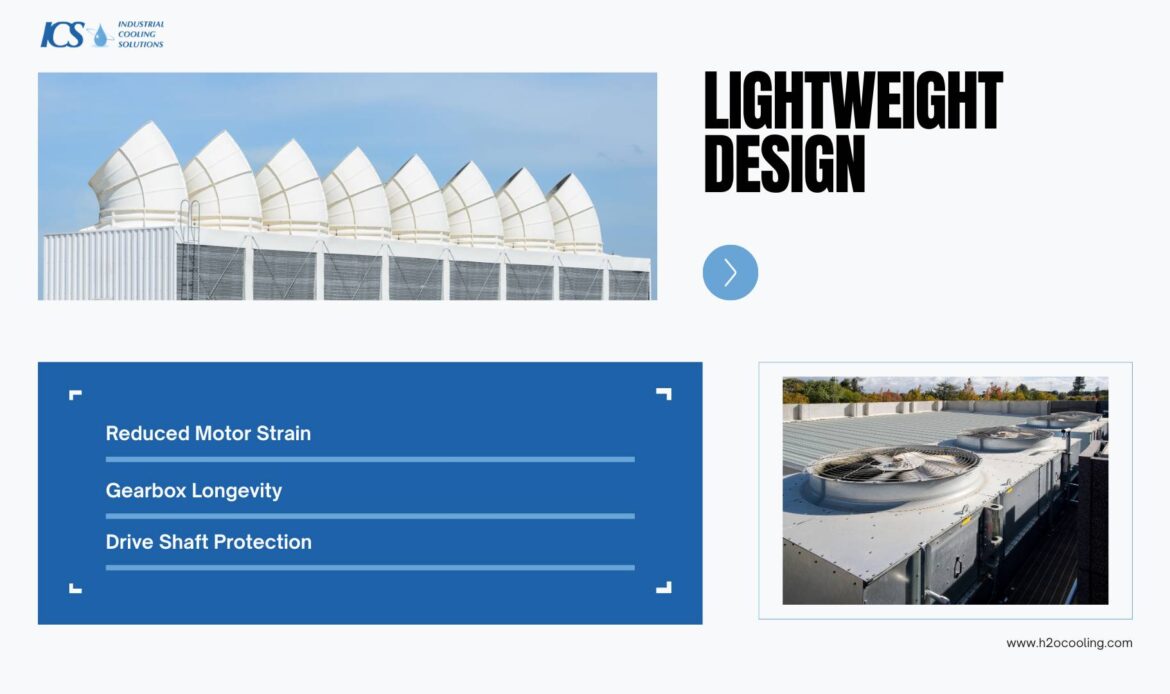
Why does weight matter in a cooling tower?
- Reduced Motor Strain: Lighter blades require less torque to accelerate during startup, reducing the electrical inrush current and thermal stress on the motor.
- Gearbox Longevity: The reduced rotating mass puts less load on the gearbox bearings and gears, extending their operational life.
- Drive Shaft Protection: Lower inertia means less torsional stress on the drive shaft during start and stop cycles.
Lower Rotational Mass and Dynamic Load Reduction
Reducing the weight of rotating cooling tower components extends the lifespan of every supporting mechanical part. One of the key FRP fan blades benefits is that they are significantly lighter than their aluminum or steel counterparts.
Here’s how the reduction in mass benefits mechanical systems:
- Lowers starting torque requirements.
- Reduces mechanical stress on the gearbox and bearings.
- Ideal for retrofits, as it decreases the load on existing drive train components.
- Extends the service life of aging gearboxes and motors.
Corrosion-Free Operation at the Blade Level
Cooling towers are inherently corrosive environments, filled with water vapor and water treatment chemicals. Metal blades are in a constant state of chemical attack, requiring specialized coatings that eventually fail.
Why does corrosion matter more on the blade than the hub? The blade tip moves at high velocity, accelerating erosion and corrosion effects:
- Chemical resistance is intrinsic to the FRP resin matrix, meaning the material does not rust, rot, or oxidize regardless of the water chemistry.
- Imbalance prevention occurs because the blade does not lose mass to corrosion, keeping the fan balanced longer than metal equivalents.
- Surface integrity remains smooth, preventing the aerodynamic drag that occurs when metal blades become pitted and rough.
Improved Vibration Control Without System Replacement
Vibration is the enemy of rotating machinery, leading to noise complaints and mechanical failures. FRP composites possess natural damping characteristics that metals lack.
Here's how FRP blades absorb vibration energy for a smoother operation:
- Dampens vibrations: Instead of transmitting vibration energy to the hub and driveshaft like metal blades, FRP blades absorb a portion of this energy.
- Ensures smoother operation: This damping effect leads to a smoother-running machine.
- Resolves persistent issues: Swapping to FRP blades can often fix vibration problems that balancing metal fans can't correct.
Safer Failure Behavior Compared to Metal Blades
Safety is paramount, especially regarding components rotating at high speeds on elevated fan decks. The failure mode of the material dictates the level of collateral damage.
- Metal Blade Failure: If a metal blade fails, it can break off as a single, heavy piece. This often leads to severe damage to the cooling tower's structure and gearbox.
- FRP Blade Failure: In contrast, FRP blades tend to "broom" or delaminate upon impact. This gradual failure process absorbs energy, typically causing only localized damage instead of destroying the entire mechanical system.
When Should You Upgrade to FRP Blades?
Not every situation calls for a new fan, but certain scenarios make upgrading to FRP fan blades more worthwhile. Understanding the benefits of FRP fan blades helps maintenance managers focus their budgets on upgrades that deliver the highest return on investment.
Aluminum-to-FRP Blade Conversion Projects
The most common upgrade involves replacing aging cast aluminum blades while retaining the existing hub and shaft. This approach is highly cost-effective because it preserves the expensive machined components that rarely wear out.
- Eliminates fatigue risk: Swapping out aluminum blades for FRP eliminates the risk of metal fatigue.
- Upgrades aerodynamic performance: They offer improved aerodynamic efficiency.
- Reduces downtime: Technicians don't need to remove the hub or realign the drive shaft.
- Creates a quick and impactful project: The retrofit is a straightforward and effective maintenance task.
High-RPM and Variable-Speed Fan Applications
Modern cooling towers increasingly utilize Variable Frequency Drives (VFDs) to control fan speed. However, varying speeds can expose metal fans to resonant frequencies that cause rapid structural failure.
- FRP blades excel in these applications due to their high strength-to-weight ratio and damping properties.
- They handle rapid speed changes and harmonic vibrations from VFD operation better than metal.
- This ensures energy-saving control strategies don't compromise mechanical reliability.
Maintenance and Inspection Advantages of FRP Fan Blades
Beyond performance, the material choice plays a key role in the daily and yearly workload of the maintenance team. One of the key FRP fan blades benefits is how they simplify the routines needed to keep the tower running safely and efficiently.
Reduced Balancing and Re-Pitching Requirements
Because FRP blades do not corrode or deform, their mass distribution remains constant. Metal blades often require frequent re-balancing as they lose material to oxidation or change shape.
They hold their pitch setting securely. Once technicians set the angle of attack during installation, the composite material does not creep or bend. This means the fan maintains its airflow target without requiring frequent manual adjustments to the blade pitch.
Easier Visual Inspection and Damage Detection
Detecting impending failure in metal blades often requires dye penetrant testing or X-rays to find hairline cracks. FRP offers a more straightforward inspection process for maintenance personnel.

Damage to composite blades usually manifests as visible surface crazing, fiber blooming, or leading-edge erosion. These signs are easily visible during routine walkthroughs. Operators can identify wear patterns early and plan for replacements proactively, rather than reacting to the invisible fatigue failures common with aluminum.
Common Misconceptions About FRP Fan Blade Upgrades
Despite the clear advantages, misinformation often prevents facilities from modernizing their equipment. We encounter several myths that suggest FRP is either incompatible or unnecessary for existing towers.
“FRP Blades Are Only for New Towers”
Many operators believe that composite technology is exclusive to modern, factory-assembled towers. This is false. They are manufactured in a wide range of profiles and shank designs specifically to retrofit into legacy cooling towers.
“Blade Replacement Requires Full Fan Replacement”
There is a prevalent belief that you cannot mix new blades with old hubs. In reality, as long as the mechanical interface is engineered correctly, replacing just the blades is a standard procedure.
We clarify the scope boundaries to ensure clients do not spend budget on hubs or clamps that are still fully serviceable.
Conclusion
Switching from metal to composite materials, such as FRP fan blades, is a strategic way to enhance reliability and reduce maintenance costs. Unlike aging aluminum blades, FRP fan blades address key issues like corrosion, fatigue, and inefficiency.
This upgrade allows facilities to extend the lifespan of their cooling systems without the need for full replacements, minimizing downtime and reducing the risk of major failures. One of the key FRP fan blades benefits is the ability to modernize equipment, improving operational performance while also cutting long-term expenses.
This blog explores the advantages of FRP fan blades and why they’re a smart investment for cooling infrastructure longevity and efficiency.
Does your facility rely on aging metal fans? Contact ICS today for an inspection and upgrade consultation to secure the reliability of your cooling process.
Frequently Asked Questions
What are the benefits of FRP fan blades?
FRP fan blades' benefits include corrosion resistance, lighter weight, vibration damping, and consistent airflow performance. Unlike aluminum, FRP does not fatigue or deform, which improves efficiency and reduces mechanical wear.
Are FRP fan blades better than aluminum?
Yes, FRP fan blades outperform aluminum in durability, safety, and long-term efficiency. They resist corrosion, maintain blade pitch, and reduce vibration, making them more reliable in harsh cooling tower environments.
Can FRP fan blades reduce vibration in industrial cooling towers?
Yes, one of the most valuable FRP fan blades benefits is vibration reduction. FRP materials naturally dampen vibration instead of transmitting it through the fan hub and drive train. This results in smoother operation, lower noise levels, and extended life of mechanical components.
Are FRP fan blades suitable for retrofitting existing cooling towers?
FRP fan blades are ideal for retrofit projects. In most cases, facilities can replace aging aluminum blades while retaining the existing hub and shaft. This allows operators to gain the benefits of FRP fan blades without the cost and downtime of a full fan or tower replacement.
Are FRP fan blades suitable for VFD systems?
FRP fan blades are ideal for VFD and variable-speed applications. Their damping properties and strength-to-weight ratio help prevent resonance and fatigue caused by speed changes.