


In the first part of this two-part series, we established that a high fan efficiency rating on paper does not guarantee optimal performance in the field. We now shift our focus from theoretical design to professional field application.
This second installment offers a practical guide to conducting a proper cooling tower fan analysis, ensuring your system performs as expected in real-world conditions. We’ll show you how to spot performance gaps that standard specifications often miss and explore the critical parameters needed to diagnose airflow issues and mechanical stress.
By the end, you'll be equipped with the knowledge to perform a comprehensive cooling tower fan analysis and guarantee your system is running at its peak.
Why Cooling Tower Fan Analysis Is Critical After Installation
Many facility managers assume that if a cooling tower turns on and cools water, it works efficiently. This assumption often leads to significant, unnoticeable energy waste. A comprehensive cooling tower fan analysis is the only way to bridge the gap between design specifications and actual field performance.
Difference Between Design Efficiency and Field Performance
Design efficiency often assumes ideal conditions that are rarely present in an operating plant. In reality, field performance is affected by numerous factors such as wind, obstructions, temperature fluctuations, and system wear and tear.
These real-world challenges can significantly impact how a fan performs compared to its design specifications.
Key differences between design efficiency and field performance include:
- Environmental factors: Wind, humidity, and temperature changes can alter fan performance.
- Obstructions: Nearby equipment or structural elements can disrupt airflow.
- System wear: Over time, wear and tear on fan components, like blades and bearings, reduces efficiency.
- Load variations: Fans may operate outside their optimal range due to fluctuating system demands.
- Installation issues: Improper setup or alignment can lead to inefficiencies in performance.
Understanding and addressing these factors is essential for improving operational reliability and energy efficiency in real-world conditions.
Core Elements of a Professional Cooling Tower Fan Analysis
You cannot determine the health of a cooling tower fan by simply listening to the motor or checking water temperatures. A professional assessment requires specific, quantifiable data points to create an accurate picture of system health.
What specific elements must technicians evaluate to ensure the fan moves air effectively?
- Airflow Measurement and Distribution Assessment
Technicians measure the velocity of air moving through the fan stack to calculate total volume. They also verify that the air distributes evenly across the entire fan deck. - Static Pressure and System Resistance Evaluation
This step quantifies the resistance the fan must overcome to pull air through the fill media and drift eliminators. High static pressure often indicates blockages or poor tower design. - Fan Operating Point Verification
The operating point is the intersection where the fan curve meets the system resistance curve. Analysis confirms if the fan operates at its peak efficiency point or if it is stalling. - Blade Pitch, Twist, and Geometry Assessment
Physical measurements of the blades confirm that the pitch angles match the design requirements. We also check for deformities in the blade twist that could disrupt airflow. - Motor Load and Power Draw Analysis
This involves measuring the amperage and voltage to calculate the actual horsepower usage. We compare this against the motor nameplate to prevent overloading.
Key Parameters Evaluated in Cooling Tower Fan Analysis
To standardize the results, professionals look at a specific set of metrics. These parameters provide the raw data necessary to make informed decisions about repairs or upgrades.
| Analysis Parameter | What Is Measured | Why It Matters |
| Airflow (CFM) | Volume of air moved | Confirms heat rejection capability |
| Static Pressure | System resistance | Identifies airflow restrictions |
| Fan Operating Point | Curve intersection | Reveals mismatch issues |
| Blade Pitch Angle | Blade configuration | Impacts efficiency and load |
| Motor Amperage | Power consumption | Detects overloading or losses |
Common Performance Losses Identified During Fan Analysis
Even high-quality fans will underperform if the system environment is not ideal. A detailed cooling tower fan analysis often uncovers specific phenomena that degrade capability. What are the most frequent issues that rob your system of its cooling potential?
Recirculation and Hot Air Ingestion
This occurs when the fan draws its own hot discharge air back into the air inlets. It artificially raises the wet-bulb temperature, which is the primary driver of evaporative cooling, and significantly reduces the tower's overall cooling capacity.
This is often caused by low discharge velocity, nearby obstructions that trap air, or prevailing wind conditions.
Hub and Tip Losses
Inefficiencies often plague the center of the fan (hub) and the clearance between the blade tip and the fan stack. Excessive gaps in this area allow air to bypass the fan, reducing pressure and overall airflow.

This phenomenon, known as "tip clearance loss," means the fan has to spin faster to achieve the desired cooling effect, consuming more energy unnecessarily.
Inlet and Plenum-Related Airflow Restrictions
Debris, poor structural design, or proximity to other buildings can choke the air supply to the fan. This starvation forces the fan to work harder against higher static pressure just to move the same amount of air, leading to reduced efficiency and potential motor overload.
Mismatch Between the Fan Curve and System Resistance
Sometimes, the installed fan is simply the wrong tool for the job. Analysis reveals if the fan generates too little pressure to overcome the resistance created by the fill media, drift eliminators, and other internal components.
This mismatch means the fan operates away from its Best Efficiency Point (BEP), wasting energy and failing to deliver the required airflow. This issue is common after system modifications, such as a change in fill type, without re-evaluating the fan's suitability.
How Fan Blade Design Influences Fan Analysis Results
The material and shape of the fan blade dictate how it interacts with the air. These physical characteristics directly impact the data collected during an inspection.
Aluminum vs FRP Fan Blades
Aluminum blades are rigid and typically have a consistent profile, but they can suffer from fatigue. Fiber Reinforced Polymer (FRP) blades allow for more complex aerodynamic shapes. Analysis often shows that FRP blades maintain better efficiency across a wider range of operating conditions.
Importance of Blade Shape
A wide, twisted blade is designed to equalize pressure from the hub to the tip, ensuring that air moves uniformly across the entire fan diameter. This design is crucial for maximizing efficiency and performance.
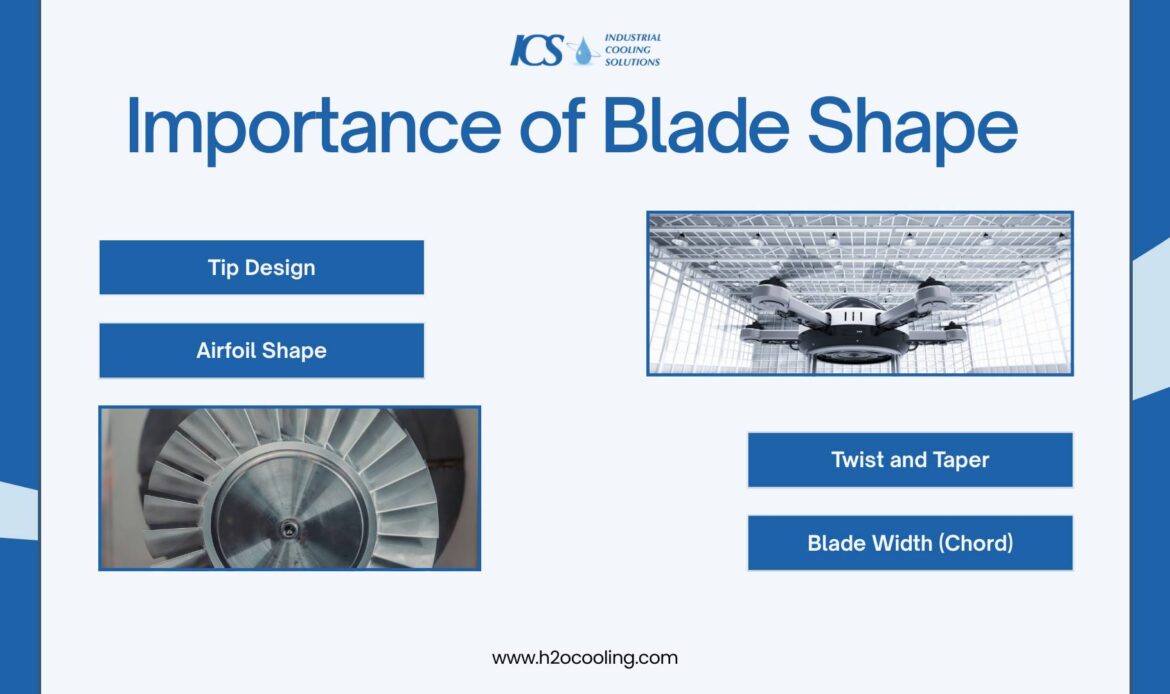
Analysis confirms whether the blade geometry effectively utilizes the available fan deck area, preventing issues like air recirculation at the blade tips or a "dead zone" near the hub.
Here's how specific blade shapes impact cooling tower performance:
- Airfoil Shape: Uses an airfoil shape, like an airplane wing, to move air efficiently.
- Twist and Taper: Twists from hub to tip to maintain uniform airflow and optimal performance.
- Blade Width (Chord): A wider blade can move more air at lower speeds, balancing airflow with drag.
- Tip Design: Specialized tips reduce energy loss and noise by minimizing vortices.
Understanding the Fan Operating Point Through Analysis
The operating point is the most critical concept in understanding fan performance. It defines the exact trade-off between the pressure the fan generates and the volume of air it moves.
How the operating point affects airflow and efficiency
If the operating point shifts too far to the left of the curve, the fan may stall and cause vibration. If it shifts too far to the right, the fan moves air inefficiently and wastes power. Cooling tower fan analysis pinpoints this location to ensure stability.
Role of fan speed and pitch adjustment
You can shift the operating point by changing the rotational speed or adjusting the blade pitch. Increasing pitch increases airflow but requires more horsepower.
Limits of adjustment without redesign
There is a limit to how much you can adjust pitch or speed before the motor overloads or the fan becomes unstable. Analysis identifies when you have reached the mechanical limits of the current equipment.
Expert Insight: Why Faulty Design Always Reveals Itself in Fan Analysis
There is no place to hide poor engineering when you apply rigorous testing. The data always exposes shortcuts taken during the initial design or subsequent modifications. Why is it impossible to mask design flaws during a comprehensive audit?
- How design shortcuts show up in performance data
Undersized plenums or poor fan stack geometry show up immediately as high static pressure readings. Turbulence and uneven velocity profiles clearly indicate aerodynamic neglect. - Importance of proper analysis during upgrades and retrofits
Adding new fill media changes the system resistance. Tower fan analysis ensures the existing fan can handle the new pressure requirements without stalling.
Conclusion
A cooling tower is only as effective as the fan that drives it. Proper fan analysis replaces guesswork with actionable engineering data, ensuring your system meets cooling requirements with maximum energy efficiency and minimal mechanical stress.
By conducting Cooling Tower Fan Analysis and reviewing performance data, you can avoid equipment failure, optimize energy use, and make informed decisions to protect your infrastructure.
Don't settle for assumptions. For expert cooling tower repair, maintenance, or parts, contact the specialists at ICS to schedule an analysis and optimize your cooling operations today.
Frequently Asked Questions
What is cooling tower fan analysis?
Cooling tower fan analysis is a field-based evaluation of airflow, static pressure, blade geometry, and motor load. It verifies whether the fan performs efficiently under real operating conditions, not just on paper.
Why is fan analysis needed after installation?
Installation conditions often differ from design assumptions. Fan analysis reveals performance gaps caused by airflow restrictions, recirculation, or system resistance that are invisible during startup.
What data is collected during a fan analysis?
Technicians measure airflow (CFM), static pressure, blade pitch, motor amperage, and fan speed. These parameters show whether the fan operates near its Best Efficiency Point (BEP).
What is the fan operating point and why does it matter?
The operating point is where the fan curve meets system resistance. If it shifts too far, the fan wastes energy, stalls, or causes vibration and mechanical stress.
How does static pressure affect fan performance?
High static pressure indicates airflow resistance from fill, eliminators, or obstructions. This forces the fan to consume more power while delivering less airflow.