


Industrial and commercial facilities are facing a significant challenge: the demand for cooling capacity is rising, but the space to install necessary equipment is shrinking. Urban growth has led to denser cityscapes, while plants are packing more equipment into existing footprints.
Regulatory restrictions often add another layer of constraint, limiting where and how new structures can be built. For facility managers and engineers, this creates a difficult puzzle: how do you expand cooling capabilities without the luxury of space?
The answer lies in a modern engineering approach: Modular Cooling Tower Construction. This innovative method reimagines how cooling towers are designed, built, and installed, offering a practical solution to footprint limitations.
This guide will explore how modular tower construction works, the problems it solves, and what you need to consider to get the design right. We'll show you why this method is quickly becoming the best option for projects where every square foot counts.
Understanding Modular Cooling Tower Construction
What does "modular" truly mean in the context of cooling tower engineering? It signifies a shift from building a large, single structure on-site to assembling a series of precision-engineered, factory-built sections.
What are the core components of this approach?
- Segmented Structure: The tower is designed as a collection of separate, manageable modules or "cells."
- Factory-Built Components: Each module is manufactured in a controlled factory environment, ensuring high quality and consistency.
- Scalable Modules: The design allows for adding or removing cells to meet specific cooling demands, offering unparalleled flexibility.
This stands in stark contrast to traditional monolithic construction, where the entire tower is built from the ground up on-site. Traditional methods require a large, open area for materials, equipment, and labor over an extended period.
Key Challenges of Building Cooling Towers in Tight or Restricted Areas
Constructing any large industrial equipment in a confined space presents a unique set of obstacles. What specific difficulties do cooling tower projects face in these environments?
- Limited crane access and equipment maneuverability: Narrow corridors, surrounding structures, and overhead obstructions can prevent the use of large cranes needed for heavy lifts.
- Height/access limitations: Rooftops, mezzanines, and enclosed courtyards pose significant challenges for moving large components into position.
- Safety risks when working in compact settings: The proximity of workers, equipment, and existing operations increases the potential for accidents.
- Downtime sensitivity for operational sites: Many facilities, such as hospitals or data centers, cannot afford to shut down operations during construction.
- Environmental & noise restrictions: Urban and dense industrial areas often have strict regulations regarding construction noise and environmental impact, limiting work hours and methods.
How Modular Assembly Streamlines Construction in Tight Spaces
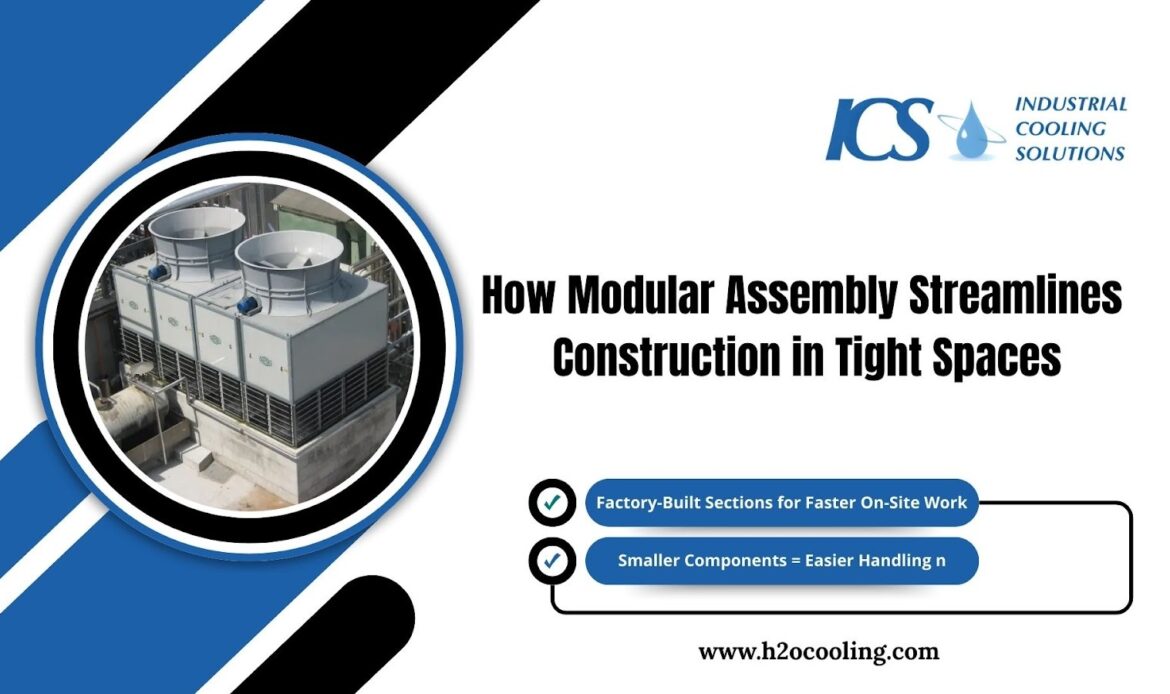
Modular construction directly addresses the challenges of building in confined areas. By rethinking the assembly process, it transforms a logistical nightmare into a manageable, efficient project.
Factory-Built Sections for Faster On-Site Work
A primary advantage of the modular approach is that the bulk of the construction happens off-site. This innovative method offers value-added benefits such as reduced labor, higher precision, and faster timelines. Here’s how:
- Sections are manufactured in a controlled factory environment, ensuring higher precision.
- Fewer labor hours are required on location, cutting down costs and effort.
- On-site fabrication and welding needs are significantly reduced.
- Minimal on-site disruption leads to faster project completion.
Smaller Components = Easier Handling & Transportation
Large equipment can navigate narrow spaces by being broken down into smaller pieces. This allows for easier handling and transportation through tight areas.
- Modules are specifically sized to fit through narrow access points like service elevators, doorways, and tight corridors.
- This design allows workers to move individual components across rooftops, through existing building interiors, or along tight industrial alleyways, which would be impossible with monolithic parts.
Step-By-Step On-Site Assembly Process
The on-site assembly of a modular tower is a highly choreographed sequence designed for efficiency and safety. Unlike traditional construction, where each component is built from raw materials on-site, modular assembly involves connecting prefabricated sections. But how does this process unfold on-site?
Delivery & staging:
Modules are delivered to the site fully prepped for installation, saving time and reducing on-site labor. Each module is staged in a carefully planned sequence to ensure a smooth and efficient assembly process. This streamlined approach minimizes delays and enhances project coordination, keeping timelines on track.
Base frame installation:
The foundational steel has been precisely set and aligned to provide robust support for the modular cells. This critical step ensures both structural integrity and long-term reliability of the overall design.
Additionally, this setup facilitates seamless integration of the modular components, ensuring efficiency during assembly and future scalability.
- Provides a stable base for modular cells to prevent structural shifts.
- Enhances durability and supports high load capacities.
- Ensures compliance with safety regulations and industry standards.
Modular cell stacking:
Cranes or other lifting equipment place the individual cells onto the frame, stacking them to form the tower structure.
Fill, casing, fan deck installation:
The internal components are installed in each cell to optimize performance. The fill media, which is crucial for maximizing the water-to-air contact surface, is carefully placed to facilitate efficient cooling. The exterior casing provides structural integrity and protection, while the fan deck houses the mechanical equipment essential for air movement.
- Installs fill media to create a large surface area for heat exchange.
- Fits the exterior casing for protection and structural support.
- Secures the fan deck, which supports the fan and motor assembly.
Motor, fan, and drift eliminator integration:
The mechanical equipment has been successfully installed, and the drift eliminators are now in place to finalize the assembly. These components ensure optimal performance by reducing water loss and improving overall efficiency.
Proper mounting and fitting of all parts minimizes operational downtime and enhances system reliability.
Final alignment & commissioning:
All components undergo thorough alignment checks, followed by commissioning to ensure the system operates precisely to its specifications. This process guarantees optimal performance, enhances system reliability, and minimizes potential downtime
Key highlights of this process:
- Alignment checks ensure seamless integration of all components.
- Commissioning confirms the system operates as intended with no discrepancies.
- Enhanced testing assures durability and consistent performance over time.
Minimizing Downtime During Assembly
For facilities that must remain operational, minimizing disruption is critical. Modular construction allows on-site preparation, such as foundation work, to occur in parallel with the off-site manufacturing of the tower modules.
This concurrent activity drastically shortens the overall project timeline. The quick installation of pre-built modules means the period of significant on-site disruption is reduced from weeks or months to a matter of days.
Enhanced Safety for Confined Construction Zones
Safety is paramount in any construction project, especially in tight quarters. How does modularity create a safer work environment?
- The use of lighter, smaller modules often allows for smaller cranes or alternative lifting methods, which are easier to manage in confined spaces.
- It significantly reduces the number of high-risk, heavy lifts required compared to traditional construction.
- The assembly process is controlled and repeatable, minimizing unexpected risks and creating a more predictable work environment for the crew.
Design Considerations for Modular Cooling Towers in Limited Footprints
Effective modular design requires careful planning to maximize performance within the given constraints. Engineers must account for every variable to ensure the tower operates efficiently and safely.

Unit Dimensions & Custom Footprint Engineering
The first step is to tailor the tower's dimensions to the available real estate. This often involves a tradeoff between height and width to fit the designated area. Multi-cell designs provide flexibility, allowing engineers to configure the tower in various shapes (e.g., L-shape or a long, narrow line) to match an irregular footprint.
Structural Load Planning
When installing a cooling tower on a rooftop or elevated structure, weight is a critical factor. Engineers must conduct detailed structural load planning to ensure the building can support the tower's operational weight.
Airflow Requirements & Intake Clearance
A cooling tower needs unobstructed airflow to function efficiently. In a tight space, surrounding buildings or equipment can block air intake, leading to recirculation—where the tower draws in its own warm, moist exhaust air.
This drastically reduces performance. Designers must choose the right tower type (crossflow vs. counterflow) and model airflow to ensure a clear path for intake air.
Water Distribution Optimization
Proper water distribution is essential for cooling performance. In a modular design, engineers must plan the piping layout to efficiently connect the water manifolds between cells. This can be challenging in a constrained space, requiring creative solutions to ensure balanced flow and easy maintenance access.
Advantages of Modular Cooling Tower Construction for Tight Spaces
Why should facility managers opt for a modular approach when space is limited? The advantages speak for themselves. Modular designs maximize space efficiency, allowing for flexible layouts that adapt to changing needs.
They also reduce construction time and minimize disruption, ensuring operations continue smoothly. Plus, modular solutions are often more cost-effective, making them an ideal choice for tight budgets without sacrificing quality.
- Reduced physical footprint: The most direct advantage is that the design can be customized to fit into small or irregularly shaped areas.
- Scalable design: The modular nature allows for easy expansion. As cooling needs grow, new cells can be added to the existing structure.
- Faster installation and commissioning: With most of the fabrication done off-site, on-site assembly is significantly quicker.
- Easier upgrades, retrofits, and replacements: Replacing an old tower or upgrading components is simpler when dealing with modular sections.
When Modular Cooling Tower Construction Is the Best Fit
Modular cooling tower construction is an ideal solution for projects with tight constraints or unique challenges. Its flexibility allows for installation in complex environments where traditional methods would be impractical or too expensive.
- Urban commercial buildings: Especially for rooftop installations where space and crane access are severely limited.
- Industrial sites: For plants with limited yard space due to surrounding equipment or buildings.
- Facilities that must stay operational: Hospitals, data centers, and manufacturing plants that cannot afford downtime.
- Plants requiring rapid expansion: When a new cooling capacity needs to be brought online quickly to meet rising demand.
- Replacement projects: When an old tower is being replaced and is surrounded by existing infrastructure that cannot be moved.
Material Selection & Durability in Compact Installations
The choice of materials is crucial for modular cooling towers, especially when they need to fit into tight spaces. Selecting the right components ensures the tower can handle the unique challenges of a compact installation, guaranteeing long-term durability and performance.
Materials must not only be robust but also lightweight enough for easy transport and assembly in constrained areas. So, what are the best options to consider?
- FRP structures: Fiberglass Reinforced Polymer (FRP) is an excellent choice for the tower structure due to its high strength-to-weight ratio, making modules lighter and easier to handle.
- Stainless steel basins: For corrosion resistance and longevity, stainless steel is a premium choice for cold water basins, especially in harsh industrial environments.
- UV-resistant components: For rooftop installations exposed to direct sunlight, components with UV-resistant coatings or materials are essential to prevent degradation over time.
Essential Checklist Before Starting Modular Cooling Tower Construction
To ensure a successful project, a thorough pre-construction checklist is vital. What are the essential steps?
- Evaluate space limitations precisely: Conduct a detailed survey of the installation area.
- Perform load and airflow modeling: Confirm the structural support and ensure adequate airflow.
- Identify lifting constraints and access routes: Plan how modules will be moved into place.
- Plan modular staging & assembly sequence: Create a detailed, step-by-step installation plan.
- Confirm utility connections and piping layout: Ensure all water and electrical connections are planned.
- Ensure safe, code-compliant maintenance access: Design for serviceability from day one.
- Validate structural support requirements: Double-check all structural calculations and designs.
Modular Construction: The Future of Cooling
Modular Cooling Tower Construction is revolutionizing cooling tower engineering, offering a smart solution for modern facilities facing space and efficiency challenges. This approach stands out for its scalability, faster installation, enhanced safety, and adaptability to tight spaces. Unlike traditional methods, modular construction allows organizations to optimize their cooling systems without compromising performance, even in crowded environments.
By adopting modular designs, facilities can future-proof their operations with resilient, high-performing systems ready to meet growing demands. This blog explores the key benefits of modular cooling towers and how they address the challenges of today’s industrial and commercial spaces while preparing for tomorrow’s needs.
If your facility is facing the challenge of limited space, a modular design provides a powerful and practical path forward. To learn how a modular solution can be tailored to your specific needs, visit h2ocooling.com and consult with our cooling tower experts today.
Frequently Asked Questions
What is modular cooling tower construction?
Modular cooling tower construction uses factory-built sections that are shipped to the site and assembled quickly. This method is ideal for facilities with limited installation space.
Why is modular cooling construction better for tight or restricted spaces?
Modular systems come in smaller, manageable sections that can fit through narrow access points, rooftops, alleys, and congested industrial zones, making installation feasible where traditional cooling towers cannot be transported or assembled.
How do I know if modular construction is suitable for my project?
Modular cooling towers are recommended if your site has:
- Limited footprint
- Restricted crane access
- Rooftop installation needs
- Narrow entry points
- Urban or congested industrial layouts
- Strict downtime limitations
A site assessment from a cooling tower engineer can confirm feasibility.
What materials are best for modular cooling towers in harsh environments?
Common choices include:
- FRP for corrosion resistance
- Stainless steel for chemical-heavy environments
- HDG steel for cost-effective durability
Material selection depends on climate, water chemistry, and operational load.