


What if the lowest bid for your new cooling tower ends up costing you the most? While the initial price tag often takes center stage during planning, focusing solely on upfront savings can be a costly mistake. Seemingly economical choices can quickly lead to a cascade of long-term expenses, from premature corrosion and unexpected component failures to complex and frequent maintenance.
The key to a durable and efficient cooling tower lies in a strategic approach to cooling tower material selection. This strategy involves a direct link between the tower's specific operating environment—including water chemistry, temperature, and structural load- and the optimal material grade for every single part.
By making informed choices from the start, you can ensure the tower operates reliably for more than two decades, avoiding the costly cycle of repairs and replacements. In this blog post, we will provide an expert analysis of the materials that define cooling tower longevity, helping you build for the future, not just for the immediate budget.
Primary Structural Materials: A Comparative Deep Dive
The structural framework is the backbone of any cooling tower. Understanding the distinct advantages and failure modes of the primary material options, such as Fiberglass Reinforced Plastic (FRP), Galvanized Steel (HDG), and Stainless Steel (SS), is fundamental to making a sound investment.

Fiberglass Reinforced Plastic (FRP)
FRP is a popular choice for its inherent corrosion resistance, a critical attribute given the constant exposure to water and treatment chemicals in cooling towers. Unlike traditional metal structures, FRP composites do not rust or degrade from electrochemical reactions.
Pros:
- Excellent resistance to UV degradation, especially with a quality gel coat.
- Lightweight material.
- Generally immune to corrosion from water chemistry.
Cons:
- Vulnerable to fire damage
- Lower strength-to-weight ratio compared to steel
- Can be susceptible to stress cracking in aggressive chemical environments
- Pultruded Fiberglass is the better choice for applications requiring maximum strength
Galvanized Steel (HDG)
Hot-dip galvanized steel offers excellent corrosion resistance, making it ideal for long-term outdoor use. Its durability reduces maintenance costs over time, providing significant value for infrastructure and construction projects.
- Pros: HDG provides high structural strength and typically has a lower upfront cost than stainless steel or pultruded FRP.
- Cons: Its primary vulnerability is corrosion. The lifespan of galvanized steel is directly tied to the integrity of its protective zinc coating. Once this coating is compromised, the steel is highly susceptible to "red rot" corrosion, a form of pitting failure that can lead to rapid structural decay.
Stainless Steel (SS)
Stainless steel grades determine their durability, corrosion resistance, and suitability for different applications. Higher-grade stainless steel, such as 316, offers superior resistance to rust and chemicals, making it ideal for marine or industrial use.
The Critical Distinction:
- The most common options are Stainless Steel 304 (SS 304) and Stainless Steel 316 (SS 316). While SS 304 is often sufficient for freshwater basins with controlled water chemistry, it can fail in more demanding conditions.
- SS 316 contains molybdenum, which provides superior resistance to chlorides and pitting corrosion. This makes it essential for coastal installations, facilities with high-cycle concentrations, or environments with aggressive chemical treatments.
Critical Internal Component Choices (The Hidden Costs)
The most frequent maintenance issues and operational losses often originate from the cooling tower's internal components. Overlooking the material quality of these parts can undermine the entire structure, regardless of the primary material used.
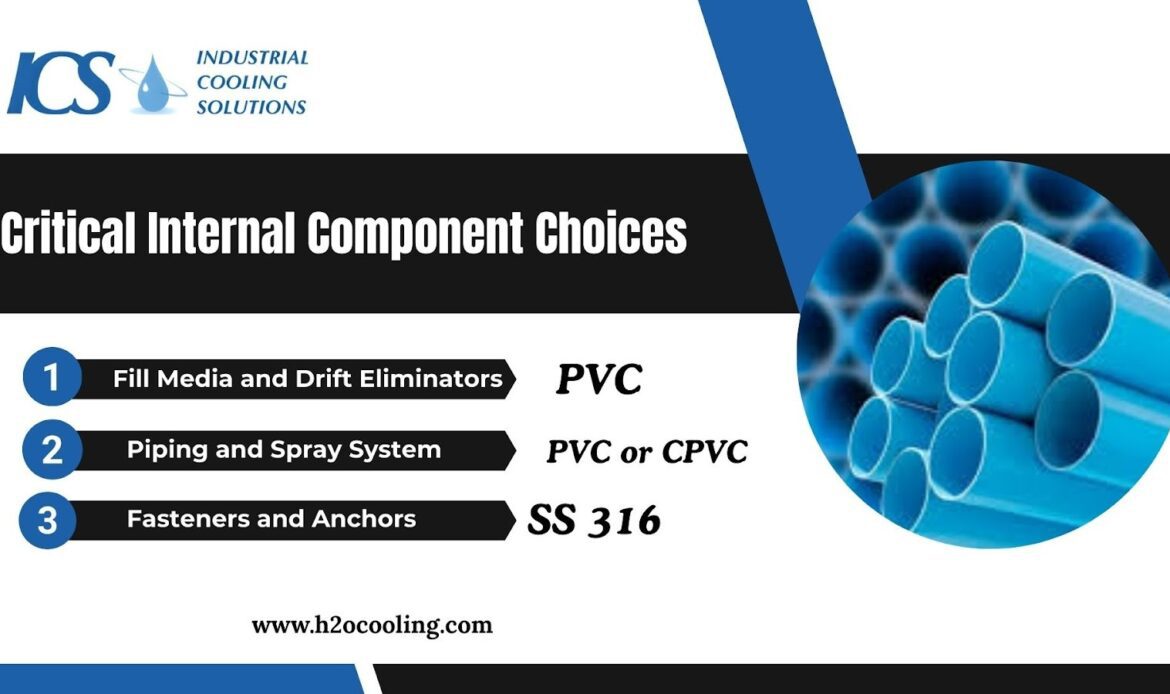
Fill Media and Drift Eliminators
The fill media plays a crucial role in the efficiency of the heat transfer process, as it facilitates maximum contact between air and water. Temperature impacts the choice of material, with high-temperature applications requiring materials like PVC or polypropylene due to their durability and resistance to thermal deformation.
- Industry Standard: Polyvinyl Chloride (PVC) is commonly used for fill media and drift eliminators.
- High-Temperature Limitation: Standard PVC can warp, deform, or collapse in high-temperature systems, such as those in industrial processing plants.
- Alternative Materials: High-Temperature PVC (HTPVC) or Chlorinated PVC (CPVC) is required to ensure structural integrity in these environments.
- Maintenance Impact: The choice of material affects the cleaning frequency and method for fill media, influencing long-term maintenance costs.
Piping and Spray System
The water distribution system is designed with durable materials that resist corrosion and wear from treated water. Regular maintenance, leak monitoring, and infrastructure upgrades further enhance its longevity.
- All spray system components (piping, distribution headers, and nozzles) must demonstrate proven material compatibility with process water and treatment chemicals.
- Compatibility is essential for systems undergoing periodic acid washes for scale removal.
- Using incompatible materials can lead to premature failure of the spray system, poor water distribution, and reduced thermal performance.
Fasteners and Anchors
A structure is only as strong as its weakest link. For cooling towers, these weak links are often the fasteners and anchors. These small components bear significant structural loads and are highly susceptible to corrosion, which can compromise the entire tower's integrity.
- Corrosion often begins at fasteners, posing a significant risk.
- Using anything less than SS 316 fasteners in galvanized steel towers is a critical mistake.
- The small extra cost of SS 316 fasteners is negligible compared to the risk of structural failure.
- Corroded connection points can lead to premature structural failure.
- Mandating SS 316 for all fasteners and anchors is essential for a strong material strategy.
The Environmental Decision Matrix
The lifespan of a cooling tower depends heavily on its interaction with the surrounding environment. Proper cooling tower material selection is essential to ensure the tower can withstand environmental challenges.
Water Chemistry
Water quality directly impacts the performance and longevity of a cooling tower. Factors like pH levels, mineral content, and impurities can affect corrosion rates, scaling, and overall efficiency.
- Aggressive water chemistry, such as high Total Dissolved Solids (TDS), elevated chloride levels (especially in coastal regions), or an imbalanced pH, requires the use of advanced materials.
- SS 316 or specialized polymer coatings are essential in these environments to combat rapid corrosion.
If the maintenance regimen involves acid washes, all wetted components must be certified for Acid Wash Resistance to prevent damage.
Operating Temperature
High temperatures can weaken traditional materials, leading to reduced efficiency and potential failures in tower components. Advanced materials like heat-resistant alloys and ceramics are designed to withstand extreme thermal conditions, ensuring durability and optimal performance even under intense stress.
- Operating temperatures above 140°F (60°C) can cause standard materials to fail.
- Internal components like fill media and drift eliminators need thermal plastics (e.g., HTPVC or CPVC) to prevent warping and maintain structural integrity.
- Protective coatings on steel surfaces must be rated for the expected operating temperature to ensure effectiveness.
Structural Load and Location
External forces can test the limits of a cooling tower. Location-specific demands play a crucial role in choosing the right materials, ensuring durability and performance in varying climates.
- Cooling towers in high-wind zones or areas with specific seismic load requirements need a robust structure.
- Heavy-gauge steel or pultruded fiberglass are often the preferred materials in these demanding locations due to their high inherent strength and durability.
- The design must account for these dynamic loads to ensure long-term structural stability.
Air Quality
The air a cooling tower breathes can be its undoing, as poor air quality significantly accelerates corrosion. Contaminants present in the air, such as industrial chemicals or saltwater spray, get drawn into the tower's airflow.
- Industrial environments often contain airborne pollutants such as sulfur or ammonia.
- These pollutants get drawn into cooling towers and mix with water, creating a corrosive environment.
- The resulting atmospheric corrosion damages all surfaces exposed to ambient air.
- To combat this, full SS 316 construction is often required for longer operational life.
Conclusion
Effective cooling tower material selection is a crucial risk-mitigation strategy tailored to your specific operational context. The choice between materials like Stainless Steel 304 and 316, the type of PVC for internals, and the quality of fasteners can be the difference between a tower that lasts 10 years and one that provides 25 years of reliable service.
Investing in the right materials from the start is the most effective way to protect against factors like poor water and air quality, ensuring long-term value and operational peace of mind.
Do not risk premature failure and unplanned capital expenditures due to a poor material choice. Contact h2ocooling.com today for a comprehensive Material Compatibility Analysis based on your specific site water chemistry and environmental factors.
Frequently Asked Questions
What is the best material for a cooling tower frame?
It depends on water chemistry, environment, and load. For aggressive or coastal conditions, high-grade stainless steel (like SS 316) often offers the longest lifespan.
What are the risks of using galvanized steel in a cooling tower?
Galvanized steel is prone to "red-rot" corrosion once the zinc protective layer deteriorates, leading to pitting, structural weakening, and costly maintenance or replacement over time.
Which is better: SS 304 or SS 316?
SS 316 provides superior resistance to chlorides, pitting, and harsh water chemistry. SS 304 works well for controlled freshwater conditions but fails faster in coastal or chemically aggressive sites. SS 316 ensures longer operational life.
Are galvanized steel cooling towers reliable?
They’re reliable initially but depend entirely on the zinc coating for protection. Once that coating breaks down, red-rot corrosion starts rapidly. This leads to costly structural damage and shortened lifespan.
What fill media material lasts the longest?
Standard PVC works for most systems, but high-temperature systems require HTPVC or CPVC. These materials resist warping and deformation, ensuring stable heat transfer performance over time.