


The world is facing a growing water crisis, and industrial demands are increasing. For facility managers and engineers, the challenge is finding ways to stay sustainable without losing performance. The solution is optimization. Zero Liquid Discharge cooling towers are here to help. They offer the perfect combination of water efficiency and sustainability.
By mastering Cycles of Concentration (CoC), facilities can drastically reduce water consumption and minimize waste. This strategy not only ensures compliance with strict environmental regulations but also delivers significant cost savings.
This guide serves as a comprehensive blueprint for optimizing Cycles of Concentration (CoC) to achieve Zero Liquid Discharge (ZLD) goals. Inside, you'll discover practical strategies, key considerations, and step-by-step approaches to enhance water efficiency, reduce waste, and move closer to sustainable operations.
Understanding Cycles of Concentration (CoC) in Cooling Towers
Cycles of Concentration (CoC) serves as the primary metric for cooling tower efficiency. It represents the ratio of dissolved solids in the recirculating water compared to the dissolved solids in the makeup water. As pure water evaporates from the tower to provide cooling, dissolved minerals remain behind. These minerals concentrate in the remaining water.
Operators calculate CoC by dividing the conductivity (or chlorides) of the tower water by the conductivity of the makeup water. For example, if the makeup water has 500 TDS (Total Dissolved Solids) and the tower water has 2000 TDS, the system operates at 4 cycles.
Introduction to Zero Liquid Discharge (ZLD) in Cooling Towers
Zero Liquid Discharge (ZLD) constitutes an ambitious water management strategy where a facility eliminates all liquid waste discharge. In the context of industrial cooling, this means the system recovers and recycles all blowdown water, leaving only solid waste for disposal.
Adopting ZLD matters for several reasons. It ensures total compliance with increasingly stringent environmental discharge regulations. It demonstrates corporate environmental responsibility. Furthermore, in regions with high water costs or scarcity, ZLD creates financial resilience.
- Conventional vs. ZLD Systems: A conventional blowdown management system discharges water when it reaches a specific saturation point to prevent scaling. In contrast, a ZLD system treats this blowdown water, often using evaporation or crystallization, allowing it to be reused within the facility.
- Realistic Expectations: Achieving ZLD is not always straightforward. Its feasibility depends on factors like the quality of the makeup water, the rate of drift loss (water lost as mist), and the facility's maintenance capabilities.
- Phased Approach: While not every cooling tower can achieve absolute zero discharge immediately, maximizing the Cycles of Concentration (CoC) is a crucial first step in any ZLD strategy.
The Relationship Between CoC and ZLD
Maximizing Cycles of Concentration acts as the prerequisite for ZLD. You cannot practically achieve zero discharge if your tower generates excessive blowdown. Increasing CoC minimizes the volume of blowdown water that the ZLD system must eventually treat.
- Implementing a Zero Liquid Discharge (ZLD) strategy: The first step is understanding the connection between Cycles of Concentration (CoC) and blowdown volume.
- The impact of increasing CoC: Raising the CoC from 2 to 4 can cut blowdown volume by 50%.
- Benefits for ZLD technologies: This reduction in blowdown means downstream ZLD equipment, like evaporators, can be smaller and cheaper to run.
- The challenge of water chemistry: As CoC increases, so does the risk of scaling, corrosion, and biological growth.
- The balancing act: Achieving ZLD means you have to optimize CoC while also maintaining strict safety protocols to protect your equipment from damage caused by high salt concentrations.
Preparing for High CoC Operations
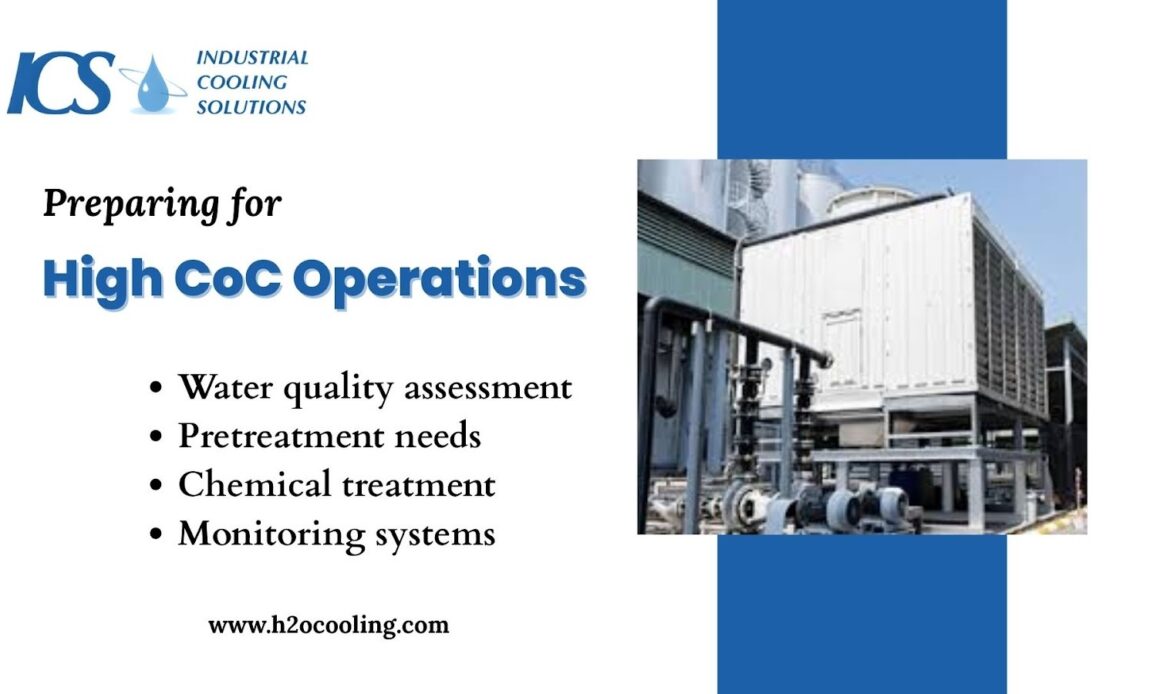
You cannot simply close the blowdown valve and hope for the best. High cycles require specific preparation to prevent catastrophic system failure. Consider these essential preparatory steps:
- Water quality assessment: Analyze the makeup water thoroughly for hardness, silica, conductivity, Total Dissolved Solids (TDS), and alkalinity to understand the baseline chemistry.
- Pretreatment needs: Install necessary technologies such as water softeners, side-stream filtration, or reverse osmosis systems to remove impurities before they enter the tower.
- Chemical treatment: Select robust scale inhibitors, corrosion inhibitors, and biocides formulated specifically for high-stress, high-concentration environments.
- Monitoring systems: Implement continuous conductivity monitoring, precise temperature controls, and automated alert systems to detect chemistry changes in real time.
Step-by-Step Guide to Maximizing CoC for ZLD
Moving toward zero discharge requires a methodical approach rather than a sudden operational shift. It’s about optimizing processes, improving water quality, and enhancing equipment efficiency to reduce waste sustainably.
By implementing advanced monitoring systems and regularly analyzing water chemistry, you can identify opportunities for improvement. Follow this structured path to safely increase your cycles:
- Assess current system: Review the current makeup water quality, measure daily blowdown volume, and document the existing Cycles of Concentration.
- Set target CoC: Determine a safe maximum cycle number based on the limiting factors of your water chemistry and the metallurgy of your equipment.
- Upgrade water treatment: Introduce advanced scale and corrosion control chemicals, and install filtration or softeners if the assessment indicates a need.
- Implement monitoring: Install conductivity sensors, online dashboards, and alarms that trigger immediately if water parameters breach set thresholds.
- Gradual increase: Slowly increase the CoC targets while closely monitoring heat exchangers for any signs of scaling, corrosion, or fouling.
- Document & track: Meticulously record CoC levels, blowdown rates, water quality readings, and any maintenance interventions.
- Review regularly: Adjust chemical dosing, cleaning schedules, and CoC targets based on the data collected to ensure continuous optimization.
Operational Challenges and How to Overcome Them
To ensure smooth performance, it's crucial to stay alert to common operational risks that can arise. Issues such as scaling, corrosion, and biofouling can compromise efficiency and damage equipment if left unchecked.
Regular monitoring, proper maintenance, and using the right chemical treatments are essential to mitigate these threats. Stay proactive and ensure your system runs optimally by addressing potential problems before they escalate.
- Scaling risks: Identify minerals like calcium and silica that cause scale, and utilize specific polymeric dispersants and anti-scalants to keep them in solution.
- Corrosion concerns: Monitor pH and conductivity levels strictly, and implement anodic and cathodic corrosion inhibitors to protect metal surfaces.
- Biofouling: Utilize oxidizing and non-oxidizing biocides on a strict schedule to prevent biological growth, which thrives in warm, concentrated water.
- Drift and evaporation losses: Install high-efficiency drift eliminators to control water loss and maintain the precise water balance required for ZLD.
- Equipment monitoring: Deploy smart sensors and automation to provide 24/7 visibility into system health and prevent minor issues from becoming major failures.
Benefits of Achieving High CoC and ZLD
Running a Zero Liquid Discharge cooling tower isn’t just about saving water; it’s a game-changer for your industrial operations. By optimizing your system with the right cooling tower parts, you can achieve bigger results: boosted efficiency, smarter sustainability, and a stronger bottom line. Ready to transform the way you operate?
- Water conservation and sustainability: Dramatically reduces the withdrawal of fresh water from local sources, preserving the watershed for the community.
- Reduced chemical and utility costs: Lower water volume means less makeup water to purchase and less volume to treat, reducing overall operational expenses.
- Compliance with environmental regulations: Eliminates the risk of discharge violations and simplifies the permitting process for the facility.
- Longer equipment life and reduced maintenance: Proper treatment reduces scale and corrosion, extending the lifespan of pumps, piping, and heat exchangers.
- Improved plant efficiency and operational reliability: Clean heat transfer surfaces ensure the cooling system operates at peak thermal efficiency.
Best Practices for Maintaining ZLD Cooling Towers
Consistency is the key to long-term success in high-efficiency water management. Regular monitoring, system checks, and timely maintenance can prevent costly issues down the line.
Ensure your equipment is operating at peak efficiency by cleaning filters, inspecting for leaks, and updating to the latest technology when needed. Adhere to these protocols to maintain optimal performance and maximize water savings.
- Regular audits and water quality tests: Conduct frequent lab analyses to verify that online sensors are accurate and water chemistry remains within spec.
- Scheduled maintenance and chemical dosing adjustments: Perform preventative maintenance on pumps and filters, and calibrate chemical pumps to match current load demands.
- Staff training on monitoring and CoC optimization: Ensure all operators understand the principles of CoC and ZLD so they can recognize and respond to anomalies.
- Documentation and record-keeping for compliance purposes: Maintain detailed logs of all water usage and treatment activities to satisfy regulatory audits.
- Integration with plant-wide water management programs: View the cooling tower as part of a holistic water strategy, integrating it with other plant processes for maximum efficiency.
Conclusion
Maximizing Cycles of Concentration is the key to transforming traditional cooling tower operations into sustainable, Zero Liquid Discharge cooling tower systems. By reducing water waste and optimizing resource use, this approach not only ensures regulatory compliance but also protects the environment and lowers operational costs.
Although transitioning to ZLD comes with challenges like water chemistry management and system monitoring, the long-term benefits outweigh the hurdles. With proper treatment strategies and diligent parameter monitoring, facilities can achieve both economic and environmental gains.
Ready to improve your cooling tower's efficiency and sustainability? Visit h2ocooling.com to learn more and discover solutions tailored to your needs.
Frequently Asked Questions
What is the ideal CoC for a cooling tower?
The ideal CoC depends on the makeup water quality. Most systems target between 3 and 6 cycles. However, with advanced treatment and ZLD goals, systems can often push beyond 10 cycles safely.
Can all cooling towers achieve Zero Liquid Discharge?
Technically, yes, but it may not always be economically feasible for every tower. It depends on the cost of water, disposal fees, and the investment required for treatment equipment.
How often should water quality be monitored in high CoC operations?
Operators should monitor conductivity and pH continuously via automated sensors. Complete chemical analysis should occur at least weekly to ensure the treatment program prevents scaling and corrosion effectively.
What chemical treatments are essential for high CoC systems?
High CoC systems require a robust combination of scale inhibitors (anti-scalants), corrosion inhibitors (for specific metallurgies), and a dual-biocide program to control biological growth.