

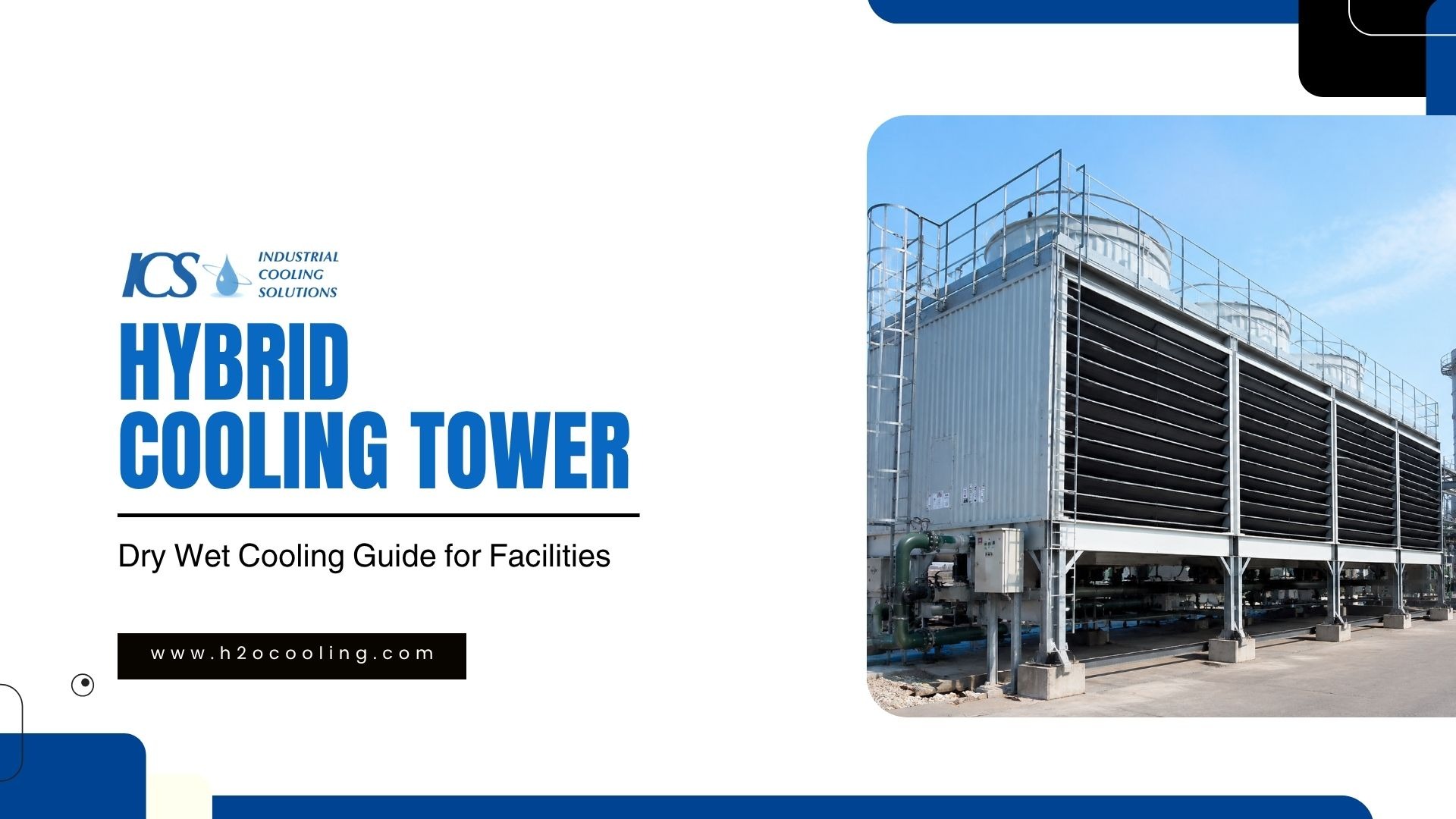
A Hybrid Cooling Tower combines dry wet cooling in one system to balance water savings, thermal performance, and visible plume control. In cooler or lower-load conditions, the tower uses dry cooling to reduce water use.
During peak heat, it switches to wet evaporative cooling for stronger heat rejection. A strong hybrid design helps industrial facilities reduce plume concerns, manage water costs, and avoid the limits of dry-only or wet-only cooling systems.
The Industrial Heat Rejection Problem
Many industrial plants require reliable heat rejection to keep operations running. These facilities often face strict water restrictions, rising utility costs, plume complaints, and environmental pressure. Facility teams need a solution that meets thermal demands without draining local water supplies.
A Hybrid Cooling Tower gives facility teams a flexible option. It does not replace every wet or dry system. It solves problems where water savings and thermal performance both matter.
Traditional wet cooling provides strong heat rejection but consumes heavy amounts of water. Dry cooling saves water but often struggles during hot weather. Hybrid towers combine both methods to ensure continuous operation.
What Is a Hybrid Cooling Tower?
A Hybrid Cooling Tower is a heat rejection system that combines dry air cooling and wet evaporative cooling. It operates in dry mode, wet mode, or combined mode depending on ambient conditions, cooling load, and operating goals.
Understanding the differences between systems helps operators make better procurement decisions.
The most useful points include:
- Water reduction: Dry cooling mode significantly reduces water use during favorable weather.
- Peak performance: Wet cooling mode improves peak heat rejection during summer months.
- Balanced operation: Hybrid operation balances water and energy consumption to lower costs.
- Smart controls: Automated controls decide when to use each mode based on real-time data.
- Environmental compliance: Hybrid towers support plume abatement and water conservation mandates.
Hybrid Cooling Tower vs Traditional Wet Cooling Tower
Wet towers use evaporative cooling as the main method for heat rejection. They achieve lower cold water temperatures but consume significant makeup water. Hybrid towers reduce wet operation during favorable conditions to minimize this water consumption.
Hybrid Cooling Tower vs Dry Cooler
Dry coolers use air only for heat rejection. They save water but depend heavily on the ambient dry-bulb temperature. Hybrid towers add evaporative cooling when dry cooling cannot meet the demand. This improves operational flexibility for hot climates or high-load operations.
How Dry Wet Cooling Works in a Hybrid Cooling Tower
A hybrid system works by utilizing dry-wet cooling modes based on real-time needs. The operating mode depends on outdoor conditions, heat load, water limits, and the required leaving water temperature.
Dry Mode
Dry mode uses air-cooled coils or dry heat exchange to remove heat. This mode reduces or completely avoids evaporation.
It works best during cool weather, nighttime, low-load periods, or shoulder seasons. This mode saves the most water but may require more fan energy under certain conditions.
Wet Mode
Wet mode relies on evaporative cooling to remove heat from the process water. It delivers stronger heat rejection during high-load or hot-weather conditions.
This mode uses more water than dry mode. Facility operators rely on wet mode to maintain process stability when temperature demand remains strict.
Hybrid Mode
Hybrid mode uses dry and wet sections together to optimize cooling. The dry section may reduce the water temperature or reheat saturated exhaust air.
The wet section handles the remaining heat rejection. Smart controls balance water use, energy use, plume reduction, and cold water temperature automatically.
Why Industrial Facilities Choose Hybrid Cooling Towers
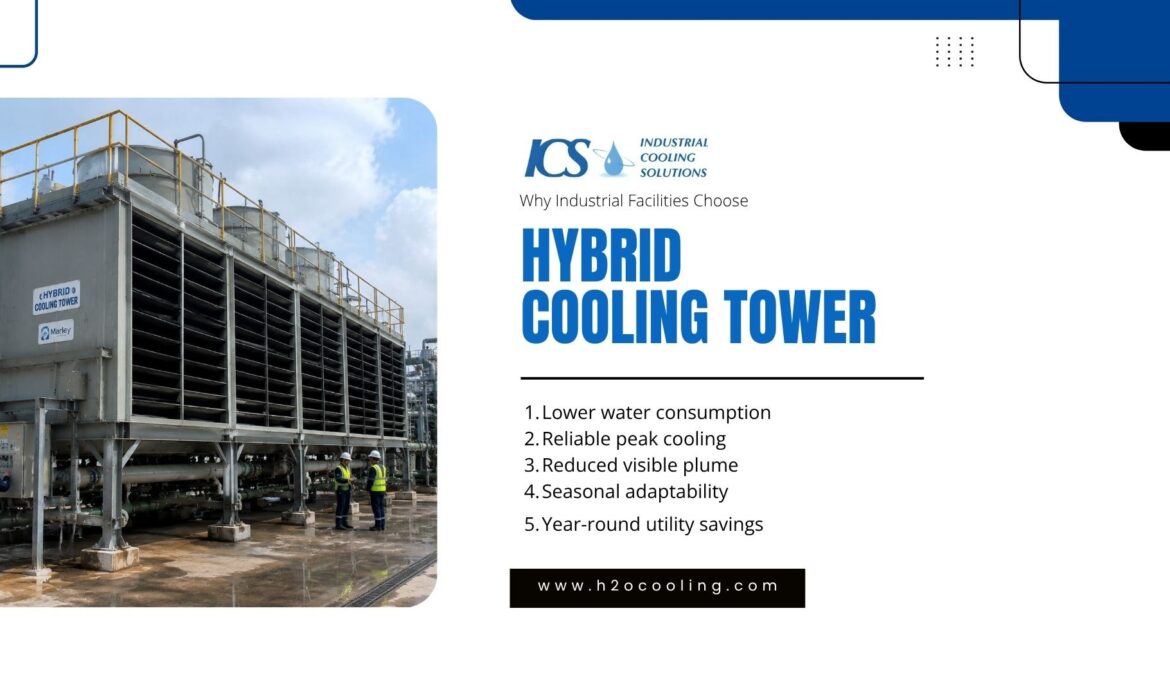
A Hybrid Cooling Tower often makes sense when a facility cannot rely on wet-only cooling or dry-only cooling. It gives operators greater control over water consumption, plume visibility, and thermal performance.
Facilities must weigh the operational advantages against their specific site constraints.
The most useful points include:
- Reduced consumption: Lower water consumption than traditional wet towers protects local water tables.
- Cooling reliability: Better peak cooling than dry-only systems ensures production does not slow down.
- Visual compliance: Reduced visible plume prevents complaints from nearby residential neighborhoods.
- Seasonal adaptability: Better control during seasonal changes optimizes utility spending year-round.
Industrial facilities often select these systems where water is scarce, water costs are high, uptime is critical, or visible plume causes concern.
Water Savings in a Hybrid Cooling Tower
A hybrid system reduces water use, but actual water savings depend on the system design and operating conditions. Facilities must model annual performance to project accurate return on investment.
Engineers must evaluate several site-specific variables to calculate expected reductions.
The most useful points include:
- Climate data: Local wet-bulb and dry-bulb temperatures dictate how often dry mode operates.
- Thermal demand: Process heat load and required cold water temperatures influence evaporation rates.
- System settings: Water treatment programs, cycles of concentration, and blowdown rates affect total usage.
Why Climate Affects Water Savings
Cooler climates allow more dry-mode operation, maximizing water conservation. Hot and humid climates require more wet operation to meet thermal demands. The dry-bulb temperature affects dry cooling performance, while the wet-bulb temperature dictates evaporative cooling limits.
Why Load Profile Matters
A stable high heat load usually requires continuous wet operation. Variable or seasonal loads create more opportunities to run the system in dry mode. Plants should model annual performance based on typical loads, not only the peak design day.
Plume-Free and Plume-Reduced Cooling: What Buyers Should Know
Industrial buyers must understand the difference between plume-reduced and plume-free claims. Do not expect full plume-free operation in every condition unless the system has specific engineering for that exact weather profile.
A visible plume forms when warm saturated tower exhaust meets cooler outside air. Hybrid wet/dry systems reduce plume by reheating, drying, or mixing this exhaust air before it leaves the tower. Plume control matters near highways, airports, rail crossings, public areas, and residential zones. Plume creates visibility concerns, public complaints, and icing risks in cold climates.
When Plume Control Matters Most
Plume control matters most where visibility, safety, public perception, or icing risk affects site operation. A standard wet tower may work well in remote areas, but a visible plume can create problems in sensitive locations.
Facilities should review plume risk carefully in these places:
- Airports: Plume can create visibility concerns.
- Highways: Plume may distract drivers or reduce visibility.
- Rail crossings: Moist exhaust can create safety concerns in cold weather.
- Urban industrial sites: Nearby communities may complain about visible discharge.
- Commercial campuses: Plume can affect public-facing facilities.
- Residential-adjacent plants: Neighbors may view the plume as pollution.
- Cold climates: Moist discharge can increase icing concerns.
Buyers should ask for project-specific plume performance data instead of accepting a general plume-free claim.
Hybrid Cooling Tower vs Adiabatic Cooling
Adiabatic cooling and hybrid cooling both help reduce water use, but they do not function exactly the same way. The final choice depends on heat load, climate, leaving water temperature, footprint, and maintenance capacity.
Comparing the technologies directly helps facility managers select the correct equipment for their site.
| Factor | Hybrid Cooling Tower | Adiabatic Cooling | Best For | Expert Recommendation |
| Cooling method | Combines dry and wet cooling | Pre-cools air before dry heat exchange | Sites comparing water and energy use | Choose based on required leaving water temperature |
| Water use | Lower than wet-only, higher than dry-only | Usually lower than wet cooling | Water-conscious facilities | Model annual water use |
| Peak performance | Stronger during hot conditions | Depends on design margin | High-load industrial sites | Use hybrid when peak heat rejection matters |
| Plume control | Can reduce visible plume | Usually less plume than wet towers | Urban or sensitive sites | Confirm plume expectations by season |
| Maintenance | Wet and dry sections need service | Pads, coils, and water system need service | Facilities with maintenance staff | Compare cleaning access and fouling risk |
Hybrid Cooling Tower Design Considerations
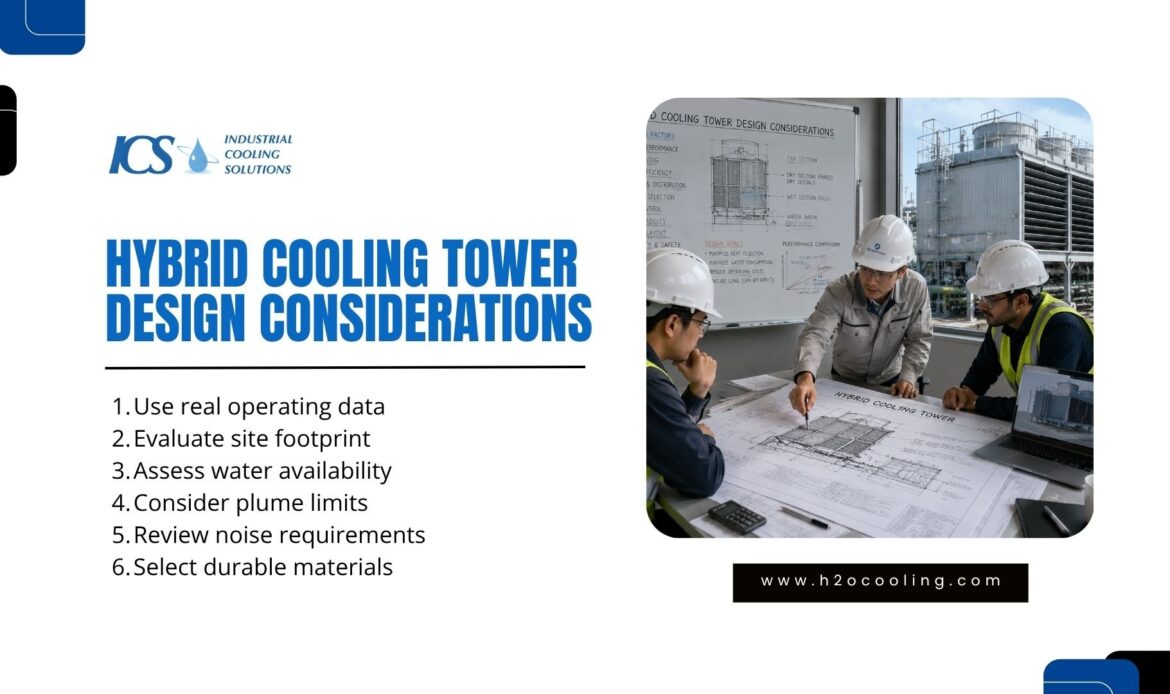
A strong hybrid design starts with real operating data. Engineers should not size a hybrid system only from peak load or generic capacity numbers.
Designers must evaluate site footprint, water availability, water quality, plume limits, and noise limits. A successful project requires careful selection of materials and components.
Key Components in a Hybrid Cooling Tower
Hybrid towers contain complex internals that require robust engineering. The quality of these parts determines the lifespan of the unit.
The most useful points include:
- Heat transfer media: The dry coil and wet fill section perform the actual heat rejection.
- Air movement: Fans, motors, and gearbox drive systems push or pull air through the system.
- Water management: The water distribution system, drift eliminators, and basin contain and direct the fluid.
Controls and Mode Switching
Controls decide when to operate in dry, wet, or hybrid mode. Poor controls waste water and electrical energy. Good controls use temperature, humidity, load, and leaving water setpoints to maximize efficiency.
Hybrid Cooling Towers vs Wet and Dry Cooling Towers
Selecting the right heat rejection method requires balancing upfront costs with long-term utility expenses. Facilities must compare performance limits before committing to a specific technology.
This comparison matrix highlights the operational differences between the three main cooling categories.
| Factor | Wet Cooling Tower | Dry Cooling Tower | Best For | Expert Recommendation |
| Water use | Highest | Lowest | Wet for low water cost, dry for water-scarce sites | Choose hybrid when water savings and cooling performance both matter |
| Energy use | Often efficient for heat rejection | Can require higher fan power in heat | Sites with stable utility costs | Compare annual energy, not only peak design |
| Thermal performance | Strong in hot conditions | Limited by dry-bulb temperature | High heat load facilities | Hybrid keeps wet support for peak demand |
| Plume | Can create visible plume | No evaporative plume | Sensitive locations | Hybrid can reduce plume without going fully dry |
| Capital cost | Usually lower | Often higher for large heat duty | Budget-driven or water-restricted projects | Use lifecycle cost, not purchase price only |
Best Applications for Hybrid Cooling Towers
Hybrid cooling towers suit facilities that need both performance and resource control. They become especially useful when water cost, plume restrictions, or environmental goals affect design decisions.
They also help facilities with variable loads because controls can shift between operating modes as demand changes.
Strong application areas include:
- Power plants
- Data centers
- Chemical plants
- Petrochemical facilities
- Refineries
- Food and beverage plants
- Manufacturing facilities
- District cooling systems
- Large HVAC plants
- Industrial sites in water-scarce regions
Facilities with high uptime needs should evaluate hybrid cooling through lifecycle cost, not only initial equipment price.
When a Hybrid Cooling Tower May Not Be the Best Choice
A hybrid system can solve many problems, but it does not fit every site. Honest evaluation improves trust and prevents poor investment decisions.
Hybrid towers may not make sense when water is cheap, plume does not matter, energy cost dominates the business case, or the site lacks maintenance capacity.
Common limitations include:
- Higher upfront cost than wet-only towers
- More complex controls
- More components to maintain
- Coil fouling risk
- More inspection points
- More engineering required during retrofit
- Possible space or structural limitations
A hybrid tower should solve a real operating problem. It should not become a default choice without a clear payback case.
How ICS Can Help With Hybrid Cooling Tower Projects
ICS helps industrial facilities evaluate whether a Hybrid Cooling Tower, dry cooling, wet cooling, or adiabatic cooling offers the best balance for their site.
Our experts analyze thermal performance, water savings, plume control, maintenance needs, and lifecycle costs. We support facilities with new cooling tower construction, detailed inspections, and thermal upgrades.
If you need cooling tower replacement or reliable OEM parts, our engineering team ensures your project meets all operational goals.
Summary
A Hybrid Cooling Tower successfully combines dry wet cooling to solve complex industrial challenges. Dry mode supports vital water savings, while wet mode delivers peak heat rejection during difficult weather.
This hybrid design balances performance, electrical energy, water use, and visible plume control. Facilities must evaluate plume-free claims based on their exact site conditions and weather data.
While adiabatic cooling offers a related alternative, the best design always depends on climate, heat load, water cost, and long-term financial payback.
Frequently Asked Questions
What is a Hybrid Cooling Tower?
A Hybrid Cooling Tower combines dry air cooling and wet evaporative cooling in one system. It runs in dry mode to reduce water use, wet mode for high heat rejection, or hybrid mode to balance both. Industrial facilities use them to achieve water savings and plume reduction while maintaining reliable cooling performance.
How does dry wet cooling work?
Dry wet cooling works by switching between air-based heat rejection and evaporative heat rejection. In dry mode, the tower uses air cooling to reduce water use. In wet mode, it uses evaporation to improve heat rejection. Hybrid mode combines both to balance water savings, fan energy, and thermal performance.
Do hybrid cooling towers save water?
Yes, hybrid systems reduce water use compared to traditional wet cooling towers. Actual water savings depend on local climate, operating hours, heat load, and the required cold water temperature. Facilities that operate frequently in dry mode see stronger savings than sites requiring constant wet operation.
Are hybrid cooling towers plume-free?
Some systems operate as near plume-free units under specific design conditions, but they do not eliminate visible plume entirely in all weather. Plume depends on outdoor temperature, humidity, and tower design. Buyers must request project-specific plume data instead of relying on generic claims.
What is the difference between hybrid cooling and adiabatic cooling?
Hybrid cooling combines dry and wet cooling sections. Adiabatic cooling usually pre-cools incoming air with water before it reaches a dry coil. Both options reduce water use. A strong hybrid design often suits larger heat loads, while adiabatic systems typically serve lower-water process cooling needs.
When should a facility choose a hybrid cooling tower?
A facility should consider a Hybrid Cooling Tower when it needs water savings, plume control, peak heat rejection, and flexible operation. They work exceptionally well for power plants, chemical plants, and water-scarce sites. The final decision requires comparing climate data, water costs, and lifecycle payback.