

A cooling tower water management plan explains how a facility will identify, monitor, control, and document risks in its cooling tower system. A strong plan should align with ASHRAE 188, follow practical CDC compliance guidance, include a site-specific hazard analysis, and define clear steps for Legionella control.
It also works as a cooling tower water safety plan by assigning responsibilities, setting control limits, recording maintenance, and documenting corrective actions when water conditions fall outside safe operating ranges.
Why Cooling Towers Need More Than Chemical Dosing
Cooling towers use warm recirculating water, fans, air movement, drift, and open basins. That combination creates the perfect home for scale, corrosion, sediment, biofilm, and Legionella bacteria.
Occasional chemical dosing does not solve this. A poorly maintained tower can grow biofilm in days and push contaminated water droplets into the air.
A written cooling tower water management plan helps your team manage risk the same way every time. It removes guesswork and creates a record that people can follow.
Regulators, auditors, insurers, and building owners often ask to see this documentation. A clear plan protects your facility during inspections and investigations.
A good plan also connects every part of tower care. It links water safety plan steps, water treatment, inspection, cleaning, maintenance, and corrective actions into one program. H2OCooling supports the mechanical side of that plan through inspection, repairs, cleaning support, parts, upgrades, and replacement planning.
What Is a Cooling Tower Water Management Plan?
A cooling tower water management plan is a written program that identifies water-related hazards in a cooling tower. It defines control measures, sets monitoring limits, assigns responsibilities, records maintenance, and explains what to do when control limits are not met.
The plan turns scattered tasks into one clear system. Everyone knows their role, their limits, and their next step.
Why Cooling Towers Need a Written Plan
Cooling towers can aerosolize water droplets through fan-driven airflow. If Legionella grows inside the system, contaminated droplets may create health risk for people nearby.
A written plan helps teams manage this risk consistently. It also reduces missed inspections and unclear responsibilities.
Cooling towers need a plan because:
- Cooling towers can produce aerosols.
- Warm water can support microbial growth.
- Biofilm and sediment can protect bacteria.
- Poor maintenance can increase Legionella risk.
- Written procedures reduce missed inspections.
- Records prove that the facility follows a consistent program.
- A plan supports compliance, safety, and uptime.
CDC’s cooling tower module states that scale, corrosion, sediment controls, and system cleaning are critical for cooling tower operation and Legionnaires’ disease prevention. It also says disinfectant residual should be monitored and adjusted by an automated system.
How ASHRAE 188 Applies to Cooling Towers
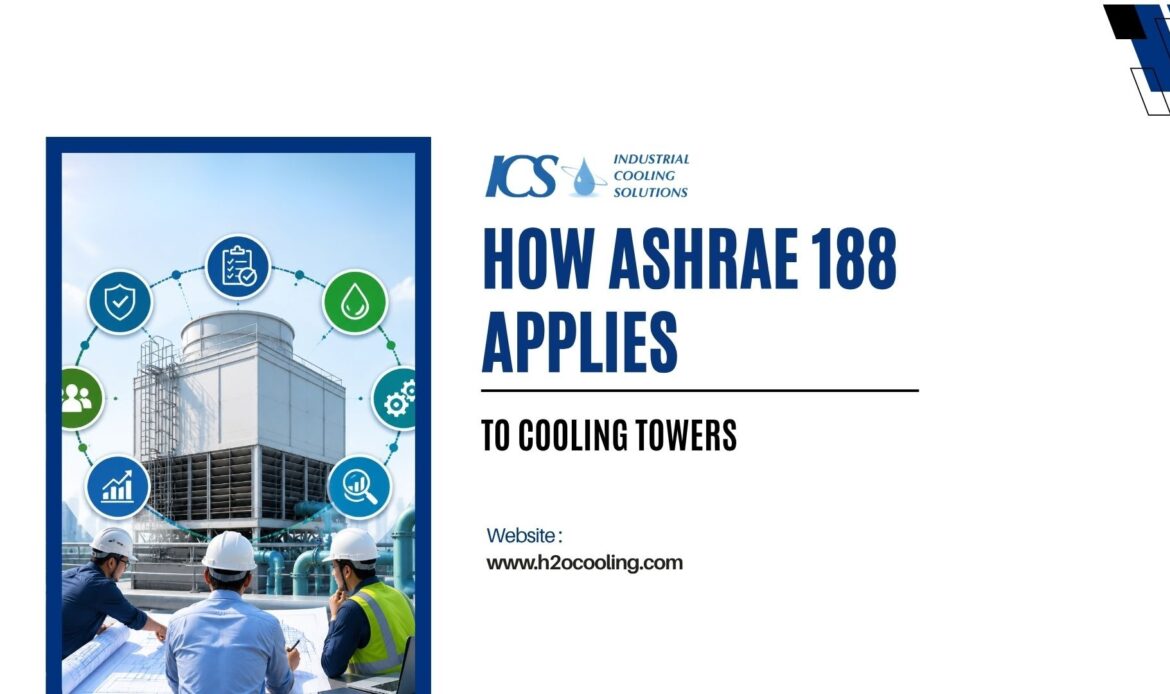
ASHRAE 188 provides a recognized risk management framework for reducing Legionella risk in building water systems. According to ASHRAE, Standard 188 outlines the principles for developing a water management program and includes preventive measures, documentation, and commissioning.
Cooling towers fall under this standard because they use recirculating warm water and produce aerosols. That makes them a key system to manage.
What ASHRAE 188 Covers
The standard does not give you one fixed recipe. Instead, it gives you a structure to build a site-specific program.
The core ideas you should apply include:
- Risk management focus: ASHRAE 188 is built to reduce Legionella risk, not just track chemistry.
- Building water systems: It targets systems that can support Legionella growth, including towers.
- Cooling tower relevance: Warm recirculating water and drift make towers high priority.
- Site-specific design: Your plan must match your tower, not a generic template.
- Documentation and controls: The plan needs defined control measures and clear records.
- Local review: Always check local rules and professional guidance for your area in the USA.
ASHRAE 188 in Plain Language
The standard sounds technical, but the logic is simple. You can explain it to any new team member in a few steps.
Think of ASHRAE 188 as this cycle:
- Know your water system and how water moves through it.
- Identify where risk can occur in the tower and piping.
- Set controls to reduce that risk.
- Monitor those controls on a schedule.
- Act when limits are missed with planned corrective steps.
- Keep records of every reading and action.
- Review and update the plan as the system changes.
CDC Compliance Guidance for Water Management Programs
The CDC toolkit helps building owners and managers build and run a water management program. The CDC states that an effective water management program is the primary strategy to control Legionella growth and help prevent Legionnaires' disease.
This guidance pairs well with ASHRAE 188. Together they give you a practical path to CDC compliance.
The CDC Seven-Step Framework
The CDC framework breaks the work into clear stages. Each stage builds on the one before it.
The seven steps are:
- Build a team: Create a water management program team with clear roles.
- Describe the systems: Map out every building water system, including the tower.
- Find risk areas: Identify where Legionella could grow and spread.
- Set control points: Decide where control measures apply and how to monitor them.
- Plan interventions: Define what to do when control limits are not met.
- Confirm performance: Make sure the program runs as designed and works.
- Document everything: Record and share all activities and results.
How the CDC Framework Applies to Cooling Towers
A cooling tower water management team should include facility, safety, maintenance, water treatment, and management roles.
The system description should include towers, basins, pumps, makeup water, blowdown, fill media, drift eliminators, treatment equipment, and operating schedule.
Hazard areas may include basins, dead legs, low-flow zones, fill, drift eliminators, fouled nozzles, warm-water zones, and stagnant piping. Control measures may include biocide residual, pH, conductivity, cleaning, filtration, and inspections.
Documentation should include readings, service reports, corrective actions, photos, and test results where applicable.
Hazard Analysis for Cooling Towers
A hazard analysis identifies where Legionella and other water-quality risks could occur in your cooling tower system.
Hazard analysis must be site-specific. A small commercial tower and a large industrial tower face different risks, so a copied list will miss real problems.
Cooling Tower Hazards to Evaluate
Walk the system and study every point where water sits, slows, or warms up. These are the spots where trouble starts.
Common hazards to check include:
- Warm water temperature that speeds bacterial growth.
- Stagnant or low-flow areas where water sits too long.
- Biofilm and algae that protect bacteria from biocide.
- Sediment and scale that build up in the basin.
- Corrosion that damages surfaces and traps debris.
- Poor biocide residual and pH control that weaken treatment.
- Dirty basins and dead legs that hold contamination
High-Risk Conditions to Watch
Some conditions raise risk far more than others. Knowing these helps you focus your monitoring.
According to the CDC cooling tower module, sediment, biofilm, temperature, water age, and disinfectant residual all influence Legionella growth. Watch closely for:
- Long water age and poor circulation.
- Inconsistent treatment and heavy organic debris.
- Dead zones in the basin.
- Warm weather and startup after shutdown.
- Construction dust and outside contamination.
- Poor documentation and no corrective action process.
Legionella Control Measures for Cooling Towers
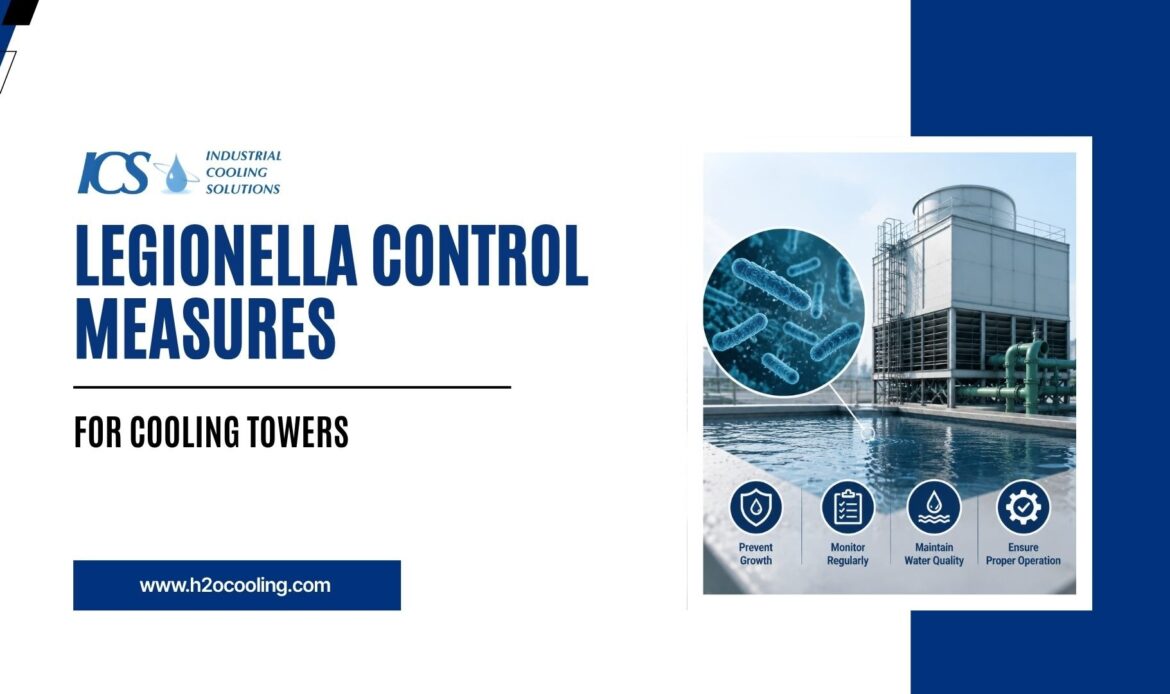
Strong Legionella control depends on a mix of water treatment, physical cleaning, monitoring, maintenance, and documentation. Biocide alone cannot fix a system full of sludge, scale, biofilm, or poor circulation.
The best programs treat chemistry and mechanics as partners. One supports the other.
Core Control Measures
Effective control measures address both the water and the equipment. Skipping either side leaves a gap that bacteria can use.
The key controls to maintain include:
- Biocide program: Keep a steady disinfectant program and monitor the residual.
- pH and conductivity: Control pH and watch conductivity to keep treatment working.
- Blowdown: Manage cycles of concentration to limit mineral and debris buildup.
- Basin cleaning: Remove sediment and sludge before they shield bacteria.
- Equipment inspection: Check fill, nozzles, louvers, and drift eliminators on schedule.
- Scale and corrosion control: Protect surfaces so debris cannot collect.
- Circulation: Maintain proper water flow to avoid dead zones.
- Shutdown checks: Inspect and recommission safely after long downtime.
Cooling Tower Water Management Plan Checklist
A checklist is an essential part of your cooling tower water management plan. It helps you confirm that each component is in place and functioning correctly, ensuring your plan is more than just words on paper.
| Checklist Area | What to Confirm | Risk If Missing | Record to Keep | Expert Recommendation |
| ASHRAE 188 alignment | Program team, system description, control measures, documentation | Weak compliance structure | Plan review record | Use ASHRAE 188 as the framework |
| Hazard analysis | Risk points for Legionella, biofilm, sediment, and stagnation | Hazards may go unmanaged | Risk assessment form | Review after system changes |
| Legionella control | Biocide, pH, conductivity, cleaning, inspection | Microbial growth and biofilm | Treatment logs | Combine chemistry with cleaning |
| Monitoring schedule | Who checks what and how often | Missed control limits | Daily, weekly, monthly logs | Assign clear responsibility |
| Corrective actions | Steps when limits fail | Repeated unsafe conditions | Corrective action reports | Define actions before problems occur |
| Verification | Check that tasks happen as written | Paper plan only | Internal audit log | Review records regularly |
| Validation | Confirm the plan controls risk | Unknown effectiveness | Test results or expert review | Use professional guidance |
| Documentation | Logs, reports, photos, service records | No proof of program activity | Digital or paper archive | Keep organized, dated records |
Writing the Plan Step by Step
Creating your cooling tower water management plan is easier when you follow a clear process. A step-by-step approach not only simplifies building the plan but also makes it easier to maintain over time.
Follow these steps in order, adjusting each one to the specifics of your tower.
Step 1: Build the Water Management Team
Include facility, safety, water treatment, maintenance, operations, and management roles.
Step 2: Describe the Cooling Tower System
List tower type, location, basin, pumps, water treatment, makeup water, blowdown, drift eliminators, fill, nozzles, and operating schedule.
Step 3: Create a Flow Diagram
Show where water enters, circulates, concentrates, gets treated, blows down, and leaves the system.
Step 4: Perform Hazard Analysis
Mark every point where Legionella, biofilm, sediment, stagnation, and poor treatment can occur.
Step 5: Set Control Measures and Limits
Define measurable controls for biocide, pH, conductivity, cleaning, inspection, and equipment condition.
Step 6: Create Monitoring Procedures
Define who checks each item, how often, where readings are taken, and how results are recorded.
Step 7: Define Corrective Actions
Write clear actions for missed limits, dirty basins, failed chemical feed, biofilm, or shutdown events.
Step 8: Add Verification and Validation
Explain how the facility confirms the plan is followed and working.
Step 9: Create Documentation Templates
Prepare logs for readings, inspections, cleaning, corrective actions, testing, and plan reviews.
Step 10: Review and Update the Plan
Update the plan after system changes, tower replacement, major repairs, outbreaks, repeated failures, or regulation changes.
How H2OCooling Can Help With Cooling Tower Water Management
H2OCooling can support the mechanical and maintenance side of a cooling tower water management plan. Water-treatment providers handle chemistry, but mechanical condition also affects Legionella control, cleaning, airflow, drift, and system reliability.
H2OCooling can help with:
- Cooling tower inspection
- Basin, fill, drift eliminator, fan, and nozzle review
- Cleaning and maintenance support
- Mechanical repair planning
- Cooling tower replacement
- Thermal upgrade review
- Spare parts support
- Fan, gearbox, and motor inspection
- Fill media replacement
- Coordination with water-treatment providers
This support helps facilities connect water safety, maintenance, and cooling performance in one practical plan.
Summary
A cooling tower water management plan helps facilities control water-related hazards and document risk management. ASHRAE 188 provides a recognized framework for Legionella risk management in building water systems.
A cooling tower water safety plan should include team roles, system description, flow diagram, hazard analysis, control measures, monitoring, corrective actions, verification, validation, and documentation. Legionella control requires chemistry, cleaning, maintenance, and records. CDC compliance guidance supports a structured water management program.
Frequently Asked Questions
What is a cooling tower water management plan?
A cooling tower water management plan is a written program for identifying, monitoring, controlling, and documenting water-related hazards in a cooling tower. It supports Legionella control through ASHRAE 188 alignment, hazard analysis, monitoring schedules, control limits, corrective actions, verification, validation, and organized maintenance records.
Is ASHRAE 188 required for cooling towers?
ASHRAE 188 is a recognized risk-management standard for building water systems and may be referenced by owners, regulators, insurers, or facility policies. Requirements vary by jurisdiction, building type, and site risk. Facilities with cooling towers should review local rules and professional guidance before deciding how to structure their plan.
What should a cooling tower water safety plan include?
A cooling tower water safety plan should include team roles, system description, flow diagram, hazard analysis, control measures, monitoring schedule, corrective actions, verification, validation, documentation, and a review process.
How does a water management plan help with Legionella control?
A water management plan helps Legionella control by reducing conditions that support bacterial growth and spread. It targets warm stagnant water, biofilm, sediment, poor disinfectant residual, scale, corrosion, dirty basins, damaged drift eliminators, and weak maintenance.
What is hazard analysis in a cooling tower plan?
Hazard analysis identifies where Legionella, biofilm, sediment, stagnation, poor treatment, or aerosol risk may occur in the cooling tower system. It reviews basins, fill media, nozzles, drift eliminators, low-flow zones, dead legs, shutdown periods, water age, chemical control, and cleaning access.