

Every industrial facility recognizes a "Code Red" moment. It is the unexpected cooling tower performance crash that threatens millions in product and operational safety. When the critical alarm sounds, you do not just call a generic tower services company; you deploy the Ghost Team.
This is not a story about standard tower maintenance with wrenches and hammers. It is about a specialized unit operating with proprietary cooling tower repair and maintenance strategies to restore your most critical cooling tower components. They work in the time it takes the competition to simply find the right cooling tower parts.
This elite Cooling Tower Repair Team performs surgical, high-speed repairs and restorations using methods unknown to other companies. We will now reveal the three "Top Secret" strategies this team uses to slash tower downtime, increase efficiency, and guarantee cooling tower asset integrity, completely rewriting what is possible in an emergency cooling tower repair project.
Anatomy of an Elite Response Team
A rapid response requires more than just technical skill—it demands a synergy of specialized roles vital for complex cooling tower repairs. The "Ghost Team" is built on four critical pillars, each member a master of their area in the cooling tower industry. This structure ensures every facet of cooling tower failure is addressed simultaneously, from diagnosis to logistics, maximizing tower efficiency.
Cooling Tower Repair Team Roles and Requirements
| Team Role | Core Skill / Certification | Specialized Tool | Key Requirement |
| Diagnostic Scout | Certified Vibration Analyst | Acoustic Leak Detector (ALD) | 10+ Years RCA Experience |
| Mechanical Surgeon | Precision Laser Alignment | Hydraulic Jacking Set | Multi-OEM Gearbox Certified |
| Chemical Interrogator | Water Treatment & Risk Management | ATP Meter & Biocide Kit | Legionella Protocol Mastery |
| Logistics Commander | Supply Chain Management | Real-Time Inventory Database | 24/7 Availability |
Beyond the Wrench: The Four Critical Roles
- The Diagnostic Scout (Non-Contact Specialist): This expert must hold Level 2 Thermography and Vibration Analysis certifications. Their primary function is to isolate the failure in mechanical equipment without shutting down the cooling tower system first. Using advanced non-invasive tower inspection tools, they detect issues before they escalate, providing a precise analysis that directs the entire cooling tower repair mission.
- The Mechanical Surgeon (Gearbox/Fan Specialist): This technician possesses deep knowledge of all major OEM drive systems for cooling towers, including Marley and Baltimore Aircoil. Their purpose is to execute complex mechanical tower repairs and swaps with unmatched speed and quality. They perform the "Zero-Torque Swap," restoring the heart of your cooling tower whether it is a fan deck, gearbox, or drive shaft.
- The Biological/Chemical Interrogator: With expertise in Legionella, water treatment, and cooling tower chemistry, this team member integrates immediate chemical risk mitigation and addresses bacterial growth into the repair timeline. As mechanical repairs proceed, they analyze and neutralize risks to cooling tower fill, drift eliminators, and other tower components, ensuring the tower is not only fixed but also operates safely for all facility systems.
- The Logistics Commander (The Fixer): This individual manages the "Rapid Parts Deployment" database and oversees supply chain management for cooling tower parts and materials. They bypass standard procurement delays for cooling tower services by using pre-negotiated, cross-OEM access to critical tower components. As tower repairs proceed, they ensure the exact cooling tower part needed arrives promptly, eliminating costly delays and increasing tower reliability.
The Unconventional Toolkit: Slashing Repair Time
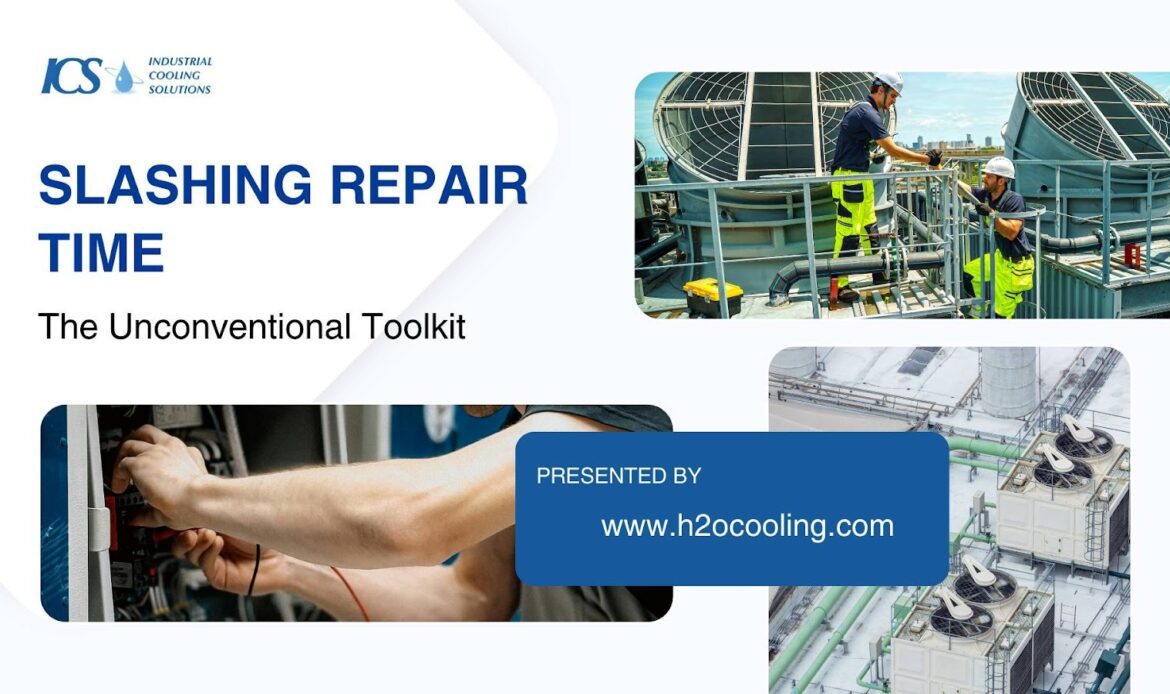
An elite Cooling Tower Repair Team does not follow the standard cooling tower maintenance playbook; it writes a new one. Their value lies in innovative strategies for tower repair, tower construction, and preventative maintenance that solve age-old tower failures.
These three moves fundamentally reduce the mean time to repair (MTTR) and improve cooling tower performance.
Acoustic Leak Detection (ALD) — The Stealth Diagnosis
The conventional method for finding leaks in a cooling tower basin requires draining the cell, taking the tower offline, and wasting hours of valuable production time. Water flows vertically through the structure, and even tiny leaks can undermine tower efficiency.
The Ghost Team employs advanced acoustic leak detection (ALD) to listen for the specific frequency of water leaking through FRP or concrete joints while the cooling tower is still operating.
The technology pinpoints the leak location within the tower, whether in counterflow cooling towers, crossflow design, or custom builds, in minutes rather than hours. This enables the team to move quickly into the repair phase and restore the tower to good condition.
The Zero-Torque Motor Swap — The Rapid Heart Transplant
Swapping a motor or gearbox in a cooling tower is traditionally a slow process due to the detailed laser alignment required for reliability. These key tower components must be positioned with precision to avoid fan vibration, corrosion, or further need for tower repairs.
With the "Zero-Torque Motor Swap," custom hydraulic jacking sets and sliding systems allow the Ghost Team to lift an old motor and slide the new one into the exact micro-position on the base plate.
Because tower alignment is preset, only minimal checks are needed. This process dramatically increases efficiency, saving the company time and money on each job.
Full-Load Hydro-Cleaning — The Time Warp Tactic
Bio-fouling and scaling on cooling tower fill media can cripple tower performance and lead to bacterial growth. The standard repair in commercial buildings and industrial applications demands a total shutdown for manual cleaning, reducing system capacity and affecting facility operations.
The Ghost Team’s high-risk, high-reward strategy uses ultra-high-pressure water jets during very brief, monitored periods while the tower is operating. This process blasts debris and scale from fill media, drift eliminators, and tower walls, restoring 10–15% of thermal efficiency without a multi-day shutdown.
Strict safety protocols are followed, so only elite repair teams can execute this cooling tower solution.
Post-Mission Protocol: Guaranteeing the Fix
A repair is not complete when the cooling tower is running again. For a top-tier Cooling Tower Repair Team, the cooling tower project ends only when the tower is properly maintained, upgraded, and protected for future service.
This transforms a simple repair into a comprehensive cooling tower upgrade and long-term asset reliability.
The Proof of Work
- The Baseline Re-Establishment: The job is not finished until new baseline vibration and temperature data are collected for the cooling tower and analyzed. This data becomes the new standard for the facility’s predictive maintenance program and ongoing maintenance, supporting preventive maintenance and future tower efficiency.
- The Component Life-Extension Report: Every cooling tower repair is documented with a report estimating the extended life gained from the new tower component or repair method. Customers receive clear ROI proof, helping them save money and protect business continuity.
- The 120-Day Thermal Performance Guarantee: Confidence in quality and service means the tower must reach its guaranteed cold water temperature within 120 days post-repair, or labor for secondary repairs is free. This drives tower performance and customer satisfaction for all cooling tower services.
- The Mentorship Transfer: Before leaving, the team spends 30 minutes with in-house maintenance, training them on root cause analysis, early warning signs of tower repair needs, and key tower operating tips—such as air flows horizontally, water flows vertically, and sound changes signaling fan or system imbalance.
Conclusion:
The immense cost of downtime demands more than a quick fix. It requires a specialized Cooling Tower Repair Team equipped for cooling tower repairs, installation, construction, and all aspects of cooling tower services.
With advanced diagnostics, proprietary strategies, and a passion for mechanical equipment reliability, the Ghost Team does not just patch a problem; they restore your cooling tower to peak performance and extend its life.
When your critical cooling tower needs are on the line, the choice is clear. Are you hiring a general contractor, or are you deploying the Ghost Team to restore, repair, or install new cooling towers, ensuring the quality and performance your facility depends on? Visit h2o cooling
Frequently Asked Questions
What does a cooling tower technician do?
A cooling tower technician inspects, repairs, and maintains cooling towers, ensuring optimal performance, safety, and compliance with operational standards.
How to maintain a cooling tower?
Regularly clean components, check water quality, inspect for corrosion, replace damaged parts, ensure proper airflow, and perform routine preventive maintenance.
What is meant by COC in cooling tower?
COC (Cycles of Concentration) refers to the ratio of dissolved solids in the cooling tower water compared to the makeup water, indicating water efficiency.
How to troubleshoot a cooling tower?
Inspect for common issues like poor airflow, scaling, leaks, or mechanical failures. Check water quality, fan operation, and system alignment to identify and resolve problems.
What is the most common failure of the cooling system?
The most common failure is scaling and fouling, which reduce heat transfer efficiency and can lead to overheating or system breakdowns.
What is tower maintenance?
Tower maintenance involves cleaning, inspecting, repairing, and optimizing cooling tower components to ensure efficient operation and extend its lifespan.