


Many industrial and commercial establishments require cooling towers as a necessary component. Their primary function is eliminating surplus heat from industrial operations or air conditioning systems. Cooling towers use a mechanism of transfer heat efficiently and evaporation to accomplish this. Cooling towers, however, need fill to operate correctly. This article will examine the rationale for filling in cooling towers.
What does a cooling tower's fill mean?
The material used to fill the inside of a cooling tower is referred to as fill. The cooling tower fill
is an essential part of the tower because it gives water a lot of surface area to flow across and helps transmit heat from the water to the air. Usually composed of PVC or another type of plastic, the fill is intended to be solid and lightweight.
The purpose of cooling tower fill
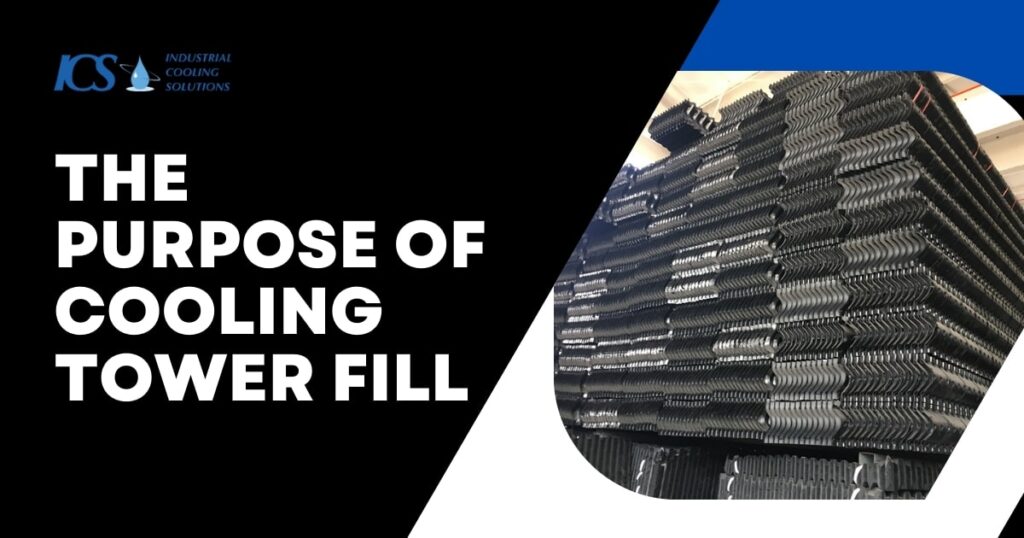
Increasing the surface area of the water exposed to the air is the primary goal of filling a cooling tower. Water spreads into a thin film fill as it passes over the fill material, maximizing contact with the air. This more significant surface area maximizes the quantity of heat that may be transmitted from the water to the air.
As the water passes through the tower, the fill material also causes excellent turbulence. This turbulence ensures that every portion of the water is exposed to air and breaks up any stagnant spots. Consequently, the cooling tower's total efficiency is enhanced.
Reducing the quantity of water lost to evaporation is a significant benefit of filling a cooling tower. The amount of water evaporates is reduced when water is sprayed onto the fill material because the water is split up into droplets. This is significant because, in a cooling tower, evaporation may be a significant source of water loss. Reducing this loss can lower operating expenses.
The Two Principal Cooling Tower Fill Types
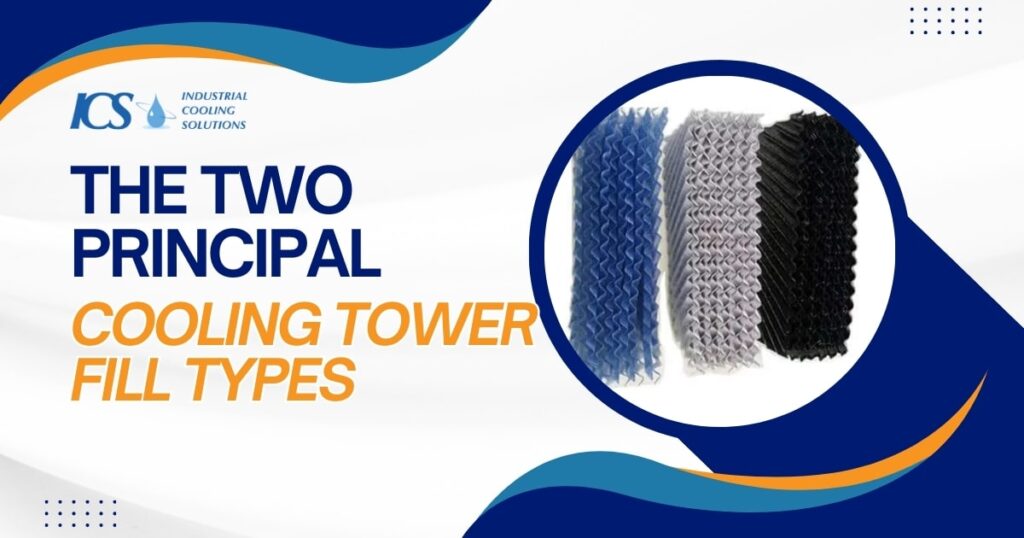
There are twon common type of fill packs used in cooling towers.
Splash fill:
A splash fill cuts across or interrupts the flow of water, as the name implies, causing splashing. Splash fill employs horizontal bar layers that fracture water into tiny droplets upon contact. Evaporation happens more quickly with more (and smaller) droplets. Splash fill isoften made of PVC since they are more reliable (and practical) than wood. It is also said to be a relatively "wettable" substance, making it simple for liquids to spread across. PVC is also incredibly long-lasting, water-resistant, and easily covered with water.
Splash fills are frequently preferable for applications where water quality is consistently poor. Efficiency is maintained since this kind needs areas where dirt or other material from entering water might gather.
Film fill:
The second most common cooling tower fill style involves placing adjacent fragile, textured PVC sheets so that water spreads between them, creating a kind of film. Channels or flutes are the names given to the PVC textures. Flutes may be arranged in infinite ways, including vertical, horizontal, cross-corrugated, and more. Instead of letting incoming water flow in a straight line, the canals effectively send it on a protracted journey full of curves and twists. The resultant layer is fragile and evaporates fast because the water can move in many ways.
The film fills can be the ideal choice given their rapid evaporation rate. Nevertheless, these fills are not the best choice in applications where incoming water is heavily concentrated with debris or dirt. If the debris is improperly sized, it can easily block the flutes. If a film fill is desired, a way to address this problem would be to increase the flute/channel size, making it harder for debris to gather and block the fill.
Water quality is a significant concern, though, in which case a different fill, such as a bar fill, may be more effective. Bar fills aid in processing highly polluted water but less effectively than cleaner water.
Principles of Operation for Cooling Tower Fill material
Let's examine; cooling tower fill principles. The purpose of using pp film fill is to cool heated trash. Water flowing over the sheet-type fill has a much larger surface area. The heated water will rapidly cool. This is the rationale for the everyday "film fill." The guiding concepts of operation are:
Hot water is cooled quickly with a larger surface area thanks to cooling tower fill, which uses sheet, air, and a very long film fill medium. Once the water has cooled, it is pumped into a container to cool more hot water. Meanwhile, hot water & air is released from the cooling towers' tops and exits the fill. In this way, the cooling towers continuously cool warm water hits by removing warm air from above and cooling air from below.
Cooling water usually removes waste heat from industrial manufacturing or refrigeration processes. The tower is a heat exchanger between the air inside the tower and the cooling water transporting waste heat.
Which cooling tower fill material should I choose?
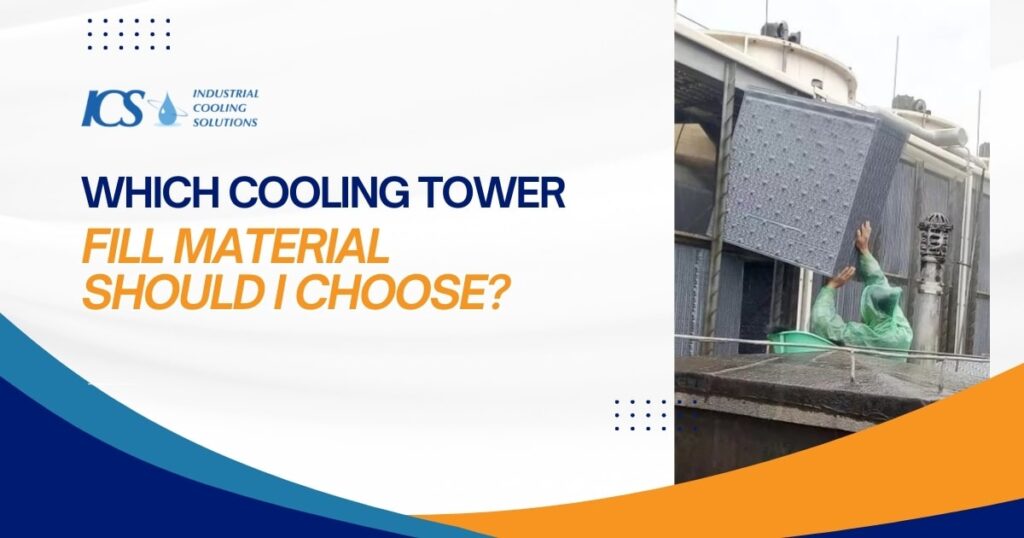
In a cooling tower, splash fill and film fill work well together to speed up the evaporation and cooling effect. On the other hand, film fill medium produces a more extensive surface area and optimized performance, making it more efficient in heat transmission. However, it is more prone to wear and tear since it is constantly submerged in water at extremely high temperatures.
For optimal performance, consider using splash fill media in cooling tower applications where recirculating water with high solids content and low quality is required. Additionally, splash fill media with metallic bars may be a good option if water is created at very high temperatures since film-fill media would degrade more quickly.
In most manufacturing enterprises, cooling towers are a necessary piece of equipment. With this information, you can select the ideal kind of cooling tower fill material to ensure the cooling tower in your business operates at peak efficiency.
The cooling tower is the primary heat-dissipating component of flowing water in industrial operations.
When using cooling towers in industrial production, there is a risk of excessive water temperatures, ineffective heat dispersion, and production standstill. The primary component promoting the hydrothermal cycle is cooling tower packing. As a result, we have to use cooling tower packaging of the highest caliber.
First, the conventional size of the cross-flow cooling tower.
One and a half times the fan's diameter should separate the top of the cooling tower packing from the bottom of the fan.
Second, the standard angle of the counterflow cooling tower.
- Packing top and airflow alignment:
In a counterflow cooling tower, the packing top and the airflow section should be set close to 90 degrees. A diversion (deflector) coil is installed, and a flat top cover is used. The angles between the airflow section and the water eliminator should generally fall within 90–120 degrees to ensure uniform airflow and effective drift elimination. - Shrink-type tower top angle:
For a shrink-type cooling tower, the angle at the upper corner of the shrinkage section cover should be carefully controlled within 90–110 degrees to maintain stable airflow and structural efficiency. - Water-filling angle control:
The cooling tower fill water-distribution angle should be regulated within a 5–8 degree control range to ensure even wetting of the fill media and optimal heat transfer performance. - Operation of spare circulation mechanisms:
During operation, spare circulation mechanisms should be activated as needed to prevent short-circuiting between incoming air and the bottom of the cooling tower fill, which can significantly reduce cooling efficiency.
In cold climates, we have to use a different kind of filler material; we should pick one with a high degree of cold resistance based on the local temperature. The cooling tower packing's heat and resistance should be determined by thoroughly examining the fan. Determine the best cooling tower packing by using the calculations.
Last Words: ICS cooling tower Fill material
For the majority of manufacturing enterprises, cooling towers are essential. Knowing enough about cooling towers and their parts can help you select the best cooling tower fills media for your equipment's best performance and increased efficiency. Select a unique filler material for cold climates according to the local temperature. It can be wise to use a filler with high cold resistance.
The top supplier of cooling tower fill is Industrial Cooling Solutions. Kindly contact us immediately if you are interested in our cooling tower fill products!
Frequently Asked Question
1. What is cooling tower fill and why is it important?
Cooling tower fill is the heat transfer media inside the tower that increases the contact surface area between water and air. Proper fill design and installation directly affect cooling efficiency, energy consumption, and overall tower performance.
2. How does cooling tower fill angle affect performance?
The fill angle controls water distribution and airflow contact time. Incorrect angles can cause channeling, dry spots, or air short-circuiting, reducing heat transfer efficiency and increasing operational costs.
3. What are the common types of cooling tower fill?
The most common types are film fill, splash fill, and low-clog fill. Film fill is widely used for clean water applications, while splash and low-clog fills are better suited for dirty or high-fouling water conditions.
4. How often should cooling tower fill be cleaned or replaced?
Cleaning frequency depends on water quality and operating conditions, but inspections are typically recommended every 6–12 months. Fill replacement is usually required when scaling, fouling, or physical damage significantly reduces airflow or water distribution.
5. What problems indicate poor cooling tower fill performance?
Signs include reduced cooling capacity, uneven water distribution, higher approach temperatures, increased fan energy consumption, and visible scaling or biological growth on the fill media.