

Choosing the correct material for your cooling tower is one of the most significant decisions an engineer or facility manager will make. This choice impacts not only the initial construction budget but also long-term operational efficiency, maintenance schedules, and safety protocols.
For decades, the industry relied heavily on traditional materials, but advancements in composite engineering have shifted the landscape. Today, the debate often comes down to two dominant options: traditional concrete structures and modern Fiberglass Reinforced Plastic (FRP).
Understanding the nuances between these materials requires looking beyond the sticker price. This guide provides a clear, side-by-side comparison of concrete vs FRP cooling towers, helping you determine which material aligns best with your facility's operational goals and budget.
Concrete Cooling Towers: Structural Material Overview
What Concrete Cooling Towers Are
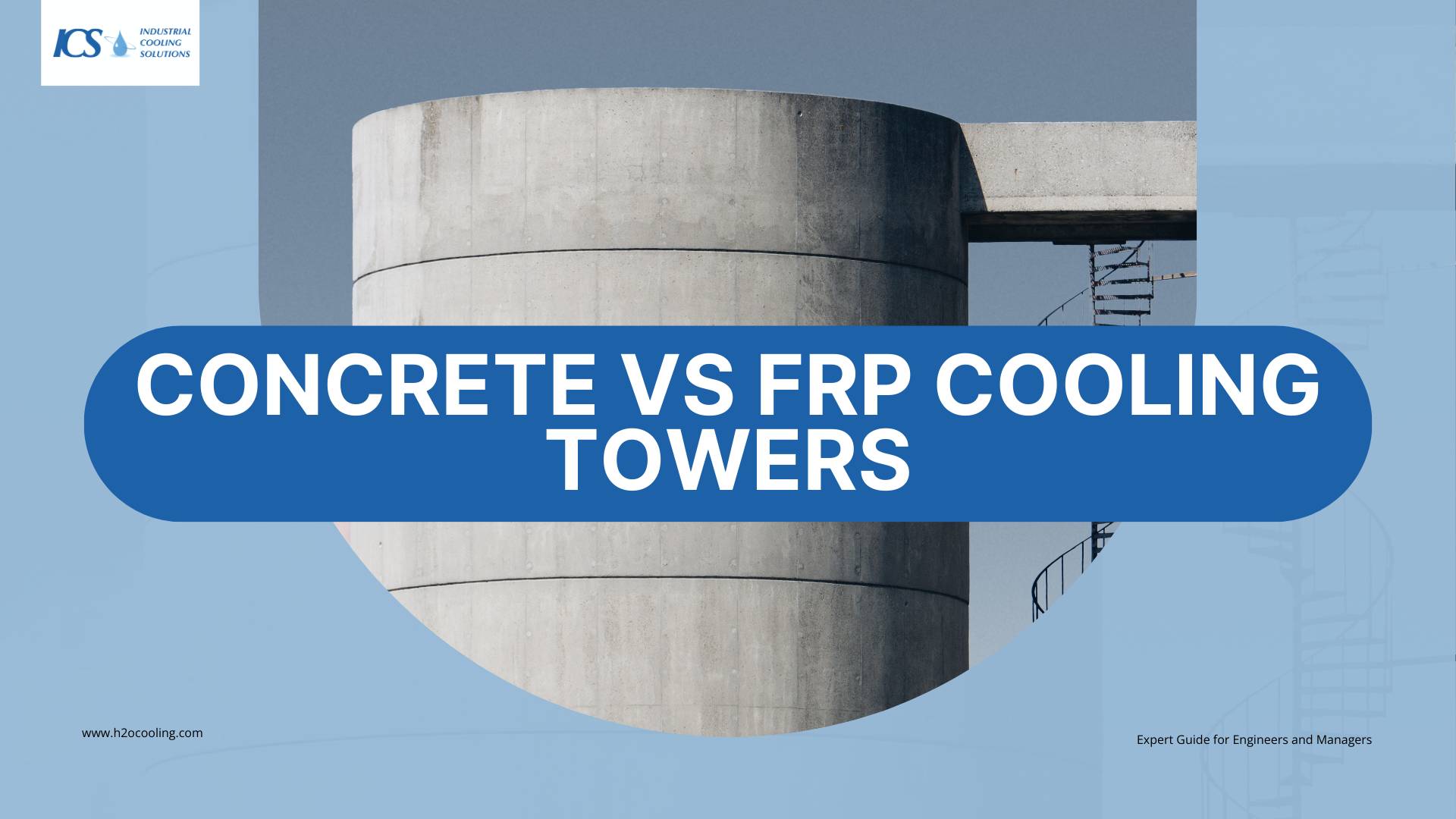
Concrete cooling towers are massive, permanent heat rejection devices built primarily using steel-reinforced concrete. They operate on the same fundamental principles as other cooling towers but rely on the sheer mass and rigidity of concrete to form the structural frame and basin.
Their construction process is civil-heavy and involves:
- Extensive on-site labor
- Formwork and rebar installation
- Pouring and curing of concrete
- Treatment as civil infrastructure projects rather than mechanical equipment installations due to their permanence
Where Concrete Cooling Towers Are Commonly Used
Due to their massive scale and permanence, concrete towers are frequently found in sectors that require immense cooling capacity over long lifespans.
You will typically see these structures in:
- Power Generation Plants: Nuclear and coal-fired plants often utilize large hyperbolic concrete towers.
- Petrochemical Refineries: Facilities that process vast quantities of chemicals require durable, heavy-duty cooling solutions.
- Heavy Industrial Facilities: Steel mills and mining operations may default to concrete due to legacy design preferences.
FRP Cooling Towers: Composite Design Explained
What FRP Cooling Towers Are
FRP cooling towers utilize a structural frame made of Pultruded Fiberglass Reinforced Plastic. Pultrusion is a manufacturing process where fibers are pulled through a resin bath and a heated die, creating structural shapes with exceptional strength-to-weight ratios.
- FRP towers have a modular design, unlike the monolithic nature of concrete.
- Components are factory-made to exact specifications and assembled on-site.
- The composite structure provides industrial-grade rigidity.
- Lighter in weight compared to masonry or concrete.
Typical Applications of FRP Cooling Towers
The versatility of fiber-reinforced plastic cooling towers enables them to capture a significant portion of the market previously dominated by concrete and wood.
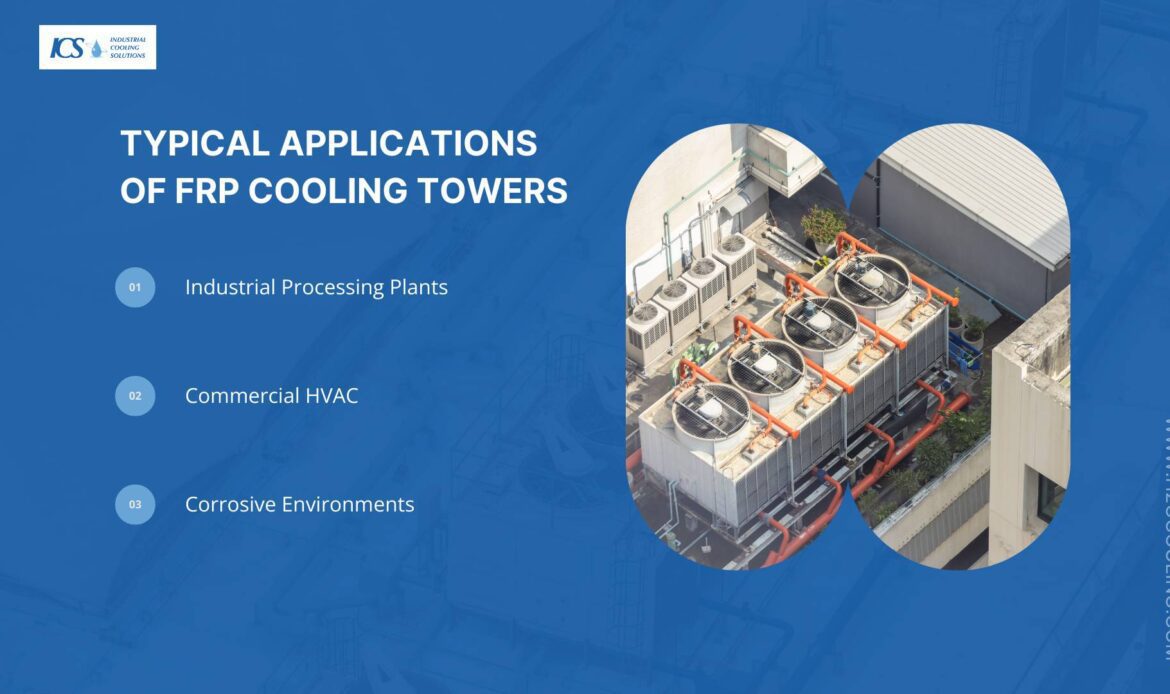
Common applications include:
- Industrial Processing Plants: Chemical, food, and beverage facilities value the chemical resistance of FRP.
- Commercial HVAC: Large commercial buildings often choose FRP for its blend of durability and aesthetics.
- Corrosive Environments: Coastal facilities and plants with aggressive water chemistry rely on FRP to withstand harsh conditions.
Key Differences Between Concrete and FRP Cooling Towers
To make an informed decision, stakeholders must evaluate how concrete vs FRP cooling towers perform across several critical categories.
Manufacturing and Build Quality
The environment in which a cooling tower is built directly dictates its structural integrity and longevity.
- Concrete: Relies on-site concrete pouring. This process is subject to weather conditions, contractor skill levels, and the challenges of maintaining quality control in an uncontrolled outdoor environment.
- FRP: utilizes factory-controlled fabrication. Pultruded components are manufactured under strict conditions, ensuring consistent resin-to-glass ratios and precise dimensional tolerances.
Installation Time and Project Complexity
Project timelines translate directly to money, especially when a plant must remain offline during construction.
- Concrete: Involves complex civil works. The process requires excavation, massive foundation work, forming, pouring, and long curing times. Sequencing these trades can extend projects by weeks or months.
- FRP: Offers rapid deployment. Because the structural members arrive pre-fabricated, the on-site crew focuses on assembly rather than raw construction. This modular approach significantly reduces installation time.
Structural Load and Foundation Requirements
The weight of the cooling tower dictates the engineering required beneath it.
- Concrete: Is inherently heavy. These towers exert massive dead loads, necessitating large, expensive, and heavily reinforced foundations.
- FRP: Is lightweight yet strong. An FRP structure imposes significantly lower load requirements, often allowing for smaller, less expensive foundations or installation on existing basins.
Mechanical Performance and Vibration Handling
Cooling towers contain large fans and motors that generate constant vibration.
- Concrete: Acts as a rigid body. While it is strong, concrete does not absorb vibration well. Over time, mechanical stresses can lead to micro-cracking in the structure.
- FRP: Exhibits excellent elasticity. The material allows for slight deflection, which helps absorb and dampen the vibrations from mechanical equipment, reducing stress on the connections.
Corrosion Resistance and Environmental Durability
Cooling tower material comparison conversations often center on how well the structure survives wet, chemical-laden environments.
- Concrete: Is porous and vulnerable. While concrete itself is durable, the steel rebar inside is susceptible to corrosion. Moisture and chemicals can penetrate the concrete, causing the rebar to rust and expand, which leads to spalling (cracking and flaking) of the concrete.
- FRP: Is engineered for corrosion resistance. It is impervious to rot, rust, and most chemicals. It stands up exceptionally well to saline air and aggressive water chemistries that typically destroy other materials.
Maintenance, Repair, and Operational Downtime
Every piece of industrial equipment requires care, but the intensity of that care varies wildly between materials.
- Concrete: Repairs are labor-intensive. Fixing spalled concrete requires chipping away damaged sections, treating rebar, and applying new mortar, which must then cure. This results in significant operational downtime.
- FRP: Simplifies maintenance. If a structural member is damaged, it can typically be unbolted and replaced with a new part quickly, minimizing the impact on plant operations.
Safety and Accessibility
Worker safety during inspection and maintenance is a priority that structural design must address.
- Concrete: Can become slippery. Algae growth on concrete surfaces creates slip hazards. Safety features like handrails often require additional coatings or drilling to install.
- FRP: Integrates safety. FRP components can be manufactured with non-skid surfaces molded directly into the material. Safety yellow coloring can also be embedded into the resin, eliminating the need for painting.
Flexibility, Expansion, and Retrofit Capability
Future-proofing your facility requires a cooling system that can adapt to changing needs.
- Concrete: Is permanent. Once poured, it is extremely difficult to modify, expand, or move a concrete tower without major demolition and reconstruction.
- FRP: Is modular. FRP towers can often be expanded by adding new cells to the existing structure. They can even be disassembled and relocated if the facility layout changes.
Lifecycle Cost and Long-Term Value
While initial capital expenditure is important, the lifecycle cost tells the true financial story.
- Concrete: Often has high long-term costs. The expense of repairing spalled concrete and the potential for extended downtime can inflate the total cost of ownership.
- FRP: Delivers value over time. Although the initial material cost might be comparable or slightly higher depending on the market, the reduced maintenance, extended durability, and lifespan, and operational efficiency often result in a lower total cost of ownership.
Concrete vs FRP Cooling Towers: Detailed Comparison Table
The following table summarizes the key distinctions between these two material choices to assist in your evaluation.
| Category / Criteria | Concrete Cooling Towers | FRP Cooling Towers |
|---|---|---|
| Material Composition | Reinforced cast-in-place concrete (steel + concrete) | Fiber-reinforced plastic (resins + glass fibers) |
| Typical Uses | Large industrial, power plants, utility scale | Industrial applications, small to medium HVAC & process cooling |
| Structure Types | Often hyperbolic natural draft towers; also mechanical draft supported concrete shells | Primarily mechanical draft (induced or forced) |
| Size Range | Very large capacity, custom on-site casting | Modular, factory manufactured units |
| Thermal Performance | Excellent for large loads; stable performance | Very good for modular systems; slightly lower overall thermal mass |
| Fabrication & Construction | Long construction time (months to years) | Factory assembled modules; short lead-times |
| Installation Complexity | High — requires significant civil works | Low to moderate — typically delivered assembled |
| Weight | Very heavy | Lightweight |
| Corrosion Resistance | Good corrosion resistance but concrete may spall; steel reinforcement vulnerable if poorly protected | Excellent corrosion resistance to water & chemicals |
| Durability / Lifespan | Very long (30+ years typical) | Moderate to long (15–25+ years depending on conditions) |
| Structural Strength | Extremely robust — withstands hurricanes, seismic | Good structural strength but less than concrete for very large sizes |
| Maintenance Requirements | Moderate — includes inspection of concrete surface, potential crack sealing | Lower — smooth surfaces resist fouling; easier access |
| Operational Downtime for Maintenance | Can be longer due to heavy components | Shorter — modular components easier to service |
| Thermal Stress Handling | Excellent — mass dampens temperature fluctuations | Good — thermal expansion must be accommodated |
| Chemical Treatment Compatibility | Generally compatible; acid/alkali exposure can harm concrete | Excellent with many chemical treatments |
| Bio-fouling and Scaling | Similar risk; inspection required | Similar risk; easy to clean surfaces |
| Aesthetics | Often monumental hyperbolic shape (power plants) | Functional industrial look |
| Environmental Impact (Construction) | High embodied energy and carbon due to concrete | Lower embodied energy; plastics have their own environmental costs |
| Noise Levels | Comparable mechanical draft noise; mass can dampen vibration | Comparable; depends on fan type & enclosure |
| Transportability | Not transportable once installed | Easy to transport and relocate |
| Adaptability / Modularity | Low — fixed design | High — modules can be added or removed |
| Cost — Capital | High initial cost (materials + construction) | Lower (modular, less civil work) |
| Cost — Life-Cycle | Cost-effective long term for large installations | Cost-effective for small/modular systems |
| Installation Site Requirements | Large, dedicated site; extensive foundations | Smaller footprint; simpler foundations |
| Foundation Requirements | Heavy and extensive | Light foundation |
| Design Customization | Fully customizable for unique engineering needs | Limited by manufacturing modules |
| Typical Industries | Power generation, heavy industry, petrochemical | HVAC, light industry, manufacturing, process cooling |
| Repairability | Repairable but often complex & expensive | Easier localized repairs |
| Fire Resistance | High (concrete non-combustible) | Depends on resin; many are fire-retardant but still plastic |
Which Cooling Tower Material Is Right for Your Project?
Deciding between concrete vs FRP cooling towers ultimately depends on the specific constraints and goals of your project.
When Concrete Cooling Towers Make Sense
Concrete cooling towers can be the right choice for specific, large-scale projects where long-term permanence is a key factor. Their massive structure and on-site construction method lend themselves to scenarios with extended timelines and substantial structural requirements.
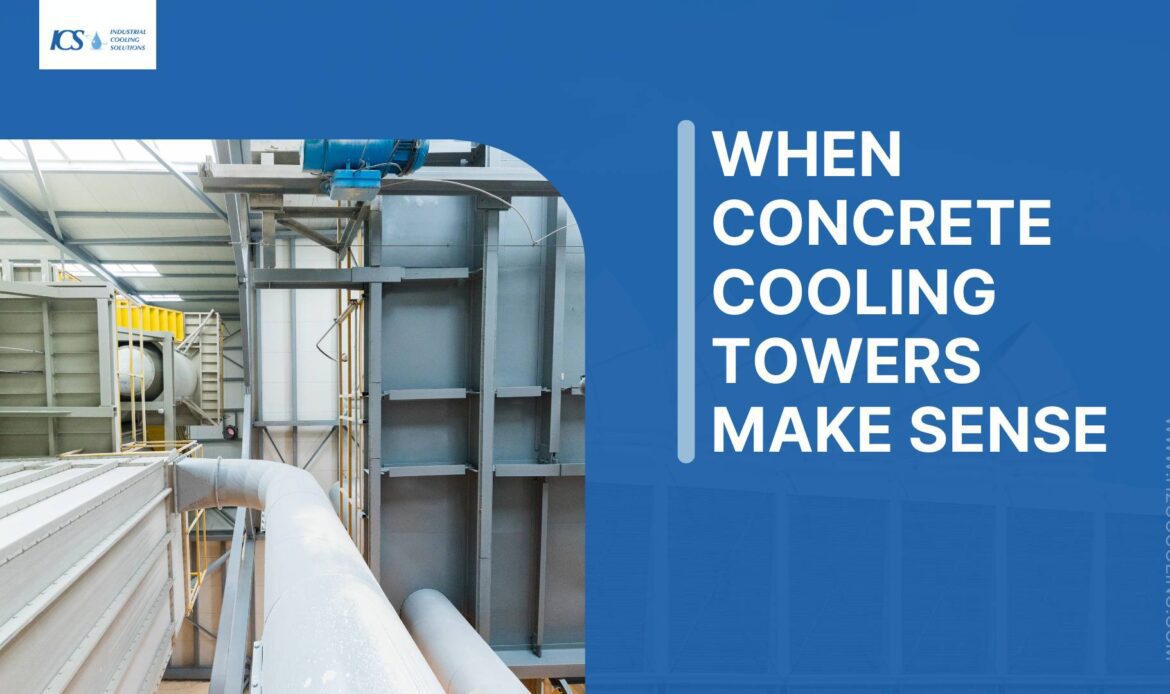
Concrete may be the best option for your project if:
- You are designing a gigawatt-scale power generation facility where the tower is a permanent fixture.
- Your project has a long construction timeline, allowing for the necessary curing and finishing of masonry.
- The budget can accommodate the extensive foundation work required to support a heavy structure.
When FRP Cooling Towers Are the Better Choice
FRP (Fiber Reinforced Polymer) is rapidly becoming the preferred material for industrial and commercial projects due to its unmatched durability, corrosion resistance, and ease of installation. If you're considering FRP for your next project, here’s why it stands out:
- Fast installation: Speeds up project timelines and reduces labor costs.
- Exceptional durability: Designed to withstand harsh and corrosive environments for years.
- Low maintenance: Minimizes upkeep and ensures operational efficiency.
- Better ROI: Long lifespan and minimal downtime make it a cost-effective choice.
Overall Winner: FRP Cooling Towers
When all critical factors are evaluated together, including construction speed, durability, maintenance effort, lifecycle cost, safety, and adaptability, FRP cooling towers outperform concrete cooling towers in most use cases.
Final Thoughts
When comparing concrete vs FRP cooling towers from a total performance and lifecycle perspective, FRP cooling towers emerge as the overall winner.
While concrete cooling towers remain suitable for select large-scale, permanent installations, they fall behind in areas that matter most to modern facilities: speed of construction, corrosion resistance, maintenance efficiency, safety, and long-term operating cost.
FRP cooling towers offer a more adaptable, durable, and cost-effective solution for the majority of industrial and commercial cooling applications.
Don't let a faulty cooling tower disrupt your operations. Whether you need a brand-new installation, urgent repairs, or routine maintenance, our experts at H2ocooling.com are ready to help. Contact us today for reliable service.
Frequently Asked Question
What is the main difference between concrete and FRP cooling towers?
The main difference between concrete vs FRP cooling towers lies in construction material, weight, and maintenance. Concrete towers are heavy, permanent structures built on-site, while FRP cooling towers use lightweight, corrosion-resistant composite materials that are factory-fabricated and assembled quickly.
Which is better: concrete or FRP cooling towers?
For most industrial and commercial applications, FRP cooling towers are better than concrete cooling towers due to faster installation, lower maintenance, superior corrosion resistance, and reduced lifecycle cost.
Are FRP cooling towers suitable for large industrial plants?
Yes. FRP cooling towers are widely used in large industrial plants, including chemical processing, petrochemical facilities, and commercial HVAC systems. Modular FRP designs can be scaled, expanded, and customized to meet high-capacity cooling requirements.
Do concrete cooling towers last longer than FRP towers?
Not necessarily. While concrete cooling towers can last decades, their lifespan heavily depends on maintenance and environmental conditions. FRP cooling towers often achieve equal or longer service life due to resistance to corrosion, vibration, and chemical exposure.