

Cooling towers are the lungs of many industrial facilities, expelling heat to keep processes running smoothly. However, when these massive structures begin to shake, it signals a serious operational threat that extends far beyond a simple rattle. Cooling tower vibrations are rarely isolated incidents; they are symptoms of underlying mechanical or structural distress that can lead to catastrophic failure if ignored.
Uncontrolled vibration threatens system reliability, increases energy costs, and endangers personnel. This guide explores the root causes of cooling tower vibrations, how to identify early warning signs, and the most effective monitoring strategies to prevent costly downtime.
What Are Cooling Tower Vibrations?
Before diagnosing specific issues, it is essential to understand the mechanical definition of vibration within this context. In a cooling tower, vibration refers to the oscillating motion of the tower's components, such as fans, gearboxes, shafts, or the structure itself, around a reference position.
- All rotating machinery, including cooling towers, has a natural frequency, meaning a certain level of vibration is normal.
- "Abnormal" vibrations happen when these oscillations go beyond the limits set by the manufacturer.
- Even small tremors can be a sign that mechanical energy is being misdirected, which puts stress on components.
- The key is to tell the difference between acceptable vibration and excessive vibration that could lead to failure.
Why Cooling Tower Vibrations Are Bad for Business
Ignoring vibration issues does more than just create noise; it directly impacts the bottom line and operational safety. When a cooling tower vibrates excessively, the consequences ripple through the entire facility.
- Reduced cooling efficiency: Vibrating fans lose aerodynamic stability, which reduces airflow and diminishes the tower's ability to reject heat.
- Accelerated mechanical wear: Constant shaking degrades bearings, seals, and gears much faster than normal operation, shortening the lifespan of expensive components.
- Unplanned shutdowns: Excessive vibration often triggers safety trips or causes component failure, forcing immediate and costly production halts.
- Safety risks to personnel: In extreme cases, fans can shatter, or supports can collapse, posing severe physical threats to maintenance staff.
- Increased lifecycle costs: Reactive repairs are significantly more expensive than predictive maintenance. Dealing with vibration damage requires emergency parts and labor, inflating the total cost of ownership.
Primary Causes of Cooling Tower Vibrations
Diagnosing the source of the shaking is the first step toward resolution. While many factors contribute to instability, most issues stem from four primary mechanical and structural categories.
Fan Imbalance and Blade Deformation
The fan assembly is the most common culprit for cooling tower vibrations. Because fans operate in harsh, humid environments, they are susceptible to physical changes that throw off their center of gravity.
- Manufacturing tolerances: Even new fans may require fine-tuning if the manufacturing process left slight weight discrepancies between blades.
- Erosion, scaling, or ice buildup: Over time, water droplets erode blade edges, or scale deposits accumulate unevenly. In winter, ice formation creates severe, sudden imbalances.
- Long-term centrifugal force effects: Years of operation can cause blades to elongate or deform, shifting the mass distribution and causing a wobble.
Shaft Misalignment and Bearing Wear
The drive shaft connects the motor to the gearbox, and precise alignment is critical for smooth energy transfer. When this connection is compromised, vibration travels rapidly through the system.
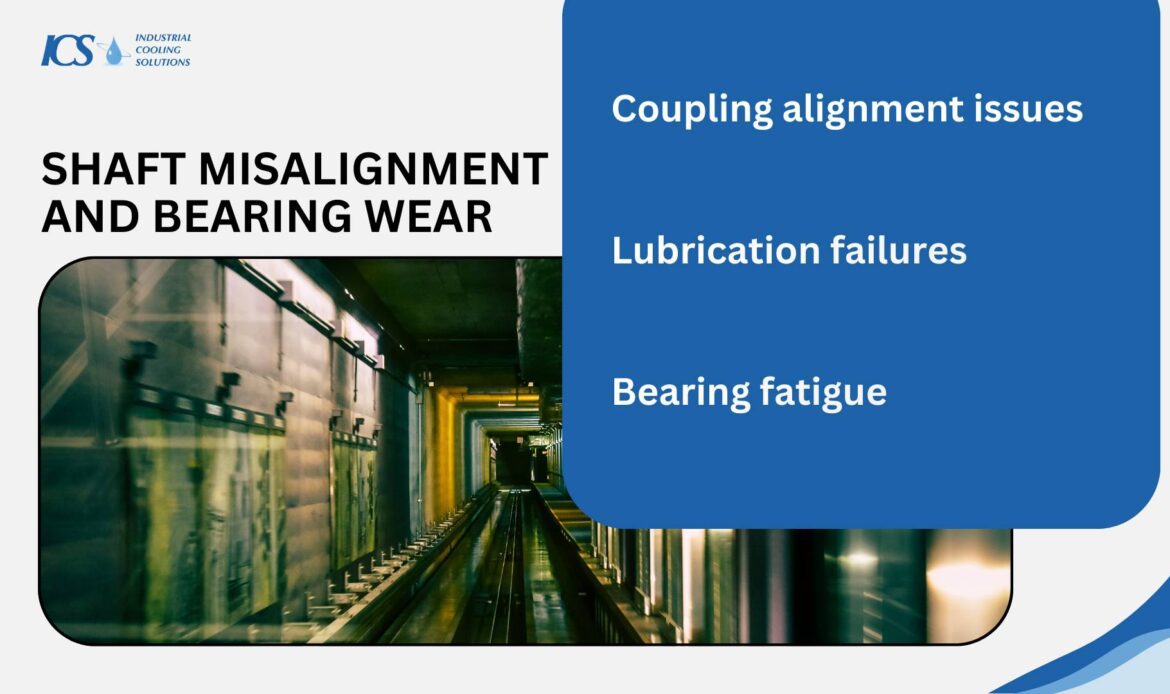
- Coupling alignment issues: If the motor and gearbox shafts are not perfectly collinear, the coupling acts as a pivot point, generating significant radial vibration.
- Lubrication failures: Bearings require consistent lubrication. Without it, metal-on-metal contact creates friction, heat, and high-frequency vibration.
- Bearing fatigue: Even well-lubricated bearings eventually succumb to fatigue, developing pits or spalls in the raceways that cause grinding vibrations.
Structural and Foundation Issues
Sometimes the machinery is fine, but the structure supporting it is failing. The massive forces generated by the fan require a rigid, stable foundation to absorb normal operational energy.
- Loose fasteners and frame distortion: Bolts loosen over time due to thermal expansion and contraction. A loose mechanical support frame allows the motor or gearbox to shift during operation.
- Aging concrete or steel supports: Corrosion in steel supports or cracking in concrete basins reduces structural stiffness, allowing vibrations to amplify rather than dissipate.
- Resonance amplification: If the fan's operating speed matches the natural frequency of the tower structure, resonance occurs, drastically amplifying the vibration levels.
Gearbox and Drive System Problems
The gearbox serves as the heart of the transmission system, playing a critical role in transferring power efficiently. Internal defects within the gearbox can disrupt its functionality, leading to complex vibration patterns that are often challenging to diagnose.
If left unaddressed, these issues can escalate, affecting overall system performance and potentially causing costly downtime.
- Gear tooth wear: As gear teeth wear down or chip, they do not mesh smoothly, creating a distinct "gear mesh frequency" vibration.
- Improper load distribution: Misaligned gears cause uneven loading, leading to premature wear and vibration on the input or output shafts.
- VFD-related harmonic effects: Variable Frequency Drives (VFDs) can sometimes induce electrical harmonics that manifest as mechanical vibrations in the motor.
How Cooling Tower Vibrations Affect Fan Performance
Vibration disrupts the precise aerodynamics required for a fan to move air efficiently. When a fan assembly vibrates, the blade tips oscillate, changing the clearance between the blade and the fan cylinder (shroud).
- Increased Energy Costs: Inconsistent airflow forces the fan to work harder, driving up power consumption and utility bills.
- Reduced Cooling Efficiency: Fan turbulence hinders heat rejection, preventing the cooling tower from cooling water effectively.
- Risk of Catastrophic Failure: Persistent vibration can lead to fan blades detaching, which may destroy the stack and cause extensive equipment damage.
Early Warning Signs of Excessive Vibration
Operators do not always need sophisticated equipment to spot trouble brewing. Your senses are often the first line of defense against developing mechanical issues.
- Audible changes (noise patterns): A humming motor sounds different than a grinding bearing. Listen for rhythmic thumping, high-pitched squealing, or irregular clanking noises.
- Visible fan wobble or oscillation: Looking through the inspection hatch might reveal the fan hub moving in an elliptical pattern rather than a perfect circle.
- Rising bearing temperatures: Friction generates heat. If a bearing housing feels hotter than usual to the touch or via an infrared gun, vibration is likely present.
- Repeated fastener loosening: If you constantly have to tighten the same bolts on the motor base or gearbox, vibration is working them loose.
- Abnormal motor current draw: A vibrating system requires more torque to turn. A sudden or gradual increase in amp draw can indicate mechanical resistance caused by misalignment or imbalance.
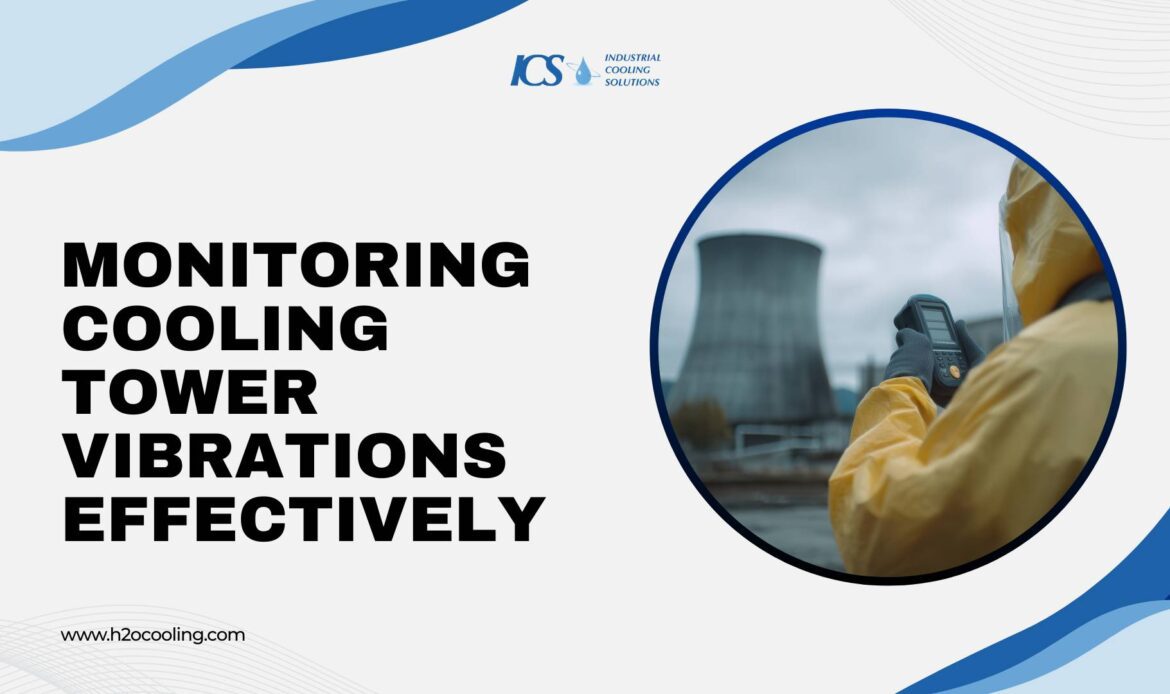
Monitoring Cooling Tower Vibrations Effectively
Relying solely on manual inspections leaves a facility vulnerable to sudden failures between rounds. Modern reliability strategies utilize technology to keep a constant watch on equipment health.
Vibration Switches and Their Role
The most basic form of protection is the vibration switch. This mechanical or electronic device acts as a safety tripwire for the cooling tower.
Here's how vibration switches work:
- They monitor the overall vibration level of the cooling tower frame.
- If vibration exceeds a pre-set limit, the switch breaks the electrical circuit.
- This immediately cuts power to the motor, preventing catastrophic damage.
- For the most accurate reading, switches should be placed on the mechanical equipment support.
Manual vs Automated Monitoring
Manual monitoring involves a technician taking portable readings periodically, perhaps once a month. While better than nothing, it misses problems that develop quickly between checks.
Automated, condition-based monitoring offers superior protection. It does not sleep and provides alerts the moment a threshold is crossed. This shift from "repair when broken" to "repair when condition changes" significantly reduces downtime and maintenance costs.
Cooling Tower Vibration Risk Comparison Table
Understanding the severity of different vibration sources helps prioritize maintenance tasks. Use this table to assess risks in your facility.
| Vibration Source | Primary Cause | Risk Level | Potential Damage | Recommended Mitigation |
| Fan Imbalance | Ice, scale, or blade deformation | High | Fan destruction, stack damage | Clean blades, re-balance assembly |
| Misalignment | Improper installation, soft foot | Medium | Coupling failure, bearing wear | Laser alignment, check shims |
| Loose Structure | Corroded supports, loose bolts | Medium-High | Structural collapse, resonance | Tighten fasteners, reinforce frame |
| Gearbox Wear | Lack of oil, metal fatigue | High | Gearbox seizure, fire risk | Oil analysis, vibration analysis |
| Resonance | Operating speed matches natural freq | High | Rapid catastrophic failure | Adjust VFD speeds, stiffen structure |
Preventing Cooling Tower Vibrations Long-Term
Prevention requires a proactive approach that begins at installation and continues through the equipment's life. Regular maintenance, routine inspections, and timely updates are crucial to ensuring optimal performance and avoiding costly downtime.
- Precision fan balancing programs: Do not assume a fan is balanced. Implement a routine schedule to check and correct static and dynamic balance.
- Proper alignment during installation and overhauls: Use laser alignment tools whenever a motor or gearbox is replaced. Eye-balling alignment is never sufficient.
- Structural integrity audits: Inspect the tower's wood, steel, or concrete frame annually. Replace corroded members that have lost stiffness.
- Predictive maintenance using vibration trends: Use data to predict the future. If vibration rises by 10% every month, schedule a bearing replacement before it hits 100%.
- Material selection considerations: When upgrading, consider Fiber Reinforced Polymer (FRP) components, which resist corrosion and maintain their mass properties better than steel in wet environments.
Conclusion
Cooling tower vibrations are a major red flag, signaling everything from fan imbalance and poor alignment to structural decay. Ignoring these warnings can lead to reduced efficiency, safety risks, and costly emergency repairs.
To prevent this, facility managers should implement proactive maintenance strategies. This includes precision fan balancing, laser alignment, regular structural integrity audits, and using vibration trend data for predictive maintenance. Upgrading to corrosion-resistant materials like FRP can also enhance longevity. By prioritizing prevention over reaction, you can extend your equipment's life and ensure reliability.
If you notice vibration issues in your system, don't wait for a failure. Contact the experts at Industrial Cooling Solutions (ICS) for comprehensive cooling tower repair and maintenance services.
Frequently Asked Questions
What causes cooling tower vibrations?
Cooling tower vibrations are commonly caused by fan imbalance, shaft misalignment, bearing wear, loose structural supports, gearbox defects, or resonance between operating speed and structural natural frequency.
Are cooling tower vibrations dangerous?
Yes. Excessive cooling tower vibrations can lead to fan failure, structural damage, gearbox seizure, unplanned shutdowns, and serious safety risks for maintenance personnel if not addressed early.
How much vibration is acceptable in a cooling tower?
Acceptable vibration levels depend on manufacturer limits, but any vibration exceeding recommended thresholds or increasing over time is considered abnormal and should be investigated immediately.
Can fan imbalance cause cooling tower vibration?
Yes. Fan imbalance is one of the leading causes of cooling tower vibration and often results from blade erosion, scale buildup, ice formation, or long-term blade deformation.