

A vibrating cooling tower fan is more than just a noisy nuisance. It serves as a clear warning sign of deeper mechanical instability that threatens the reliability of your entire cooling system. Ignoring this symptom often leads to catastrophic failure, unplanned downtime, and expensive emergency repairs.
Cooling tower fan vibration directly impacts three critical areas of your operation: fan efficiency, component longevity, and structural safety. When a fan operates out of balance, it forces the motor and gearbox to work harder, consuming more energy while delivering less cooling capacity. Over time, this oscillation shakes the entire tower structure, loosening fasteners and cracking support beams.
The goal of this guide is straightforward: to help operators identify the root causes of instability and implement practical steps to reduce cooling tower vibration. As specialists in cooling tower diagnostics and repair, ICS provides the expertise needed to restore smooth, efficient operation to your facility.
Why Cooling Tower Fan Vibration Is a Serious Operational Risk
Vibration acts as a silent destroyer of mechanical equipment. While a slight hum is expected during operation, significant shaking indicates that forces are acting against the intended rotation of the fan assembly.
Impact on Mechanical Components
The mechanical train of a cooling tower, comprising the motor, driveshaft, gearbox, and fan, relies on precise alignment and balance. Excessive vibration introduces cyclical stress loads that these components are not designed to withstand.
Why does this stress matter for long-term reliability?
- Gearbox Failure: Constant shaking degrades oil seals and misaligns gear teeth, leading to premature wear and potential seizure.
- Bearing Fatigue: Bearings absorb the brunt of the oscillatory force, causing pitting and eventual failure.
- Driveshaft Damage: Flexible elements in the driveshaft couplings can disintegrate under high vibration, risking a complete disconnection.
Effect on Cooling Performance and Energy Use
A vibrating fan is an inefficient fan. When the fan blades are not rotating smoothly, they fail to move air through the fill media effectively. This instability creates turbulence and reduces the aerodynamic efficiency of the blades.
Consequently, the motor must draw more amperage to maintain the required RPM. You end up paying for more electricity while receiving less cooling capacity. Reducing cooling tower vibration is often one of the fastest ways to improve the energy efficiency of an aging unit.
Structural and Safety Concerns
Cooling towers are engineered to support static loads, such as the weight of the water and equipment, and specific dynamic loads. They are not built to withstand the violent, rhythmic shaking of an unbalanced 20-foot fan.
If left unchecked, vibration transmits through the fan deck and into the tower's skeleton. This can lead to:
- Cracking in fiberglass or concrete fan decks.
- Loosening of critical support bolts and anchors.
- Catastrophic failure where the fan assembly detaches from its mount, posing a severe safety hazard to personnel.
Common Causes of Cooling Tower Fan Vibration
To effectively reduce cooling tower vibration, you must first understand where it originates. In most cases, the issue stems from a lack of maintenance or physical damage to rotating components.
Fan Blade Imbalance and Damage
The most frequent culprit is the fan itself. Cooling tower fans must be precisely balanced so that weight is distributed evenly around the hub. Even a small discrepancy can generate significant centrifugal force.
Common reasons for blade-related vibration include:
- Pitch Variation: If one blade is pitched differently from the others, it creates unequal aerodynamic drag.
- Physical Damage: Cracks, erosion from water droplets, or missing tip caps alter the weight of a specific blade.
- Deformation: Composite blades can warp over time due to heat and stress, throwing the assembly out of balance.
Loose or Improperly Secured Components
Vibration is often self-perpetuating. A small imbalance causes shaking, which loosens bolts, which in turn causes more severe shaking.
Inspect these areas for tightness:
- Fan Hub Bolts: The connection between the blades and the hub is a high-stress point.
- Mounting Hardware: The bolts securing the gearbox and motor to the fan deck must remain torqued to specification.
- Structural Fasteners: Loose framing supports can amplify resonance throughout the tower.
Gearbox and Driveshaft Issues
The power transmission system can introduce vibration if it is worn or defective. A gearbox with pitted gears or worn bearings will grind and shake during operation. Similarly, a driveshaft that has lost its balance weights will cause the entire mechanical train to wobble.
Worn flexible elements can also lead to the same issue. Inadequate lubrication accelerates these issues, turning minor friction into major vibration sources.
Misalignment of Rotating Equipment
Precision is key when connecting the motor to the gearbox. If the centerlines of these two components do not match perfectly, the driveshaft operates at an angle it cannot accommodate.
This misalignment forces the driveshaft to whip twice per revolution, creating a distinct vibration signature. Ensuring precise alignment between the motor, shaft, and gearbox is essential to reduce cooling tower vibration and prevent coupling failure.
Step-by-Step Guide to Reduce Cooling Tower Fan Vibration
Once you identify the source, you need a systematic approach to correct it. Follow these steps to restore stability to your cooling tower.
Step 1: Secure All Structural and Mechanical Connections
Before attempting complex balancing, ensure the machine is mechanically tight. Loose machinery often mimics imbalance issues.
Focus your efforts on these critical connections:
- Check and torque all fan hub hardware.
- Tighten gearbox and motor mount bolts.
- Inspect the unit support frame (USF) for cracks or loose welds.
- Verify that the mechanical equipment support is level.
Step 2: Inspect and Balance Fan Blades
If the hardware is tight, the fan blades likely require attention. A visual inspection often reveals obvious defects, but static or dynamic balancing offers the only definitive fix.
How do you determine if rebalancing is necessary?
- Check Pitch Angles: Use a digital protractor to ensure all blades are set to the exact same pitch.
- Weigh the Blades: If blades are detachable, weigh them individually to ensure they match.
- Dynamic Balancing: A technician can attach weights to the fan hub while the unit runs (at slow speed or using specialized equipment) to offset heavy spots.
Step 3: Verify Blade Tip Clearance and Alignment
The gap between the tip of the fan blade and the fan cylinder (shroud) needs to be uniform. If the fan is not centered or if the cylinder is out of round, the air pressure differential varies as the blade rotates.
This variance causes aerodynamic pulsation, a common source of vibration. Adjust the gearbox position or the fan cylinder segments to ensure consistent clearance around the entire circumference.
Step 4: Inspect Gearbox and Driveshaft Condition
Isolating the gearbox and driveshaft helps determine if they are the root cause. Disconnect the driveshaft and rotate the gearbox input shaft by hand. It should move smoothly without rough spots or noise.
- Inspect driveshaft couplings: Check the rubber or composite parts of the couplings for any signs of wear, such as cracking or stretching. If you find any damage, the coupling needs to be replaced right away.
- Change the gearbox oil: Adding fresh oil can help reduce small vibrations caused by the gear mesh.
Step 5: Measure and Monitor Vibration Levels
The most effective way to reduce cooling tower vibration is to track it over time. Installing vibration switches or sensors provides real-time data on the health of the equipment
What the Data Reveals:
- Misalignment: Indicated by a vibration frequency at 1x RPM.
- Looseness: Detected through irregular frequency patterns.
- Bearing Defects: Identified by specific frequency characteristics unique to bearing faults.
How to Measure and Monitor Vibration Levels:
- Use a Vibration Analyzer: Invest in a reliable vibration monitoring device to capture data.
- Set Baseline Levels: Establish normal vibration levels for the equipment or structure.
- Regular Monitoring: Conduct consistent checks to spot deviations from the baseline.
- Analyze Frequency Data: Pay attention to patterns or spikes that indicate issues like misalignment or wear.
- Take Immediate Action: Use the analysis to perform targeted repairs rather than relying on guesswork.
By following these steps, you can ensure efficient equipment maintenance and reduce downtime.
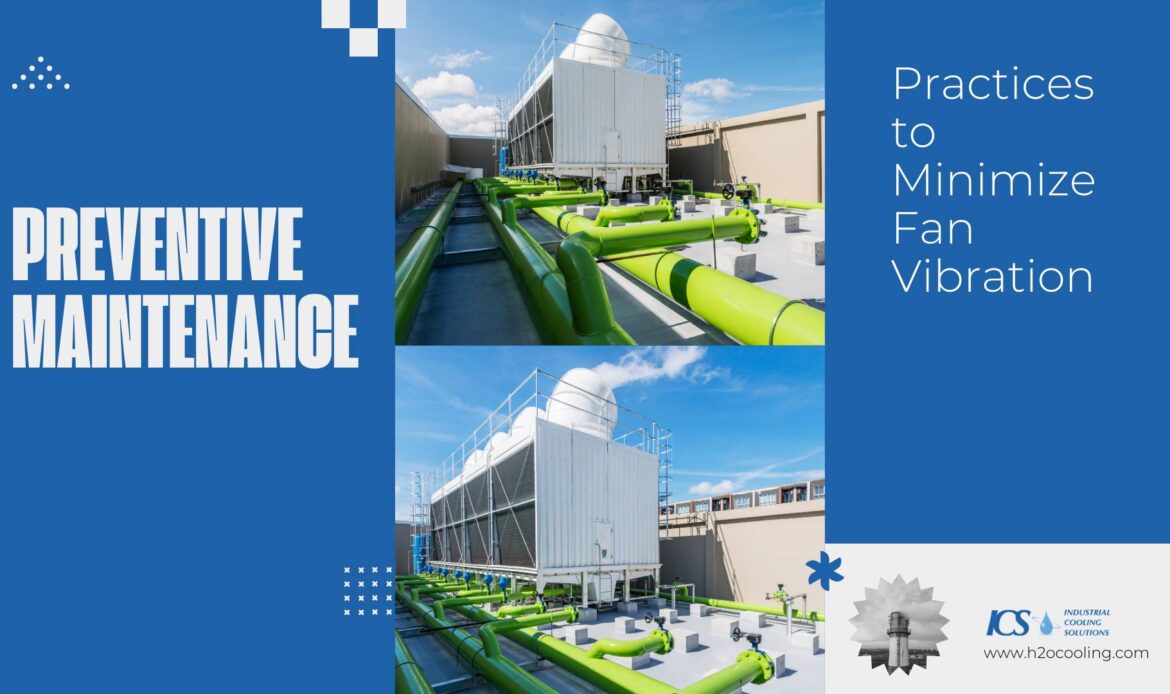
Preventive Maintenance Practices to Minimize Fan Vibration
Reactive repairs are costly. Implementing a strong preventive maintenance schedule ensures that vibration issues are caught while they are still minor annoyances rather than critical failures.
Routine Inspection Scheduling
Consistency is the foundation of reliability. Establish a routine for visual and physical inspections based on the operational load of the cooling tower. This schedule should outline when different types of checks need to happen throughout the season.
- Start of Season: Perform a deep check before bringing the tower online for the summer.
- Monthly Checks: Listen for noise changes and visually check for oil leaks or loose bolts.
- Mid-Season: Re-verify vibration levels during peak load periods.
Keeping Fan Assemblies Clean
Debris buildup is a common cause of imbalance in fan assemblies. Over time, things like scale, algae, and dust can stick to the fan blades unevenly. This buildup disrupts the fan's balance, leading to vibrations and potential damage.
If one blade carries two pounds of scale and the opposite blade is clean, the fan will vibrate significantly. Regularly pressure wash the fan blades and hub to remove buildup and maintain aerodynamic balance.
Maintaining Design Operating Conditions
Operating a cooling tower outside its design parameters invites instability. For example, running a fan at a speed that matches the natural resonant frequency of the tower structure will cause violent shaking.
Ensure that variable frequency drives (VFDs) are programmed to skip over these resonant frequencies. Furthermore, avoid running the tower in low-flow conditions where airflow becomes turbulent and unstable.
How ICS Helps Reduce Cooling Tower Vibration
At ICS, we understand that vibration is the enemy of efficiency. Our team provides comprehensive support to diagnose, correct, and prevent mechanical instability in your cooling systems.
Expert Inspection and Diagnostics
We do not just guess at the problem; we measure it. Our technicians utilize advanced vibration analysis tools to pinpoint the exact frequency and amplitude of the issue. Whether the root cause is a misaligned shaft or a failing bearing, we identify it with precision.
Precision Repairs and Component Upgrades
Once the issue is diagnosed, we provide the solution. We specialize in laser alignment for motors and gearboxes, dynamic balancing of fan assemblies, and complete component replacements. We ensure that your equipment is installed to the tightest tolerances possible.
Long-Term Reliability Support
Our goal is to keep your tower running smoothly for years. We offer tailored preventive maintenance programs that include regular vibration monitoring, lubrication services, and seasonal inspections. We help you reduce cooling tower vibration permanently, ensuring your facility remains cool and compliant.
Conclusion
Vibration is never a normal operating condition for a cooling tower. It is a distress signal that requires immediate attention. By addressing the root causes, whether they are imbalanced blades, misalignment, or mechanical looseness, you protect your investment and ensure operational safety.
Taking proactive steps to reduce cooling tower vibration delivers immediate benefits: lower energy bills, reduced maintenance costs, and extended equipment lifespan. Do not wait for the shaker switch to trip or a component to fail.
Contact H2ocooling today for all your cooling tower needs, whether it’s repairs, maintenance, or building a brand-new cooling tower. Our experts are here to help restore and optimize your system.
Frequently Asked Questions
What is the most effective way to reduce cooling tower vibration?
The most effective method is a combination of precision laser alignment of the motor and gearbox, coupled with dynamic balancing of the fan blades. Regular maintenance to keep components tight and clean prevents vibration from returning.
How does fan imbalance cause cooling tower vibration?
When the weight of the fan assembly is not distributed evenly around the center of rotation, it creates centrifugal force that pulls the fan outward as it spins. This force manifests as a rhythmic shaking or vibration that increases with speed.
Can vibration damage cooling tower gearboxes?
Yes, vibration is a leading cause of gearbox failure. It destroys oil seals, causes bearings to pit, and misaligns gear teeth. This leads to overheating, oil leaks, and eventually, the seizure of the gearbox.
How often should vibration levels be checked?
Ideally, vibration should be monitored continuously with vibration switches. For manual checks, a professional assessment should occur at least once per season or quarterly, depending on the usage of the tower.