

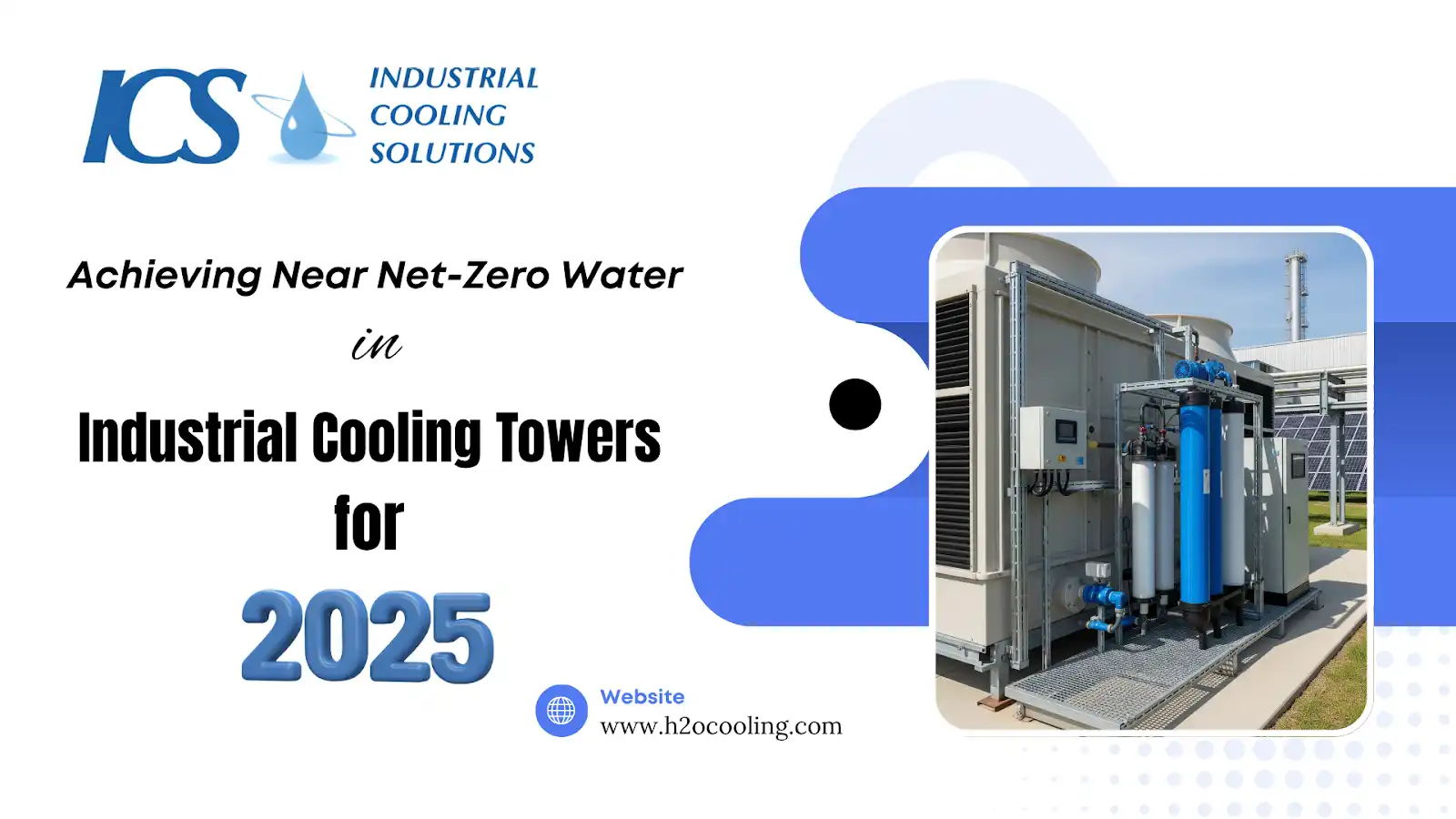
Industrial cooling towers are essential for manufacturing, power plants, and processing operations, using millions of gallons of water daily to regulate temperatures for key processes. With growing global water scarcity and stricter environmental regulations, conventional methods of operating cooling towers are encountering new and significant challenges.
Water stress affects 40% of the global population, with industrial facilities competing for increasingly limited freshwater resources. The solution lies not in accepting these constraints, but in revolutionizing how industrial cooling systems utilize water.
In this blog post, we’ll explore how combining cutting-edge technologies with proven engineering practices can drive real, measurable results. Get ready to discover the strategies behind this powerful approach and how it can make a difference for you!
What Does "Near Net-Zero Water" Mean for Cooling Towers?
Near net-zero water cooling towers minimize freshwater makeup requirements through maximized internal recycling and optimized water utilization. Unlike absolute Zero Liquid Discharge (ZLD) systems that eliminate all wastewater, near-net-zero approaches focus on practical water conservation while maintaining economic viability.
This approach significantly lowers makeup water usage—by as much as 80-95%—using innovative treatment methods. These methods allow for increased cycles of concentration, efficient blowdown recovery, and the incorporation of alternative water sources. The result is a cooling system that operates efficiently while consuming minimal freshwater resources.
Key components of near net-zero water systems include:
- Enhanced water treatment capabilities
- Sophisticated monitoring technologies
- Strategic water reuse infrastructure infrastructure
Why This Aspiration Matters More Than Ever in 2025
Water scarcity has reached critical levels across many industrial regions, with drought conditions affecting traditional cooling tower operations. Climate change continues to intensify water stress, making reliable freshwater access increasingly uncertain for industrial facilities.
The EPA's updated industrial wastewater discharge guidelines require facilities to demonstrate measurable water conservation efforts. Non-compliance risks include operational shutdowns, substantial fines, and permit revocations.
Corporate sustainability initiatives drive demand for water-efficient solutions as ESG (Environmental, Social, and Governance) requirements become standard business practice. Investors, customers, and stakeholders increasingly evaluate companies based on their environmental stewardship, making water conservation a competitive advantage.
Pioneering Technologies Driving Water Reduction

Intelligent Water Treatment and High Cycles of Concentration
Advanced chemical treatments and sophisticated filtration systems enable dramatically higher cycles of concentration (COC) in cooling tower operations. What benefits does this technology deliver? Higher COC directly reduces blowdown frequency and makeup water demand while improving overall system efficiency.
- Ultrafiltration (UF) systems provide precise particle removal for enhanced water quality
- Reverse osmosis (RO) technology enables maximum concentration levels through advanced purification
- Specialized chemical treatments prevent scaling and fouling at elevated concentration levels
These technologies work synergistically to maintain water quality while allowing concentration levels that were previously impossible. Conventional cooling towers typically function at 3-5 cycles of concentration, whereas modern advanced systems can reach 15-20 cycles or even more.
Closed-Loop Systems and Hybrid Cooling Solutions
How do these systems achieve such dramatic water savings? By eliminating evaporation, drift, and contamination, closed-loop designs minimize water loss while maintaining precise temperature control.
- Process fluid circulates through a closed piping system with no direct atmospheric contact
- Heat rejection occurs through heat exchangers rather than evaporative cooling
- Makeup water requirements drop to minimal levels needed only for system leaks
- Contamination risks disappear due to complete isolation from external sources
Hybrid cooling solutions combine wet and dry cooling modes to optimize water usage based on ambient conditions. During cooler periods, dry cooling reduces water consumption, while wet cooling provides enhanced capacity during peak demand periods.
Smart Monitoring, AI, and Predictive Water Management
IoT sensors and AI analytics transform cooling tower water management through real-time monitoring and predictive control systems. What specific advantages do these technologies provide? Precise control of blowdown timing, chemical dosing optimization, and early detection of inefficiencies enable maximum water conservation.
- Real-time monitoring of water quality parameters enables immediate response to changing conditions
- AI algorithms predict optimal blowdown timing based on concentration levels and system performance
- Automated chemical dosing systems eliminate waste while maintaining water quality standards
- Predictive maintenance identifies potential leaks and inefficiencies before they impact operations
Strategic Water Reuse: From Blowdown to Alternative Sources

Blowdown recovery technologies treat and reintroduce concentrated cooling tower discharge back into the system. What treatment methods make this possible? Advanced membrane filtration, thermal evaporation, and specialized ZLD concepts enable extensive blowdown reuse.
- Membrane filtration systems remove dissolved solids from blowdown water for reuse
- Thermal evaporation concentrates contaminants while recovering clean water
- Crystallization technologies separate valuable minerals from concentrated brine
- Advanced oxidation processes eliminate organic contaminants from recovery streams
Treated process wastewater offers another valuable water source when properly processed through appropriate treatment systems. Industrial facilities often generate wastewater streams that, with proper treatment, can supplement cooling tower makeup requirements.
The Multi-Faceted Benefits of Water Sustainability
Environmental Stewardship and Regulatory Compliance
Water-efficient cooling towers significantly reduce freshwater withdrawals from natural sources while minimizing wastewater discharge volumes. These reductions directly protect local water resources and aquatic ecosystems from thermal and chemical impacts.
- Compliance with environmental regulations is achievable through measurable water conservation efforts.
The EPA's industrial wastewater discharge guidelines reward facilities that:
- Implement water reduction strategies.
- Benefit from streamlined permitting processes and reduced monitoring requirements.
Water conservation also leads to reduced chemical consumption:
- Higher cycles of concentration require less chemical treatment per unit of cooling capacity.
- This reduces environmental impact while promoting sustainable operations.
Significant Cost Savings and Operational Resilience
Industrial facilities typically save 60-80% on water-related costs through near net-zero water implementations. These savings compound over time as water rates continue to increase.
Using fewer chemicals isn’t just better for the environment, it also cuts down on operating costs. You’ll have less to handle, store, and dispose of, which makes things simpler overall. By optimizing your chemical dosing systems, you can ensure everything runs at peak efficiency without wasting chemicals or risking overdosing.
Enhanced Corporate Reputation and Future-Proofing
Embracing sustainability sets businesses apart in competitive markets, drawing the attention of eco-conscious customers, investors, and collaborators. Water conservation initiatives demonstrate corporate responsibility and long-term thinking that resonates with stakeholders.
Talent attraction benefits from strong environmental stewardship records as professionals increasingly seek employers with meaningful sustainability commitments.
Future regulatory compliance becomes more manageable through proactive water conservation implementation. Companies that establish water-efficient systems ahead of regulatory requirements avoid costly retrofits and operational disruptions.
Implementing Your Near Net-Zero Water Strategy
Assessment and Planning
Comprehensive water balance audits establish baseline consumption patterns and identify conservation opportunities. What specific data points drive effective planning? Detailed analysis of makeup water usage, blowdown volumes, evaporation rates, and system losses provides the foundation for optimization strategies.
- Current water consumption measurements across all cooling tower systems
- Identification of peak demand periods and seasonal variations
- Analysis of water quality parameters and treatment requirements
- Assessment of existing infrastructure capacity and upgrade potential
Feasibility studies evaluate technology options based on facility-specific requirements, budget constraints, and operational priorities. Professional engineers analyze site conditions, water sources, and regulatory requirements to develop customized implementation plans.
Integration and Optimization
Seamless integration of water-efficient technologies with existing infrastructure minimizes operational disruptions while maximizing conservation benefits.
- Gradual implementation phases allow testing and optimization before full deployment
- Backup systems maintain cooling capacity during technology transitions
- Staff training ensures proper operation and maintenance of new systems
- Performance monitoring validates conservation achievements and identifies improvement opportunities
Continuous monitoring and optimization maintain peak efficiency while adapting to changing operational requirements. Sophisticated control systems adapt system settings dynamically, responding to real-time conditions and desired performance goals.
The Role of Expert Partnership
Specialized knowledge in water treatment, system design, and regulatory compliance ensures successful near net-zero water implementations. What expertise do industrial facilities require? Professional engineers with extensive cooling tower experience provide technical guidance, system design, and ongoing support.
- Control system engineers integrate monitoring and automation technologies
- Regulatory compliance experts ensure adherence to environmental requirements
- Maintenance professionals provide ongoing system optimization and troubleshooting
Conclusion
Near net-zero water cooling towers address the critical water challenges faced by industrial facilities by significantly reducing freshwater consumption without compromising reliability. By integrating advanced water treatment, intelligent monitoring, and strategic reuse, these industrial cooling towers offer sustainable solutions that conserve natural resources.
Companies adopting this technology benefit from lower operating costs, improved regulatory compliance, and a stronger corporate reputation. With water conservation now essential for long-term success, near net-zero industrial cooling towers provide a practical and profitable path to sustainable industrial cooling.
Contact H2cooling.com today to start improving water efficiency in industrial cooling. Our specialists will review your operations, find ways to save water, and create a custom plan with measurable results.
Frequently Asked Questions
How is "near net-zero" different from "Zero Liquid Discharge (ZLD)"?
Near net-zero focuses on practical, substantial water reduction through recycling. ZLD aims for virtually no liquid waste, using more complex and energy-intensive processes. Near-net-zero is generally more cost-effective for cooling towers.
Which water is used in cooling towers?
Traditionally, cooling towers primarily use freshwater sources such as:
- Municipal (city) water
- Well water
- Surface water (from rivers, lakes)
What is the biggest risk with cooling towers?
The single biggest risk associated with cooling towers, particularly open-circuit evaporative types, is the growth and dissemination of Legionella bacteria.
What does "near net-zero water" mean for a cooling tower?
It means significantly reducing fresh water use by treating and reusing water internally, often cutting makeup water needs by 80-95%. It's about smart, efficient recycling.
Can older cooling towers be upgraded for near net-zero water?
Many existing cooling towers can be upgraded. Technologies like advanced water treatment, smart monitoring, and blowdown recovery can be integrated into current infrastructure.